
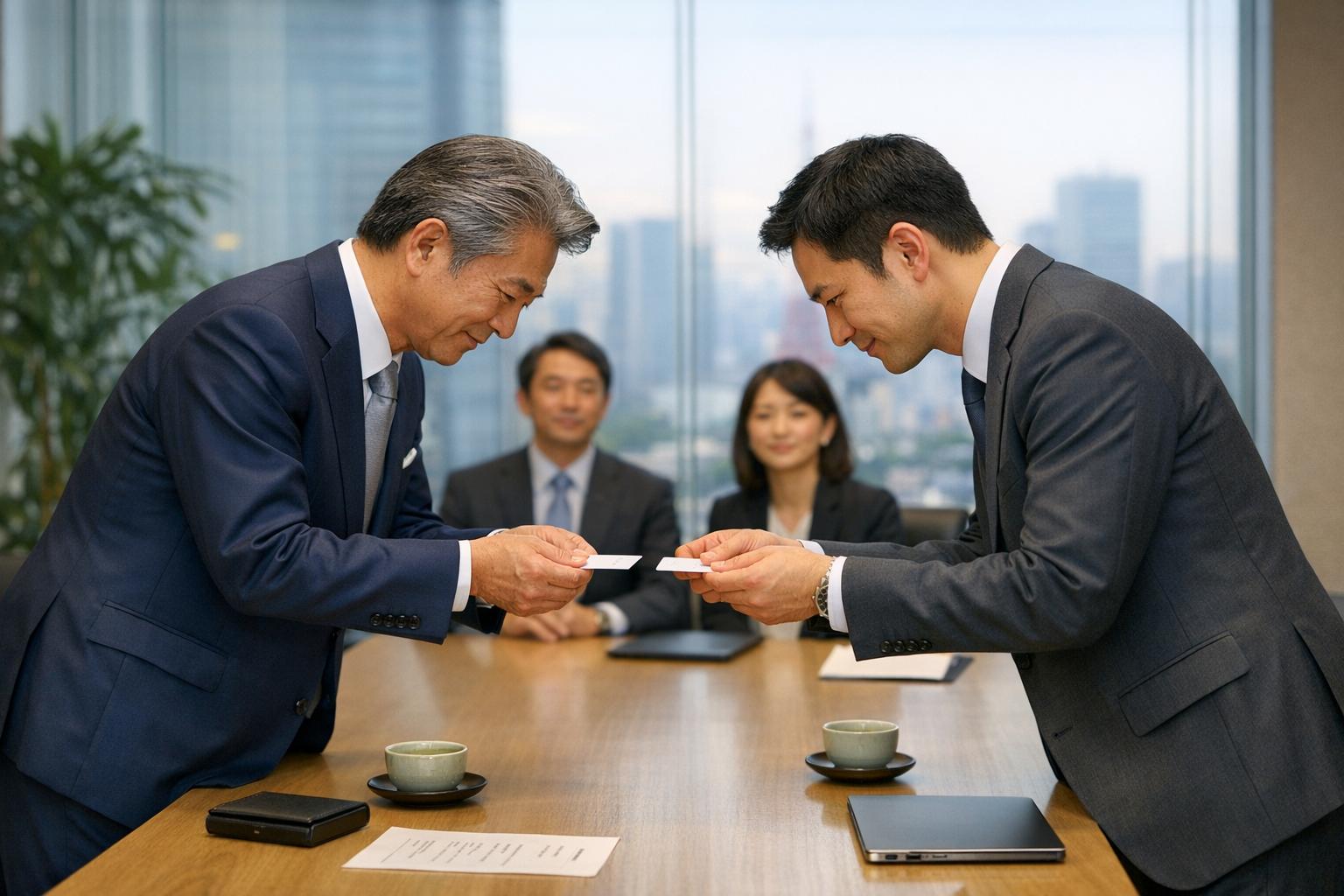
Navigating Japanese business etiquette, especially when addressing CEOs, requires understanding hierarchy, respect, and formal protocols. Here’s a quick breakdown of what you need to know:
- Titles Matter: Address CEOs as [Last Name]-shachō (e.g., Tanaka-shachō). Avoid adding -sama to titles, as it’s redundant.
- Hierarchy Is Key: Seniority dictates seating, speaking order, and even how emails are addressed. The CEO typically holds the title Shachō, but the legal representative may be the Daihyou Torishimariyaku.
- Business Card Ritual: Exchange cards with both hands, ensuring the Japanese side faces the recipient. Treat cards with care – don’t write on or pocket them.
- Bowing and Greetings: Bow at a 30° angle (Keirei) for standard business introductions. Combine bows with light handshakes for international meetings.
- Written Communication: Emails follow a formal 7-step format. Use business Japanese, including respectful language (Sonkeigo) for their actions and humble language (Kenjougo) for your own. Quick responses show professionalism.
- Meetings and Decisions: Expect slower decision-making rooted in consensus. Building trust takes time, and informal pre-meeting discussions (nemawashi) are critical.
Understanding these practices can help establish trust and streamline interactions with Japanese executives.
Hierarchy and Titles in Japanese Companies
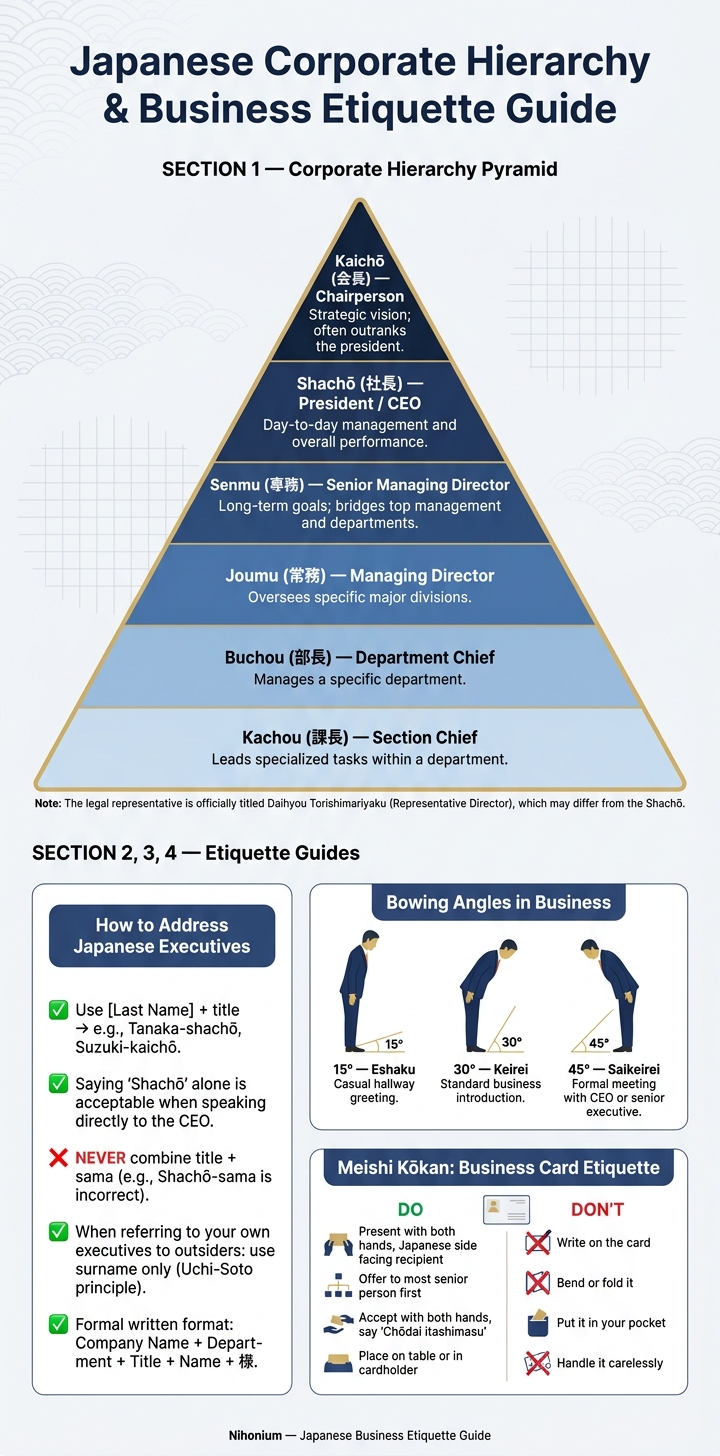
Japanese Corporate Hierarchy: Titles, Roles & Business Etiquette at a Glance
In Japanese business culture, hierarchy shapes nearly every interaction, from how people communicate in meetings to the way emails are addressed. As Japan Living Life explains:
"Japanese workplaces operate within a clear hierarchy based on age, tenure, and position. This structure directly influences how, when, and what you communicate."
Key Corporate Ranks and Their Roles
Japanese companies operate with a well-defined chain of command. At the top is the Kaichō (会長), or Chairperson, often a former president who still wields considerable influence, especially if they were a founder or maintain important banking relationships. Next is the Shachō (社長), the President or CEO, who oversees daily operations and serves as the company’s legal representative.
Below these top roles are the Senmu (Senior Managing Director) and Joumu (Managing Director), who bridge high-level leadership with department heads. These positions often handle key decision-making responsibilities. At the departmental level, the Buchou (部長) leads areas like Sales or HR, while the Kachou (課長) oversees specific sections within those departments.
| Rank (Japanese) | English Equivalent | Primary Responsibility |
|---|---|---|
| Kaichō (会長) | Chairperson | Strategic vision; often outranks the president |
| Shachō (社長) | President / CEO | Day-to-day management and overall performance |
| Senmu (専務) | Senior Managing Director | Long-term goals; bridges top management and departments |
| Joumu (常務) | Managing Director | Oversees specific major divisions |
| Buchou (部長) | Department Chief | Manages a specific department |
| Kachou (課長) | Section Chief | Leads specialized tasks within a department |
While the title Shachō is commonly associated with the CEO, the legal representative of the company is officially titled Daihyou Torishimariyaku (Representative Director). These roles are not always held by the same individual, which is important to know for formal contracts or legal matters.
Proper Use of Titles and Honorifics
Knowing the hierarchy is essential for addressing people correctly. Typically, Japanese executives are addressed using their surname followed by their job title – for instance, President Tanaka would be Tanaka-shachō, and Chairperson Suzuki would be Suzuki-kaichō. When speaking directly to the CEO, simply saying Shachō is also acceptable.
However, combining a title with sama, such as Shachō-sama, is considered incorrect and awkward in Japanese. The title itself already conveys respect, so adding sama is unnecessary.
Context plays a big role too. When referring to your own senior executives in conversations with external clients or partners, omit their title and honorifics, using only their surname. This aligns with the Uchi-Soto principle, which emphasizes humility for your "in-group" when addressing outsiders. As one expert explains:
"In Japanese business, you must humble your own company/department when talking to outsiders… Your boss deserves respect internally, but represents your humble ‘in-group’ externally!" – Ponz
For formal written communication with external executives, the proper format is: Company Name + Department + Name + Sama. This level of detail is mirrored in how companies present themselves online, particularly through specialized SaaS landing pages in Japan.
The Role of Age and Seniority
Age and tenure further refine how hierarchy influences communication and etiquette. The most senior person in the room typically sets the tone. They occupy the Kamiza seat (the seat of honor, farthest from the door), speak first, and others follow in order of rank.
This hierarchical order extends to written communication as well. Names are listed in descending order of seniority, and any deviation from this can be seen as careless or even disrespectful.
Hierarchy also plays a key role in Ho-Ren-So, the Japanese practice of Reporting, Contacting, and Consulting. Information flows step-by-step through the chain of command, and skipping levels can harm trust and slow decision-making.
These foundational insights into hierarchy and titles pave the way for mastering verbal communication and meeting protocols when considering options for Japan entry.
sbb-itb-a752276
Verbal Communication and Meeting Protocols
Understanding verbal communication and meeting etiquette is essential when navigating Japanese business culture. From greetings to seating arrangements, these practices demonstrate your respect and awareness of cultural norms. First impressions are especially important, as your behavior during introductions, seating, and the exchange of business cards can set the tone for the entire interaction.
How to Greet and Introduce Executives
Bowing is a key element of Japanese greetings. The type of bow and its angle depend on the situation:
- Eshaku (15°): A quick, casual bow, suitable for hallway greetings but not formal introductions.
- Keirei (30°): The standard bow for business introductions.
- Saikeirei (45°): A deeper bow reserved for first meetings with senior executives or highly formal occasions.
| Bow Type | Angle | Appropriate Use |
|---|---|---|
| Eshaku | 15° | Casual greetings in informal settings |
| Keirei | 30° | Standard business introductions |
| Saikeirei | 45° | Formal settings or meetings with CEOs |
Alongside bowing, a handshake with a light grip is acceptable. When introducing yourself, begin with your company name followed by your name, using the phrase: "[Company Name] no [Your Name] to mōshimasu" – which translates to "I am [Name] of [Company]." This phrasing reflects the Japanese emphasis on prioritizing the group over the individual. Understanding these nuances is a critical part of your GTM strategy in Japan.
Seating and Speaking Order in Meetings
Seating arrangements in Japanese meetings follow the Sekiji protocol, which emphasizes hierarchy. The most senior person sits in the seat farthest from the door, known as the Kamiza. Junior staff members typically take the seats closest to the door, as they handle logistical tasks. As a guest, it’s polite to wait for the host to direct you to your seat.
Paul Smith, Director at Shinka Management, highlights the importance of hierarchy in Japanese business interactions:
"Hierarchy, and one’s place within it, impacts almost all aspects of interaction – including how one is addressed, the level of politeness of language used, seating arrangements, physical movement, attentiveness, and agreement."
The speaking order mirrors this structure. Senior executives often speak last, and pauses between statements are common. These silences indicate thoughtfulness rather than awkwardness, so avoid rushing to fill them.
Business Card Exchange: The Right Way
The exchange of business cards, or Meishi Kōkan, is a crucial ritual in Japanese business culture. It’s not just a formality – the card represents the person, and mishandling it can be seen as disrespectful.
"The meishi (名刺) is treated as a stand-in for the person, so careless handling reads as careless regard." – Real-World Japanese
When presenting your card, use both hands, with the Japanese side facing up and oriented so the recipient can read it immediately. Always offer your card to the most senior person first. When receiving a card, accept it with both hands, slightly lower than it was offered, and say "Chōdai itashimasu" (I humbly receive it). Take a moment to read the card carefully. Never write on it, bend it, or put it in your pocket – these actions are seen as disrespectful. Instead, place it in a cardholder or on the table in front of you during the meeting.
Written and Digital Communication with Japanese CEOs
Once you’ve mastered in-person business etiquette, written communication introduces another layer of precision. Japanese business emails and presentations are highly structured, and failing to meet these expectations can undo the rapport you’ve built during face-to-face meetings. Just like in-person interactions, emails and presentations must reflect Japan’s strict hierarchical and formal standards.
Formal Salutations and Tone in Emails
Japanese business emails follow a 7-step format: Recipient, Greeting, Self-introduction, Purpose, Details, Closing, and Signature. Each part signals your attention to detail and respect for the recipient.
When addressing a CEO, the formal format includes Company Name + Department + Title + Name + 様. For example: 株式会社ABC 営業部 代表取締役社長 田中様. In English, "Dear Mr. Tanaka" works, but adding the title – such as "Dear President Tanaka" – adds an extra layer of respect.
Subject lines should be concise and informative. Prefacing them with bracketed labels like 【ご確認】 ("confirmation") or 【お願い】 ("request") helps the recipient quickly grasp the email’s purpose.
"A Japanese business email is a capstone application of the honorific system rather than a fresh grammar point." – J-Compass
The language tone is equally important. Use Sonkeigo (respectful language) when referring to the CEO’s actions and Kenjougo (humble language) for your own. Begin with phrases like "いつもお世話になっております" ("Thank you for your continued support") if you already have a relationship, or "突然のご連絡失礼いたします" ("Please forgive my sudden message") for first-time emails. When making requests, soften them with expressions like "お忙しいところ恐れ入りますが" ("I am sorry to bother you while you are busy"). End formally with "何卒よろしくお願い申し上げます". Prompt responses are crucial – acknowledging an email quickly, even briefly, shows professionalism and respect. Silence, on the other hand, can be misinterpreted as indifference.
This meticulous approach to email etiquette mirrors the respect and structure seen in in-person meetings.
How to Structure Presentations for Japanese Executives
When presenting to Japanese executives, precision and thoroughness are key. They expect presentations to be logical, data-rich, and detailed, as these qualities support internal review and decision-making processes.
Structure your presentation by starting with context and background, followed by supporting data, and concluding with actionable recommendations. Instead of advocating for a single "best" option, offer 3 to 4 well-detailed alternatives, each with its pros and cons. This aligns with the ringi process, a consensus-driven decision-making system.
| Presentation Element | What Japanese Executives Expect |
|---|---|
| Visual Style | Data-focused and practical; avoid flashy designs |
| Language | Bilingual (Japanese/English); ensure accurate, native-level translation |
| Decision Support | Present 3–4 options to facilitate ringi discussions |
| Sequence | Context/Background → Data/Analytics → Recommendations |
| Distribution | Share materials several days before the meeting |
Scheduling Meetings and Following Up Professionally
Digital communication in Japan demands the same level of punctuality and formality as in-person meetings. Being "on time" in Japan means arriving 5 to 10 minutes early; arriving exactly at the scheduled time may be seen as cutting it too close.
When planning meetings, avoid scheduling them during major holiday periods like Golden Week (late April to early May), Obon (mid-August), or the year-end period (December 28 to January 5). Additionally, the fiscal year transition in early April often brings heavy administrative workloads, which can delay responses.
For follow-up emails, send a thank-you note on the same day as the meeting. Include a brief summary of the discussion and outline the next steps as collaborative actions rather than hard deadlines. Avoid bypassing established points of contact to message the CEO directly, as this is considered a breach of protocol. If you encounter hesitant responses like "kentō shimasu" ("we will consider it") or "muzukashii desu ne" ("that is difficult"), understand these as polite rejections rather than openings to push further.
For businesses navigating Japan’s nuanced corporate communication standards, Nihonium offers localization services to ensure your emails, presentations, and follow-ups meet these expectations seamlessly.
Building Long-Term Relationships with Japanese Executives
Mastering the right protocols is essential for gaining access and maintaining trust with Japanese executives. It’s not just about the initial connection – it’s about showing consistency over time.
How Decisions Are Made: The Consensus Process
In Japan, decision-making is deeply tied to relationship-building, relying on a consensual decision-making process. Unlike in some other cultures, Japanese CEOs rarely make decisions on their own. By the time an issue reaches their desk, it has already been shaped by two key processes: nemawashi and ringi.
Nemawashi, which translates to "going around the roots", involves informal, behind-the-scenes discussions with stakeholders. These quiet, one-on-one conversations help surface concerns early and build alignment before any formal proposal is introduced. Once this groundwork is complete, the process moves to ringi, where a written proposal is circulated across management levels. Each person adds their approval before the document finally reaches the CEO.
What’s worth noting? By the time a formal meeting happens, decisions are often already made. The real work occurs in the informal chats leading up to it. In Japan, patience isn’t just a virtue – it’s a strategy.
How to Disagree or Give Feedback Respectfully
Direct disagreement in a formal setting can harm relationships with Japanese executives. Publicly challenging someone risks causing a loss of face, which can close doors for future collaboration.
Instead, use kushion kotoba – or cushion phrases – to soften your feedback. Expressions like osore irimasu ga ("I’m sorry to trouble you, but…") or sashitsukae nakereba ("if it’s not an inconvenience…") allow you to raise concerns without sounding confrontational. When presenting an alternative view, start by acknowledging theirs with osharu tōri desu ("You are absolutely right") before presenting your own perspective.
Silence also plays a critical role. If a CEO goes quiet, resist the urge to fill the gap immediately. Waiting at least five seconds gives space for reflection. Often, silence is an indirect way of saying "no".
"Silence is often the sound of a ‘Yes’ being carefully formed – or a ‘No’ being softened." – Makoto Matsuo, CEO, Osaka Language Solutions
Here’s a quick guide to decoding common phrases and their underlying intent:
| Phrase | Surface Meaning | True Intent |
|---|---|---|
| Muzukashii desu ne | "It is difficult, isn’t it?" | "The answer is No." |
| Kento-shimasu | "We will look into it." | "We are closing this topic." |
| Zenshu-shimasu | "I will put my best effort in." | "This is nearly impossible." |
| Wakarimashita | "I understood." | "I heard you" (but not necessarily agreement). |
Using these techniques can help you navigate feedback and disagreements while preserving trust.
Gestures That Build Trust Over Time
In Japan, trust – or shinrai – is built slowly, through small but consistent actions that demonstrate respect and reliability.
Punctuality is non-negotiable. With the Shinkansen averaging a delay of just 1.3 seconds, Japanese business culture holds timeliness in high regard. Arriving 5 to 10 minutes early shows preparation and respect, while arriving exactly on time might be seen as cutting it close.
Gift-giving is another way to reinforce goodwill. Present gifts with both hands, ensuring they are thoughtfully packaged. Regional specialties from your home country are often appreciated. Avoid giving sets of four items, as the number four (shi) is associated with death. Don’t be surprised if the gift isn’t opened in front of you – that’s the norm.
Participating in nomikai (after-work drinking gatherings) is also key. These informal settings allow for more open, genuine conversations (honne) and help deepen relationships. Declining such invitations could be interpreted as a lack of interest in building a connection.
"Japanese business etiquette exists to signal something specific: that you have prepared. That you take the relationship seriously enough to learn how Japanese professionals operate." – Patric Sawada, Founder, Silkdrive
For businesses looking to establish themselves in Japan, Nihonium’s localization and go-to-market services can help align your team’s communication style with the expectations of Japanese executives.
Conclusion: Key Points for Addressing Japanese CEOs
When working with Japanese CEOs, understanding and respecting their business protocols is non-negotiable. This involves everything from using proper titles like Tanaka-shachō to following seating arrangements (sekiji) and crafting emails with formal salutations. These practices reflect the importance of hierarchy, harmony, and building long-term trust within Japanese business culture.
"Japanese companies place a high value on group unity, known as ‘wa,’ and expect key decisions to emerge from broad consensus rather than individual authority." – Yuga Koda, Nihonium
As Yuga Koda highlights, group unity and consensus hold more weight than individual decision-making. By mastering these cultural nuances, you not only demonstrate respect but also help streamline Japan’s typically lengthy enterprise sales cycles, improving the effectiveness of your localization strategies. These small yet meaningful efforts can determine the success or failure of business opportunities.
Additionally, paying attention to non-verbal cues is just as important as what you say. Silence, posture, and even the pacing of conversations carry significant meaning in interactions with Japanese executives. These elements reinforce the consensus-driven approach that defines Japanese business practices.
For teams working with Japanese executives, Nihonium’s go-to-market and localization services provide the tools you need to align with local expectations. By applying these protocols, you can foster strong, lasting relationships with executives in Japan.
FAQs
What should I do if I’m not sure who the real decision-maker is?
In Japanese corporate culture, decisions are typically made through a group-oriented process. If you’re unsure about the primary decision-maker, avoid singling out one executive. Instead, pay attention to influential figures, such as department heads or technical experts. A useful approach is nemawashi, which involves informal, one-on-one discussions to address concerns and gradually build agreement. This method ensures that by the time senior management meets, decisions are already aligned and ready for formal approval. Nihonium provides localization services to help you successfully navigate these processes.
How do I address a Japanese CEO in English vs. Japanese?
When speaking to a Japanese CEO, it’s customary to use their family name followed by their title in Japanese, such as Tanaka-shachou (President Tanaka). It’s important to avoid attaching -san to their title.
In English, you can address them using their family name with -san, or, if the relationship is more informal, follow their preference for first names or nicknames. When referring to your own CEO in Japanese, ensure you use humble language to show respect.
What’s the safest way to follow up after a meeting without seeming pushy?
To follow up without coming across as pushy, craft a short email that highlights the key points, deadlines, and tasks at hand. This approach demonstrates dependability without adding unnecessary pressure. Begin by politely acknowledging the recipient’s busy schedule before making your request. If you’re uncertain about feedback, consider discreetly seeking input from a trusted colleague or manager rather than waiting for a formal group discussion.
Related Blog Posts
- Japanese Email Etiquette for SaaS Companies
- Why Meishi Matters in Japanese Business
- Top Practices for Building Trust with Japanese Teams
- Japanese vs. Western Meeting Etiquette
 Japanese
  English