
Salesforce has sold in Japan since 2000 and offers a Japan hosting region and a long-established partner ecosystem; HubSpot, in Tokyo since 2016, offers free CRM tools and a leaner setup that suits early-stage SaaS market entry.
For global B2B SaaS companies entering Japan, the CRM decision shapes the whole go-to-market motion, from lead capture to partner management to the multi-stakeholder approval workflows of Japanese enterprise sales. We found no primary source for the size of Japan’s CRM market, so this comparison uses only what HubSpot and Salesforce publish on their own sites. Prices are list prices seen on 19 November 2026; check them before you budget.
The trade-off is speed and lean cost against ecosystem depth and customization. Both platforms serve Japan, but differently.
Comparison Overview
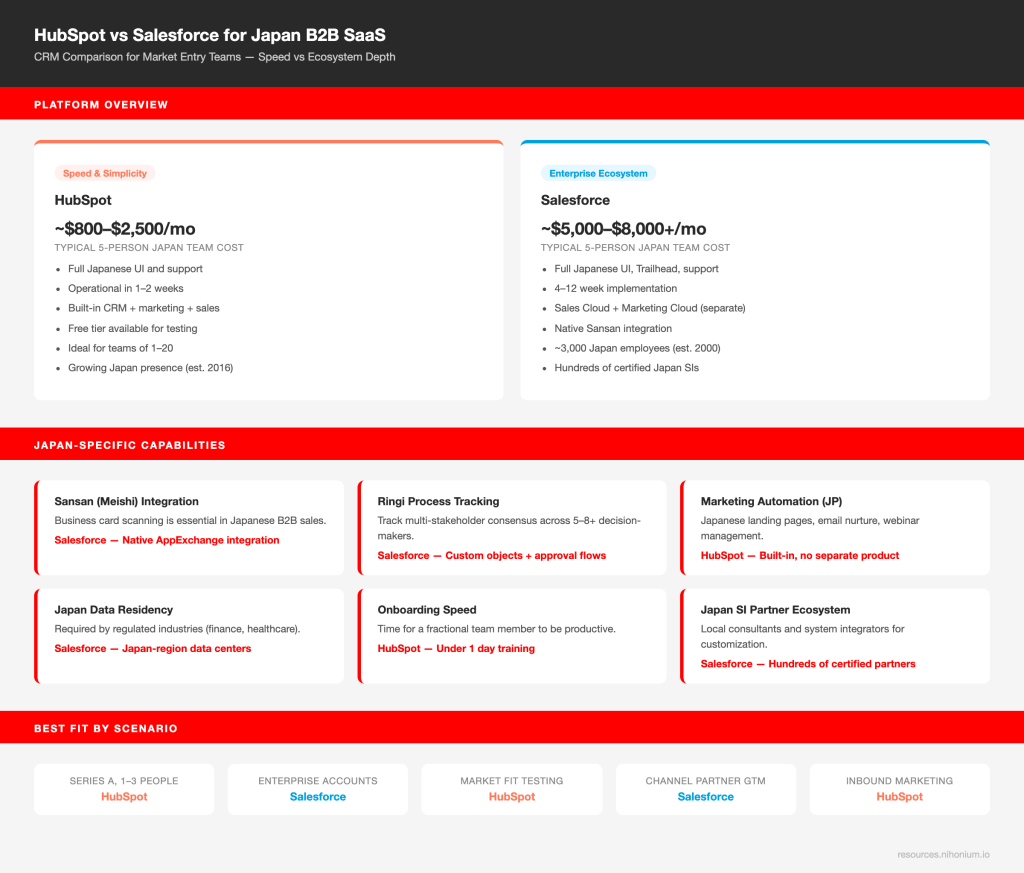
HubSpot vs Salesforce at a Glance
| Attribute | HubSpot | Salesforce |
|---|---|---|
| Japan entity | HubSpot Japan KK (HubSpot Japan株式会社), Tokyo; office opened February 2016 as HubSpot’s fourth outside the US | Salesforce Japan Co., Ltd. (株式会社セールスフォース・ジャパン), Tokyo; opened April 2000 as Salesforce’s first overseas office |
| Japanese language UI | Japanese interface and Japanese knowledge base | Japanese interface, help and Trailhead learning platform in Japanese |
| Japan-based support | Chat, email and call-back support in Japanese; phone support in English only | Japanese-language support and account teams through Salesforce Japan; support level depends on the plan |
| Starting cost (CRM + marketing) | Free CRM tools (Sales Hub Free for up to 2 users); Marketing Hub Professional from USD 800 a month with 3 core seats, plus USD 3,000 one-time onboarding | Free Suite at no cost; Starter Suite JPY 3,000 (USD 25) and Pro Suite JPY 12,000 (USD 100) per user a month, both with sales and marketing features |
| Setup complexity | Lower; designed for the team to set up itself, with paid onboarding on Professional and Enterprise | Higher on the Sales Cloud editions; often configured with an implementation partner |
| Sansan integration | Sansan and HubSpot CRM integration since June 2020 (plugin built by HubSpot) | Sansan integration with Salesforce available |
| Japan partner/SI ecosystem | HubSpot Solutions Partners in Japan; younger ecosystem | Consulting partners built up since 2000; larger ecosystem in Japan |
| Multi-stakeholder deal tracking | Multiple contacts associated with a deal, custom properties and workflows | Opportunity contact roles, custom objects and approval processes |
| Marketing automation (Japanese content) | Built in (Marketing Hub): email, forms, landing pages | Basic marketing in the Starter and Pro Suites; Marketing Cloud Account Engagement (formerly Pardot) from JPY 150,000 (USD 1,250) per org a month, annual |
| API and custom integrations | REST APIs; simpler integration model | Extensive APIs, Apex custom code, MuleSoft |
| Reporting and dashboards | Built in; intuitive but less customizable at scale | Highly customizable; Tableau and AI options on higher editions |
| Data hosting | US, Canada, Australia or EU (Germany); no Japan region | Hyperforce lets customers choose a region, including Japan |
| Best fit stage | Early stage; small Japan teams without a CRM administrator | Later stage or enterprise-focused; teams with admin capacity or a partner |
Core Distinction: Ecosystem Depth vs Operational Speed
The difference is between joining an established, deeply localized ecosystem and deploying a lean system a small Japan team can run without a CRM administrator.
Salesforce has operated in Japan for more than two decades. Its Japanese subsidiary opened in April 2000 as Salesforce’s first office outside the US (renamed Salesforce Japan in February 2022), and an ecosystem of consulting partners and AppExchange solutions for Japanese business processes has grown around it. If your Japan go-to-market means selling to large Japanese enterprises that already run Salesforce internally, using it too creates immediate alignment.
HubSpot’s advantage is speed. A SaaS company entering Japan with two to five people does not need a CRM that requires a dedicated administrator. With CRM, marketing automation, sequences and reporting in one tool, a Japan country manager or fractional sales lead can run the whole funnel without specialist admin skills.
The pricing models differ. At list prices on 19 November 2026, five Salesforce Pro Suite users cost JPY 60,000 a month (5 x JPY 12,000, annual), or JPY 117,000 on Sales Cloud Core (5 x JPY 23,400); Account Engagement adds from JPY 150,000 a month. HubSpot’s Marketing Hub Professional starts at USD 800 a month with three core seats, plus USD 3,000 one-time onboarding, and Sales Hub Professional costs USD 90 or 100 per seat a month depending on billing terms, plus USD 1,500 onboarding. HubSpot’s pages showed US dollars plus tax; ask for a yen quote.
Japan-Specific CRM Capabilities
Both platforms support Japanese; the differences are in integrations and hosting.
Business card scanning and contact management: In Japan, the exchange of business cards (meishi, 名刺) is still a basic business ritual, and Sansan is a widely used tool for managing them. Sansan integrates with both CRMs: Sansan and HubSpot Japan launched their integration in June 2020, with the plugin built by HubSpot’s own developers, and Sansan’s Salesforce integration is long established. Check which Sansan plan each requires.
Nemawashi and ringi process tracking: Japanese enterprise purchasing typically involves nemawashi (根回し, informal consensus-building before a decision) and ringi (稟議, formal written approval). Salesforce supports opportunity contact roles, custom objects for tracking approval stages, and workflow automation. HubSpot associates several contacts with a deal and offers workflow automation, but modelling a full ringi takes more creative use of custom properties.
Japanese payment and billing integrations: Neither vendor publishes a Japan-specific billing comparison. Check each marketplace (AppExchange, the HubSpot App Marketplace) for the Japanese billing and invoicing tools you plan to use, and make sure your invoices meet the Qualified Invoice System.
Local data residency: Salesforce’s Hyperforce infrastructure lets customers choose where Salesforce applications run, with Japan among the options. HubSpot hosts accounts in the US, Canada, Australia or the EU (Germany), with no Japan region. If a buyer requires data to stay in Japan, that settles it.
When to Choose Each
Choose HubSpot for speed and lean teams; choose Salesforce for enterprises that expect ecosystem alignment or data held in Japan.
Best Fit by Scenario
| Scenario | Best Fit | Why |
|---|---|---|
| Series A SaaS entering Japan with 1 to 3 team members | HubSpot | Free tools to start, faster setup, no admin overhead |
| Selling to Japanese enterprise accounts (1,000+ employees) | Salesforce | Ecosystem alignment with enterprise buyers who already use Salesforce |
| Testing Japan market fit before committing to a local entity | HubSpot | Free CRM tools and self-serve setup; Salesforce’s Free and Starter Suites are an alternative |
| Channel partner-led GTM in Japan | Salesforce | Partner relationship management options and a large Japan partner ecosystem |
| Inbound-led Japan marketing with content and webinars | HubSpot | Marketing Hub built in, no separate marketing product needed |
| Already using Salesforce globally | Salesforce | One global CRM avoids data silos |
| Heavy Sansan integration and meishi workflow | Either | Sansan integrates with both; check the Sansan plan each integration needs |
| Fractional or outsourced Japan sales team | HubSpot | Simpler onboarding; an intuitive interface keeps training short |
Can You Use Both Together?
Yes. A HubSpot front end for Japan marketing, with Salesforce as the global CRM of record, is a common hybrid.
HubSpot handles Japan inbound marketing (Japanese landing pages, email nurture, webinar registration, lead scoring); Salesforce holds qualified opportunities as the global CRM of record.
HubSpot’s own Salesforce integration syncs contacts, companies, deals and activity between the two systems; it is available on HubSpot’s Professional and Enterprise subscriptions.
A middle path: start with HubSpot, validate your funnel and ICP, then move to Salesforce or connect the two once deal volume justifies it.
Key Takeaways
- Salesforce has the deeper Japan ecosystem: In Japan since April 2000, with a long-established partner network and a Japan hosting option through Hyperforce, it is the default for companies selling to large Japanese enterprises that already use it.
- HubSpot wins on speed and simplicity for early-stage entry: Free CRM tools, a single interface for marketing and sales, and no need for a dedicated administrator suit small Japan teams.
- Compare list prices on your own team size: Salesforce’s Pro Suite is JPY 12,000 per user a month and HubSpot’s Marketing Hub Professional USD 800 a month with three seats (19 November 2026); onboarding fees and add-ons change the total.
- Japan-specific features: Sansan integrates with both; of the two, only Salesforce offers Japan data hosting. A hybrid (HubSpot for Japan marketing, Salesforce as the global CRM) is a supported pattern.
- Your CRM choice should follow your GTM model: Define your Japan ICP, sales motion and team structure first, then pick the CRM that supports them.
Sources
HubSpot, HubSpot Japan company information; Marketing Hub and Sales Hub pricing (seen 19 November 2026); knowledge base on hosting, support languages and the Salesforce integration.
Salesforce, Sales Cloud pricing (Japan) and Account Engagement pricing (seen 19 November 2026); name change and head office move (1 December 2021); Hyperforce (in Japanese).
Sansan and HubSpot Japan, Sansan and HubSpot CRM integration, joint press release (23 June 2020).
Frequently Asked Questions
Does HubSpot fully support Japanese language?
Largely, yes. HubSpot’s interface and knowledge base are available in Japanese, and you can build Japanese emails, landing pages, forms and blog posts. Chat, email and call-back support is offered in Japanese, while phone support is in English only.
Is Salesforce too expensive for an early-stage SaaS company entering Japan?
Not necessarily. On 19 November 2026 Salesforce listed a Free Suite, a Starter Suite at JPY 3,000 and a Pro Suite at JPY 12,000 per user a month, with Sales Cloud editions from JPY 23,400. Five Pro Suite users come to JPY 60,000 a month before partner fees; compare that with HubSpot’s Professional tiers and onboarding fees for your team size.
Can I track nemawashi and ringi approval processes in a CRM?
Both can model multi-stakeholder approval: Salesforce with more native depth (custom objects, approval processes, contact roles), HubSpot with multi-contact deals and custom properties. Buying groups are large: in One Marketing’s 2025 survey of 600 B2B buyers, high-price purchases involved 18.3 people on average, which favours Salesforce for complex enterprise deals.
Should we select our CRM before or after defining our Japan GTM strategy?
After. Your CRM should support your go-to-market motion, not define it. Define your Japan ICP, decide your sales motion and team structure, and then pick the CRM that fits. Our Japan go-to-market strategy guide covers those decisions, and you can talk to us about your Japan entry plan.