

Breaking into Japan’s SaaS market isn’t easy, but the potential is huge. Japan is the second-largest enterprise software market globally, valued at $9.5 billion in 2023 and projected to hit $14 billion by 2027. Yet, only 34% of SMEs in Japan use SaaS tools, leaving a significant untapped market. Success here requires overcoming long sales cycles, risk-averse buyers, and cultural nuances.
Here’s how you can succeed:
- Localize Everything: Go beyond translation – adapt your product, support, and materials for Japanese preferences.
- Use Local Platforms: Focus on Google, Yahoo! Japan, and LINE for marketing, and prioritize in-person events for networking.
- Leverage Product-Led Growth (PLG): Tailor strategies to Japan’s consensus-driven B2B SaaS sales process.
- Build Long-Term Trust: Commit to the market visibly with native-language support and face-to-face interactions.
- Partner with Local Experts: Collaborate with specialists to navigate market entry efficiently and cost-effectively.
Key takeaway: Patience, trust-building, and localization are non-negotiable for thriving in Japan’s SaaS market.
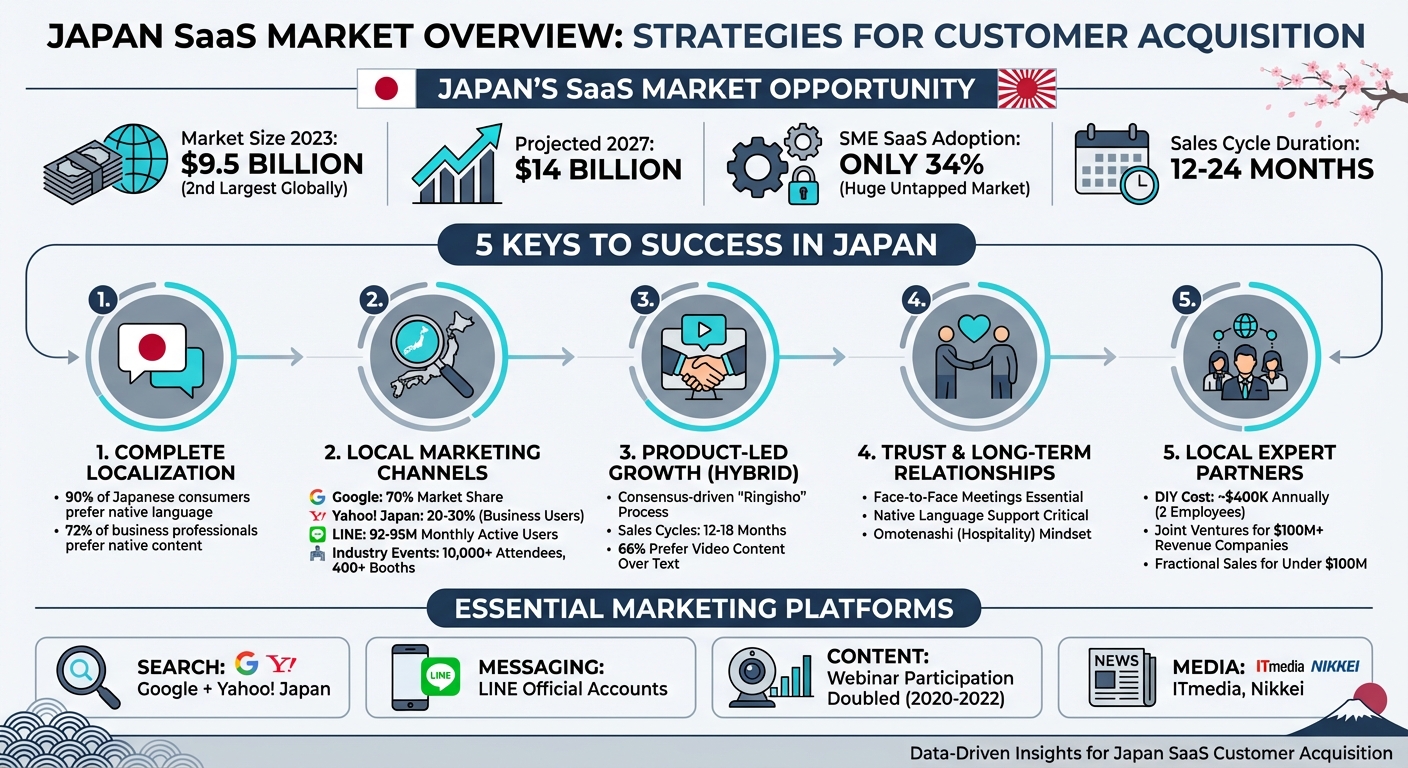
Japan SaaS Market Statistics and Customer Acquisition Strategy Overview
1. Focus on Complete Localization
When entering the Japanese market, it’s crucial to tailor your product experience to fit local customs, cultural norms, and technical standards. For instance, Japanese text often requires more vertical space in user interfaces, and you’ll need to adjust date and time formats, reorder name fields to display surnames first, and incorporate local payment options like bank transfers.
Localization isn’t just about translation – it’s about addressing the unique challenges of building trust and simplifying processes for Japanese customers. To do this, your product workflows and onboarding materials should reflect Japanese business etiquette. Keep sales materials concise and designed for advocates who will present them to decision-making committees. Aligning with these norms can make all the difference in gaining traction.
A great example is Slack, which successfully grew its Japanese user base by localizing its interface, offering local customer support, and crafting marketing strategies that resonated with the audience’s preferences.
Accuracy and cultural appropriateness are non-negotiable. Using native speakers ensures proper application of honorifics and business Japanese and avoids costly mistakes. The importance of this is clear: 90% of Japanese consumers prefer to buy products that provide information in their own language.
Additionally, setting up a dedicated Japanese support team is essential. Prompt responses and training reflect the spirit of omotenashi – a deep commitment to customer care – which helps build trust and solidify long-term relationships.
sbb-itb-a752276
2. Use Local Marketing Channels
Connecting with Japanese customers means adopting a dual approach to search engines, targeting both Google and Yahoo! Japan. While Google dominates with about 70% of the market, Yahoo! Japan still holds a solid 20–30% share, especially among business users. Successful SaaS companies often run campaigns on both platforms, acknowledging their distinct roles in addressing different search intents in Japan. But search engines are just the beginning —optimizing SaaS landing pages for these platforms is equally critical— – there are other platforms that offer unique ways to engage.
Take LINE, for example. While it’s widely recognized as a consumer platform, it has proven to be an effective tool for B2B engagement. With over 92–95 million monthly active users in Japan, LINE Official Accounts allow businesses to communicate directly with customers in a personalized way, often yielding better results than traditional email campaigns. This aligns perfectly with Japanese business culture, which prioritizes relationship-building over hard-sell tactics.
Attending industry events and conferences is another excellent way to boost visibility, particularly for SaaS companies targeting enterprise clients. Major digital transformation tradeshows in Japan draw over 10,000 attendees and feature more than 400 booths. These in-person interactions are invaluable in establishing the trust required for Japan’s consensus-driven decision-making process.
Creating thought leadership content in Japanese can also drive inbound leads. White papers, webinars, and seminars tailored to local audiences are highly effective. Between 2020 and 2022, participation in webinars among Japanese professionals doubled, and 66% of local business buyers now prefer researching software through video content rather than text. These formats not only educate but also resonate with the way Japanese buyers like to engage.
Still, when it comes to evaluating new products, partner introductions and word-of-mouth remain the most trusted sources for Japanese B2B buyers. Collaborating with respected local tech media outlets like ITmedia or Nikkei can further extend your reach and strengthen your credibility.
If you’re looking to refine your marketing strategy for Japan, consider working with specialists like Nihonium (https://nihonium.io). They provide tailored localization and go-to-market solutions designed specifically for global SaaS companies navigating the Japanese market.
3. Apply Product-Led Growth Methods
In Japan, adopting product-led growth (PLG) requires a hybrid approach rather than relying solely on the self-service model often seen in Western markets. Here, B2B purchasing decisions follow a consensus-driven process known as "Ringisho", where multiple stakeholders collectively review and approve purchases. This means your product must appeal not only to the end-users but also to decision-makers who may never directly interact with it.
To succeed, focus on starting with individual users and gradually scaling adoption across the entire company. Many Western B2B SaaS companies have thrived in Japan by enabling individual users to make initial purchases through PLG strategies, then expanding to company-wide rollouts once trust is built. A critical difference in Japan is the need for a "Download Documents" option alongside your free trial sign-up. These documents – detailed service introduction decks – are essential for trial users to present your product to internal committees. Without them, users may struggle to secure the necessary approvals.
Your self-service experience must also meet high expectations for detailed documentation. Japanese users value step-by-step manuals, extensive FAQs, and granular control settings far more than the minimalist interfaces often favored in Western SaaS products.
"A non-localized product can dissuade these stakeholders, as it could potentially give the wrong impression of limited support in Japan." – Yuga Koda, Nihonium
Proof of Concept (PoC) implementations are another standard expectation in Japan. These allow companies to test your product’s fit before making a commitment. Incorporating PoCs into your strategy helps trial users clearly demonstrate the product’s value to their organizations. Keep in mind that sales cycles in Japan are lengthy, often lasting 12–18 months. Your self-service model should be designed to support these extended evaluation periods, offering continuous resources and nurturing throughout.
For companies looking to tailor their PLG strategies to Japan’s unique market needs, Nihonium (https://nihonium.io) offers solutions like localized onboarding flows and documentation to ensure your approach aligns with local expectations.
4. Build Trust Through Long-Term Relationships
In Japan, trust isn’t just a nice-to-have – it’s the foundation of doing business. Before any transaction takes place, vendors must demonstrate they’re in it for the long haul. Why? Japanese buyers are naturally cautious and worry that foreign companies might pull out of the market if their revenue goals aren’t met. To overcome this, your commitment to the market must be visible and unwavering. This kind of dedication lays the groundwork for building trust at every level of the organization.
The concept of ringi highlights the importance of fostering trust across all layers of a company. This explains why sales cycles in Japan often take 12 to 24 months. Every stakeholder involved needs to feel confident that your company will stick around, offering ongoing support long after the deal is signed.
Face-to-face interactions are still the gold standard in Japanese business culture. While remote meetings are fine for routine communication, in-person meetings are essential for strengthening relationships. Attending industry events like expos, conferences, and association seminars provides unmatched opportunities for networking and visibility – things that digital channels simply can’t replace. And don’t underestimate the significance of exchanging meishi (business cards). It’s more than just a formality; it’s a key ritual that conveys respect and helps you establish credibility.
Providing native-language support – whether through phone, chat, or email – is another crucial element. Offering in-person training sessions also shows your dedication to helping customers succeed. This hands-on, customer-first approach, inspired by the Japanese principle of omotenashi (hospitality), ensures that customer needs are addressed proactively.
"Japanese buyers value responsiveness, transparency, and ongoing support, and they expect vendors to act as dependable business partners rather than mere product suppliers." – Japan Intercultural Consulting
If you’re looking to develop a long-term strategy for entering the Japanese market, consider leveraging services like Nihonium (https://nihonium.io). They specialize in fractional sales support and market entry strategies tailored to building lasting relationships in Japan.
5. Partner with Local Go-to-Market Experts
Breaking into the Japanese market on your own can be both costly and risky. For example, setting up a local operation with just two employees – a country manager and a sales/marketing professional – can rack up costs of around $400,000 annually. And that’s before you even validate the market potential.
To sidestep these challenges, teaming up with local go-to-market specialists can make a world of difference. These experts bring established business networks to the table, help you navigate cultural and language barriers, and ensure you comply with regulations like the Act on the Protection of Personal Information (APPI). Plus, having a local presence demonstrates your commitment to the market, which is critical for earning the trust of Japanese buyers.
For companies with global revenues exceeding $100 million, joint ventures tend to be the most effective approach. On the other hand, if your revenue is under $100 million, fractional sales services provide a more affordable and flexible entry point. Take New Relic, for example – they partnered with Japan Cloud in 2018 after surpassing $400 million in global revenue. Similarly, Braze followed suit in July 2020 after crossing the $100 million mark. Fractional sales services cover everything from prospecting and deal closures to account management, allowing you to test the waters without committing to hefty upfront costs.
When choosing a partner, prioritize those who offer complete localization, Japanese-speaking sales teams, effective marketing strategies, and strong expertise in compliance.
For companies looking to establish a foothold in Japan, Nihonium (https://nihonium.io) provides fractional sales support and tailored market entry strategies for global SaaS businesses. Their team handles everything from localization to sales and marketing execution, giving you the freedom to focus on building a solid foundation for sustainable growth.
Conclusion
Breaking into Japan’s SaaS market demands a localized and thoughtful approach. The five strategies we’ve discussed – thorough localization, utilizing local marketing channels, adopting hybrid SLG and PLG models, fostering trust-based relationships, and collaborating with go-to-market experts – are designed to tackle the unique challenges of engaging Japanese customers. Whether it’s navigating the Ringisho consensus process or leveraging popular platforms like LINE and Yahoo! Japan, these strategies align with the specific dynamics of this market.
Here’s an eye-opening statistic: 72% of Japanese business professionals prefer consuming information in their native language. This underscores how vital localization is to building credibility. A poorly translated product or message can quickly signal a lack of commitment to the market.
It’s also worth noting that entering this market comes with upfront costs – often before achieving product-market fit. For example, HubSpot initially operated remotely in Japan but eventually established a local office as their customer base grew. This move acknowledged a key truth: Japanese buyers value a physical presence as a marker of trust and reliability.
Partnering with local experts can significantly reduce the risks of market entry. Companies like Nihonium (https://nihonium.io) provide fractional sales support and comprehensive market entry services, enabling businesses to test the waters without heavy initial investments. Their team handles everything from precise localization to sales execution, giving businesses the chance to validate demand before committing to a full-scale operation.
Ultimately, success in Japan hinges on patience, cultural understanding, and a long-term vision. By tailoring your customer acquisition strategies to align with Japanese expectations – and seeking guidance from experienced local partners – you can cultivate the trust and relationships needed to thrive in the world’s second-largest enterprise software market.
FAQs
Why is localization important for SaaS companies entering the Japanese market?
Localization plays a key role in achieving SaaS success in Japan because it ensures your product resonates with the country’s distinct cultural, technical, and business expectations. Japanese customers place high importance on trust, precision, and long-term relationships, which means a simple translation of your content won’t cut it. True localization requires adapting your product, marketing, and communication to align with local language subtleties, cultural norms, and formal business etiquette.
On top of that, Japan enforces strict regulatory and quality standards, making it essential to meet these requirements to build credibility. By tailoring your SaaS solution to meet the needs of the local market, you can create a deeper connection with customers, set your brand apart, and position yourself for lasting success in this competitive environment.
What strategies can foreign SaaS companies use to build trust with Japanese customers?
To connect with Japanese customers, foreign SaaS companies need to prioritize building a strong local presence and demonstrating a long-term commitment to the market. This effort involves much more than just translating content – it requires a deep understanding of cultural norms, developing personal relationships, and maintaining consistent engagement. In Japan, trust and long-term relationships are highly valued, making face-to-face interactions and authentic connections a key part of the equation.
Respecting Japanese business culture is equally important. This culture emphasizes patience, consensus-driven decision-making, and indirect communication. Hiring local talent, collaborating with trusted local experts, and adapting your approach to fit cultural expectations can greatly improve credibility. By showing cultural awareness and dedicating yourself to meaningful, lasting relationships, SaaS companies can build the trust necessary to thrive in the Japanese market.
Why are local partnerships important for SaaS companies entering the Japanese market?
Local partnerships play a crucial role for SaaS companies looking to establish themselves in Japan. In Japanese business culture, trust is everything, and forming strong, reliable relationships is key to earning that trust. Japanese buyers put a high premium on long-term partnerships and the credibility of their vendors, so teaming up with local partners can go a long way in boosting your reputation and dependability.
When you collaborate with local resellers, distributors, or even startups, you gain more than just a foothold in the market. These partnerships can help you fine-tune your product and marketing strategies to meet the specific preferences of Japanese customers. They also open doors to established networks, simplify the process of adhering to local regulations, and help you navigate the subtleties of Japanese business etiquette. In short, building strong local alliances can speed up your market entry and significantly improve your chances of thriving in Japan.
 English
  Japanese