

Building trust with Japanese enterprise clients is a gradual process that requires understanding their business culture and prioritizing long-term relationships. Here’s a quick summary of what works:
- Respect Hierarchy and Etiquette: Use titles and last names, follow proper business card exchange practices, and observe punctuality. Respect for seniority and decision-making processes like nemawashi (informal consensus-building) and ringi (formal approvals) is crucial.
- Adapt Communication Style: Use context-aware communication, avoid direct refusals, and follow up with clear written summaries. Hiring interpreters or bilingual staff can help overcome language barriers.
- Demonstrate Reliability: Consistently meet deadlines, deliver on promises, and provide regular updates. High-quality localization in idiomatic Japanese signals commitment.
- Leverage Local Networks: Referrals and introductions carry significant weight. Engage with local partners, trade agencies, and industry associations for connections.
- Commit to Long-Term Engagement: Regular check-ins, in-person meetings, and addressing issues transparently show dedication to the partnership.
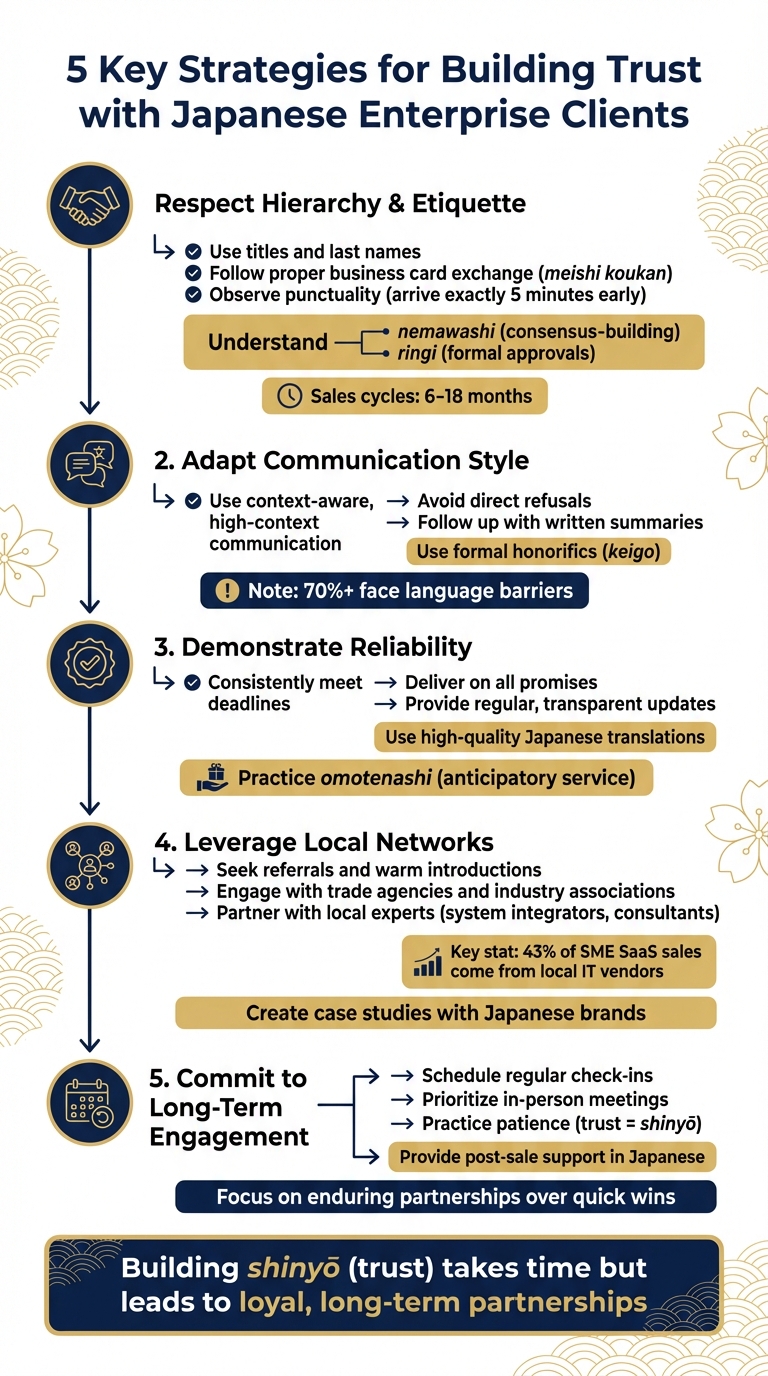
5 Key Strategies for Building Trust with Japanese Enterprise Clients
Show Cultural Respect and Sensitivity
In Japan, business relationships thrive on a foundation of cultural understanding. Before committing to a partnership, clients often assess how well you grasp their traditions and practices. Showing an appreciation for these customs signals your dedication to a lasting collaboration, while missteps can quickly create barriers.
Japanese business culture is shaped by distinct principles, including high-context communication, consensus-driven decision-making, and strict adherence to hierarchical structures. These elements influence every interaction and decision.
Respect Hierarchical Structures
Japanese companies often operate based on seniority (nenko joretsu), where age and tenure define status and authority. This structure isn’t just an internal formality – it determines who speaks in meetings, who makes decisions, and how information flows.
Decision-making typically involves nemawashi (informal, consensus-building discussions) and ringi (a formal, bottom-up approval process).
"Nemawashi as essential groundwork that eases acceptance of new initiatives." – Japan Intercultural Consulting
This approach explains why sales cycles in Japan can stretch from 6 to 18 months. Pushing for quicker decisions can be seen as dismissive of the careful internal discussions that are critical for minimizing risks. However, once a decision is finalized, implementation tends to happen quickly and in a well-coordinated manner.
Respecting hierarchy also extends to how you interact. Address clients by their last name and title, not their first name. During business card exchanges (meishi koukan), subordinates should present their card slightly lower than a superior’s card. Even seating arrangements reflect hierarchy: the highest-ranking individual typically sits in the kamiza (honor seat), which is furthest from the entrance.
Follow Business Etiquette
Japanese business etiquette emphasizes respect and professionalism through well-established rituals. For instance, when exchanging business cards, always use both hands to present and receive the card. Take a moment to examine the card and place it on the table according to seating order. Avoid pocketing it immediately or writing on it.
Bowing (ojigi) is another essential practice for greetings and farewells. The depth and duration of your bow should match the recipient’s rank. As one etiquette guide notes:
"The depth of your bow reflects the level of formality – but don’t overdo it. Too deep can feel unnatural, while too casual may seem careless." – Upgrade.co.jp
Punctuality is equally crucial. Arriving exactly 5 minutes before a meeting is ideal – too early might inconvenience the host, while lateness is considered highly disrespectful. Offering a small gift at initial meetings, such as neatly wrapped sweets or branded merchandise, is another way to show respect. The gesture itself carries more weight than the gift’s monetary value. Each of these actions reinforces trust and professionalism.
| Etiquette Element | Proper Action | Action to Avoid |
|---|---|---|
| Business Cards | Use both hands; place on table in order | Pocketing or writing on the card |
| Punctuality | Arrive exactly 5 minutes early | Being late or arriving too early |
| Communication | Address by last name with titles | Using first names or being too direct |
| Dining | Pour drinks for others; wait for a toast | Pouring your own drink; drinking early |
Adjust Your Communication Style
In Japan, communication relies heavily on context. Tone, posture, and non-verbal cues often carry as much meaning as words. Direct refusals are uncommon; instead, phrases like "it is difficult" or even silence are used to maintain harmony (wa).
"Direct refusals are exceedingly rare; rather than saying ‘no,’ Japanese businesspeople may use language such as ‘it is difficult’ or simply remain silent." – BBC
Silence during meetings isn’t a sign of discomfort – it often reflects thoughtfulness, respect, or acknowledgment of hierarchy. Rather than rushing to fill pauses, allow these moments to foster deeper consideration.
Formal honorifics (keigo) are essential. Address clients by their last name, followed by their title or the suffix "-san", to maintain professionalism. Since over 70% of the Japanese population faces language barriers, hiring interpreters or bilingual staff for key meetings is a smart move.
If a meeting ends with vague responses, follow up with a written summary to confirm mutual understanding. This step ensures alignment as the project progresses. Adapting to these communication norms helps build trust and lays the groundwork for strong, enduring partnerships.
Build Reliability Through Consistent Actions
Respecting cultural differences is just the start; reliability proves your commitment to a lasting partnership. In Japan, business relationships aren’t just about individual transactions – they’re seen as the foundation for enduring connections built on shared values and mutual trust. As Ali Grovue and Mike Watson from Ignite Management Services put it:
"Regardless of how caring, communicative, and consistent a leader may be, they will not establish trust if they are not competent. You must build the knowledge to master your craft. You can’t fake competence."
Reliability in Japanese business culture means more than just keeping promises – it’s about consistently demonstrating competence and dependability. Every interaction, from meeting deadlines to clear communication, strengthens shinrai (trust), which is the cornerstone of Japanese business relationships.
Meet Deadlines and Deliver on Promises
In Japan, decision-making often involves processes like nemawashi (consensus-building) and ringi (formal approvals). These steps require patience and precision, and every commitment you fulfill becomes a testament to your reliability. Missed deadlines or unfulfilled promises can signal a lack of readiness for the long-term collaboration that Japanese businesses value.
Punctuality goes beyond just showing up on time. Delivering milestones, responding to inquiries, or submitting documents – even just a few minutes early – demonstrates respect and preparedness. Iku Hirosaki, Director and COO at 01GROWTH, highlights the importance of consistency and personal interaction:
"Strong business ties in Japan rely on consistency and face-to-face interaction, rather than relying solely on digital communication."
Regular meetings and updates also show your commitment. However, patience is key – Japanese business culture often involves a slower pace, so pushing for faster approvals might come across as impatience.
Provide Regular, Transparent Updates
Clear, written follow-ups are essential. These should outline commitments, next steps, and any materials shared during meetings. This approach aligns with the ringi system, where proposals move through multiple levels of approval. Sharing bilingual summaries or handouts ensures all stakeholders remain aligned, as Naoki Togawa, Manager at Nikkei Business Publications, emphasizes:
"Everything should be in high-quality, idiomatic Japanese. There’s nothing worse than bad translation. It’s easy to tell which vendors know what they are doing and are really committed to the market just through the quality of their materials and programs."
When presenting updates, maintain a calm and steady tone, allowing for pauses so clients can process the information. Offering private follow-ups or Q&A sessions ensures concerns can be addressed without disrupting group harmony.
Transparency is crucial, especially when challenges arise. Address issues directly and take responsibility. Dr. Bob March, an expert on Japanese business culture, advises:
"Take responsibility for whatever happens… honesty is the only policy."
How you handle mistakes can either weaken or strengthen trust. Owning up to errors and providing concrete solutions shows integrity and builds credibility over time.
Maintain High Quality Standards
Japanese clients expect exceptional quality in products, services, and usability. Meeting these expectations signals respect and dedication to the market. Tailoring your offerings to local needs, from product modifications to superior after-sales support, demonstrates technical competence and a willingness to adapt.
Localization goes beyond language. Adjusting product features, packaging, and formulas to align with local preferences and regulations is key. Procter & Gamble faced initial challenges in Japan because their products didn’t meet local expectations. By investing in local R&D and tailoring their offerings – such as creating smaller packaging – they eventually turned Japan into one of their most profitable markets.
Strong after-sales support is equally important. Ensure technical documentation, manuals, and contracts are professionally translated to avoid misunderstandings – AI alone isn’t enough for high-stakes materials. Practicing omotenashi (anticipatory service) by addressing customer needs proactively and with care further solidifies trust.
As GlobalDeal notes:
"In Japan, trust is built over time through actions. Business partners pay close attention to whether you deliver as promised, not just whether you mean well."
Use Introductions and Local Networks
Once you’ve shown you’re reliable through consistent actions, tapping into introductions and local networks can strengthen trust even further.
In Japan, who introduces you matters just as much as what you’re offering. The business culture heavily values established relationships, where referrals and introductions carry significantly more weight than cold outreach. When someone introduces you to a Japanese enterprise client, their reputation is also on the line, creating a moral obligation, known as giri, built on personal trust.
The numbers tell the story. For small and medium-sized enterprises in Japan, 43% of SaaS sales come from local IT vendors or review sites, compared to just 24% from direct sales. Indirect channels – like partners and distributors – often make up over 50% of SaaS revenue in the Japanese market.
Build Relationships Through Referrals
Referrals are a powerful way to open doors. They align perfectly with Japan’s preference for relationship-based business over purely transactional interactions. This makes them a critical first step in building enterprise-level connections.
To get started, engage with government trade agencies, industry associations, and chambers of commerce. These organizations can connect you with high-quality partners and valuable introductions. Attending Japanese trade shows and B2B matchmaking events is another great way to meet potential partners and stakeholders in a structured setting.
After-hours gatherings, such as business dinners and nomikai (drinking parties), are just as crucial as formal meetings for building trust. Repeatedly declining these invitations can signal a lack of interest in the relationship, so treat them with the same importance as any business negotiation.
Once you’ve secured introductions, focus on creating case studies with well-known Japanese brands. These case studies act as indirect endorsements, offering "next-level certainty" to other potential enterprise buyers. Japanese buyers naturally trust brands that are vouched for by established local partners. This makes social proof from respected Japanese companies a game-changer.
To reinforce these efforts, collaborate with local experts who understand the cultural and operational nuances of doing business in Japan.
Partner with Local Experts
Successfully navigating Japan’s business culture, language barriers, and the ringi consensus process often requires the help of local experts. System integrators, value-added resellers, consultancy firms, and fractional sales teams can serve as vital connectors between global companies and key Japanese decision-makers.
Partnering with local experts shows you’re serious about the Japanese market and committed to long-term success. For instance, companies like Nihonium offer fractional sales support and tailored market entry strategies specifically for Japan. These services are invaluable because local partners already have established relationships within Japanese business circles and understand how to make effective introductions.
When choosing partners, don’t just evaluate their sales capabilities. Look for those who are willing to invest time in localization and who deeply understand Japanese business etiquette. Partners with strong local insights and a grasp of market dynamics can make all the difference.
Additionally, ensure your materials – sales decks, documentation, and presentations – are in flawless, idiomatic Japanese. High-quality translations signal genuine commitment, while poor translations can harm your credibility and the trust of your referring partner.
Local experts can also guide you through keiretsu networks – traditional enterprise groups that often influence buying decisions. Partnering with system integrators within these networks can give you a strategic edge for both entering the market and building long-term relationships.
sbb-itb-a752276
Commit to Long-Term Communication
Once you’ve established local partnerships and introductions, the next step is ensuring those relationships grow through consistent, long-term communication. In Japan, business relationships are deeply rooted in principles like Wa (harmony), Giri (duty), and Shinyō (trust). These values emphasize that trust develops gradually through reliable and consistent actions over time.
When trust is earned, Japanese companies often demonstrate loyalty through enduring supplier relationships. This is evident in keiretsu systems, which focus on maintaining systemic quality and fostering low-turnover partnerships. Ongoing, structured communication plays a crucial role in building this trust, leading to smoother negotiations and better terms.
Schedule Regular Check-Ins
Regular check-ins are vital to staying aligned and showing your dedication to the partnership. Japanese businesses often involve multiple stakeholders in their decision-making process, which means detailed updates and transparency are essential at every stage.
Whenever possible, prioritize in-person meetings to strengthen these connections. These meetings should emphasize reliability, quality assurance, and long-term commitment. Use concise, localized materials to ensure clarity and support internal consensus-building. As Naoki Togawa, Manager at Nikkei Business Publications, explains:
Everything should be in high-quality, idiomatic Japanese. There’s nothing worse than bad translation. It’s easy to tell which vendors know what they are doing and are really committed to the market just through the quality of their materials and programs.
Don’t overlook the importance of post-sale communication. Your customer success team should provide support in Japanese, as the lack of local-language assistance can be a deal-breaker for enterprise clients. Offering regular educational resources, such as webinars or thought leadership content, also signals your dedication to the market.
Practice Patience and Persistence
In addition to regular communication, patience and persistence are key. Building trust in Japan requires a long-term approach, as decision-making processes can be slow and deliberate. Japanese buyers often value reliability and stability over speed or innovation. Companies that enter the market quickly but leave just as fast after unmet revenue goals raise red flags for potential partners. Consistent effort over time reassures clients that you’re in it for the long haul.
Trust in Japan is built through steady, respectful actions. Keep your promises, follow up consistently without being overbearing, and provide transparent updates. Practice nemawashi, an informal approach to consensus-building where you engage stakeholders individually before formal meetings to address concerns and align interests. During meetings, focus on listening rather than talking, demonstrating your commitment to understanding their needs.
Signs of success include more frequent meetings, quicker resolutions, renewed contracts, and referrals – all of which reflect established Shinyō and loyalty. Pay attention to response times to your updates and invitations to social events like business dinners, which remain an important way to deepen trust.
Nihonium’s fractional sales support offers a great example of how consistent engagement can sustain trust over time. Having local experts who grasp the nuances of Japanese business culture ensures your communication stays aligned, even when navigating the extended timelines typical of enterprise sales in Japan.
How Nihonium‘s Fractional Sales Support Helps Build Trust
Nihonium’s fractional sales support bridges the gap for global SaaS companies aiming to build relationships with Japanese enterprise clients. By offering a local presence and expertise, they help ensure cultural nuances are respected and operational consistency is maintained. For companies without a Japanese entity, this service acts as an extension of their team, managing outreach and accounts in a way that aligns with Japan’s unique business environment. This approach complements the strategies previously discussed, reinforcing trust and credibility.
Customize Sales and Marketing Strategies
Japanese enterprise clients expect clear signs of long-term commitment to their market. One way to demonstrate this is by creating high-quality, localized materials in idiomatic Japanese.
Nihonium tailors sales strategies to fit Japan’s consensus-driven business culture. This includes crafting customized sales decks, using appropriate keigo (polite language) in communications, and providing detailed documentation to support internal approvals. Instead of relying on broad marketing efforts, Nihonium emphasizes relationship-focused, account-based selling. This personalized approach often leads to faster market entry – 30–50% quicker – by leveraging trusted referrals and shortening decision timelines.
Maintain Client Relationships Over Time
Building trust in Japan isn’t a one-time effort; it requires consistent engagement. Nihonium’s fractional teams ensure a reliable local presence, offering end-to-end account management that reassures cautious buyers. For example, when a SaaS client faced a delivery delay that could have eroded trust, Nihonium stepped in with nemawashi – quietly addressing concerns with individual stakeholders. This proactive approach not only resolved the issue but also strengthened relationships, resulting in a multi-year contract extension.
To deepen these connections, Nihonium organizes in-person meetings and builds credibility through case studies featuring prominent Japanese brands. This social proof is crucial for earning the confidence of risk-averse buyers. By providing these services, Nihonium allows global SaaS companies to establish a foothold in Japan without the expense of hiring a full-time local team, while ensuring the ongoing engagement necessary for long-term success.
Conclusion
Earning the trust of Japanese enterprise clients isn’t something that happens overnight. It requires genuine respect for cultural norms, a track record of reliability, leveraging local networks, and a commitment to long-term relationships. In Japan, shinyō – a deep sense of trust – functions like a moral contract. It takes time to build but often leads to partnerships that endure.
Here’s a quick recap of the key strategies: Acknowledging hierarchical structures and adhering to proper business etiquette shows cultural understanding. Consistently meeting deadlines and maintaining open, honest communication builds reliability. Additionally, warm introductions through mutual connections or collaborations with local experts can fast-track credibility far better than cold outreach ever could.
For global SaaS companies, options for entering the Japanese market require delivering high-quality localized products and services to signal genuine dedication.
When trust is established, the benefits are immense – smoother negotiations, easier problem-solving, valuable referrals, and opportunities for collaborative growth. Unlike the shorter-term focus often seen in Western business practices, these partnerships are built to last.
FAQs
Why is respecting hierarchy important when working with Japanese enterprise clients?
When working with Japanese enterprise clients, respecting hierarchy is essential for building trust. In Japan, hierarchy is deeply tied to seniority, experience, and social standing. Recognizing and honoring this structure demonstrates your awareness of local business customs and your professionalism.
Small but meaningful actions can go a long way. For example, addressing individuals by their titles, exchanging business cards with both hands, and adhering to formal etiquette all signal your respect for these traditions. These gestures may seem simple, but they carry significant weight in Japanese business culture.
Hierarchy also plays a key role in how Japanese companies communicate and make decisions. Many organizations rely on a consensus-driven approach that involves multiple stakeholders. By respecting seniority, you help maintain harmony and avoid misunderstandings, which are crucial for effective collaboration. Showing sensitivity to these practices reflects your dedication to building strong, lasting business relationships.
Why is it important to adjust your communication style when working with Japanese enterprise clients?
When working with Japanese enterprise clients, tailoring your communication approach is crucial. Japanese business culture places a high value on respect, subtlety, and building strong relationships. Unlike the more direct styles often seen in Western business environments, Japanese professionals emphasize harmony, hierarchy, and reaching consensus, which significantly influences their communication and decision-making processes.
For instance, decision-making frequently involves nemawashi (laying informal groundwork) and Ringi (circulating formal proposals for approval). These practices require patience and a thoughtful approach. Communication should always be polite, mindful of nonverbal cues, and steer clear of confrontation or overly assertive language. By respecting these norms, you can establish trust, show regard for their values, and develop lasting partnerships with Japanese clients.
How important are local networks and referrals when building trust with Japanese enterprise clients?
When working with Japanese enterprise clients, local networks and referrals play a key role in establishing trust. In Japan, business relationships often rely on personal connections and mutual trust, which are typically built through introductions by respected intermediaries or referrals from trusted contacts.
Referrals serve as a powerful form of social proof, helping foreign companies gain credibility and ease initial skepticism. By partnering with local experts or tapping into existing networks, you can access valuable opportunities and lay the groundwork for lasting relationships. Beyond formal meetings, engaging in social activities – like after-hours gatherings (nomikai) – can also help solidify these connections and show your dedication to understanding Japanese business practices.
Investing in local networks and fostering referrals isn’t just an advantage – it’s a must for building trust and forming successful partnerships in Japan.
 English
  Japanese