

B2B SaaS Sales in Japan
Introduction
B2B SaaS sales in Japan is likely a black box for many companies considering entering Japan. This may be one aspect that causes companies to have trepidation in entering the Japanese market. The Japanese sales landscape is quite different from other markets. The SaaS sales landscape has evolved in the US with product-led growth gaining traction over the past 10+ years. Product-led growth (PLG) is still a rather new concept in Japan with a high reliance on sales-led growth (SLG). Indirect sales (working with partners, resellers, and distributors) is also a big portion of revenues for many SaaS companies and adds another dimension to selling in Japan: B2B SaaS sales in Japan is not only PLG vs. SLG, but also direct vs. indirect sales. B2B SaaS sales is not one size fits all in Japan and the growth strategy evolves over time.
PLG vs. SLG
Product-led growth has become a common strategy that many SaaS companies are implementing. Pure product-led growth is hard to achieve but companies that have achieved it have reaped amazing rewards. PLG relies on an intuitive product that end-users can use and onboard without any support from a specialist. The first action in engaging the product is to actually use the product.
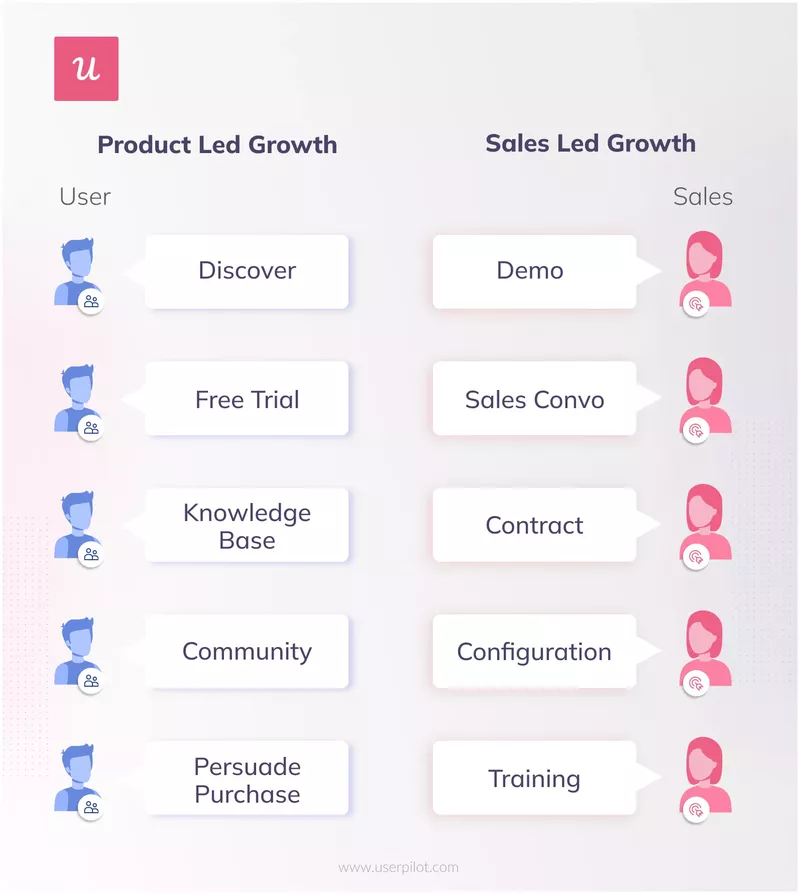
Image source: UserPilot’s “Product-Led vs Sales-Led: What’s the Difference, and Which One Is Right for You?”
On the other hand, sales-led growth is driven by salespeople explaining the benefits of using the product. Usually, the end-user has to be in communication with a salesperson before using the product. There may be different reasons to implement a sales-led funnel, but a common reason is the complexity of the product. If the only way to get the full value of the product is to go through complex implementation, a sales-led motion makes perfect sense. It’s pretty common to see less complex tools implement a PLG strategy, while more complex solutions have a SLG strategy. There are trade-offs of having PLG vs. SLG, but the strategy usually evolves after layers of iterations.
B2B SaaS companies in the US have had success with PLG even if the product (developer tools like NewRelic, MongoDB, and DataDog) requires some level of integration. Less complex tools like Dropbox and Zoom are prime examples of successful PLG.
 Source: OpenView’s “What is Product-Led Growth? How to Build a Software Company in the End User Era”
In Japan, it is rare to find a pure PLG strategy. The company may start with a pure product-led process, which is crucial to bring on early customers. Many companies that start out with a pure PLG strategy will soon add a layer of SLG by adding a “request/downloads document” call-to-action (CTA). In the US people generally want to try the product before speaking to a salesperson. End-users are actively searching for new technologies to implement. With the exception of early innovators, many Japanese companies are usually not looking to implement new technologies. They have to be convinced to change their current process or even test a new process. To accommodate both parties, many B2B SaaS companies will usually have two CTAs, “Free Trial” and “Request/Download Document.” The document or deck is important (and there are course dedicated to create the perfect deck), as it’s usually the first thing companies see even before the product itself. The document will also likely be used in the ringisho process (decision-making process), so having a good deck is crucial. Japanese SaaS companies will usually live in the intersection of PLG and SLG to accommodate both personas, end-users that want to try out the product right away and companies that need to be sold before even testing the product.
Direct vs. Indirect Sales
The direct vs. indirect sales (resellers, partners, distributors) may be a unique discussion in Japan. Of course, there are global companies that rely heavily on building out ecosystems, but in Japan, resellers, partners, and distributors play a big role. In certain cases, 50%+ of revenues end up coming from the indirect sales channels. The partners, resellers, and distributors have access to companies that are in dire need of new technology but don’t know where to look or need additional assistance. For example, 43% of SaaS sales for SMEs come from IT review sites or local IT vendors compared to 24% from direct sales. At a certain scale, SaaS companies in Japan will implement an indirect/partner sales strategy. The partner sales strategy follows the successful initial adoption of a product, usually product-driven, as partners, resellers, and distributors work primarily with companies that have found a certain level of product-market fit. Working with these channel partners is a luxury that companies can access only after finding a certain level of PMF.
Companies that initially relied on PLG will naturally shift into a hybrid model when implementing a indirect sales strategy. The sales-driven approach has two layers. The first layer is bringing on the partners, resellers, and distributors. There’s a high component of sales when convincing partners, resellers, and distributors to take on a product. The second layer is selling to the leads that come from the indirect sales channel. Once service providers start accessing companies from the channel partners, sales become more relevant, as these companies usually require convincing before trying out and purchasing a new product. When a service provider engages channel partners, the process naturally shifts to incorporate a more formal sales process. This does assume that the service provider has created a win-win relationship with the reseller, distributor, and partners are symbiotic.
PLG vs. SLG + Direct vs. Indirect Sales
The growth strategy changes and evolves depending on the phase of the company. Different phases require a different strategy and process.
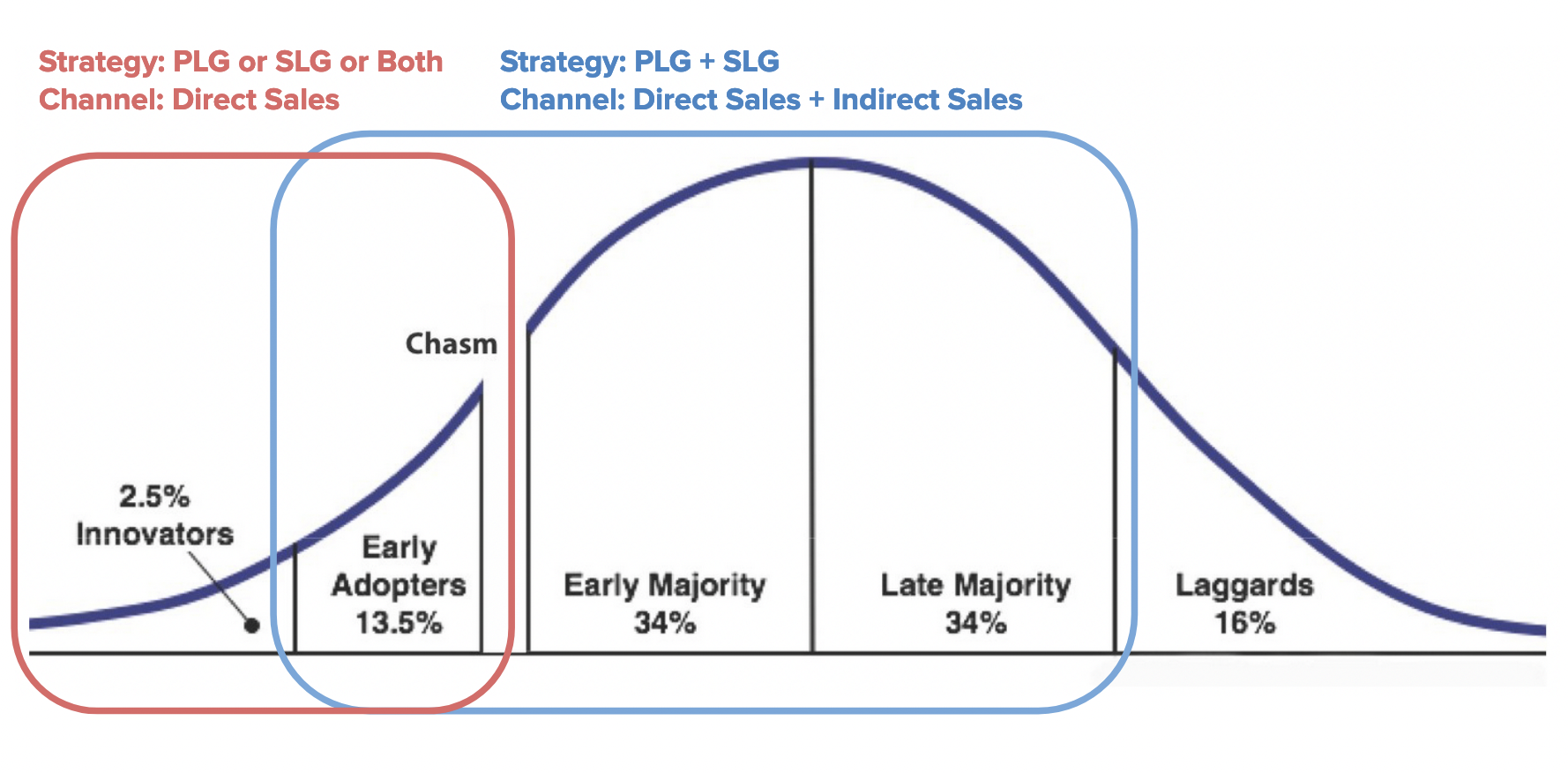 Selling to innovators, those who are willing to test out new products on their own accord, can be driven by the product. Many companies will start with PLG supported by founder-led sales. Some companies have a very clear idea of their target customer and start with strictly a sales-driven approach. Many companies will start by providing access to the product through a free trial or allowing leads to download a deck.
After creating a foundational base of customers and showing indications of PMF, companies will move to selling to early adopters. The direct sales strategies tend to be similar or the same as selling to innovators, but this is the phase where many companies consider implementing a partner sales channel or working with resellers and distributors. Partners, resellers, and distributors are a great channel to help companies cross the “chasm” and validate further product-market fit by selling into a larger group, the early majority. Selling to partners, resellers, and distributors requires a different, and at times a more formal, sales process. As a result, the growth strategy inevitably involves more sales.
Selling to the early majority, whether directly or indirectly, usually requires a sales-driven approach. Unlike innovators, who need no additional motivation to engage the product, the initial goal is to have the end user use or test the product.
The growth strategy in Japan is not a PLG vs. SLG discussion, as Direct vs. Indirect sales adds another dimension. The decision should be around meeting the end-user’s purchasing patterns, which change drastically depending on the persona. The strategy ultimately evolves with the phase of the company to meet the change in buyer persona.
 Conclusion
Selling in Japan has layers and the growth strategy is likely to evolve. A company that started with PLG may end up with some SLG in the mix. Some companies might omit PLG entirely. Like any region, the strategy should be based on the patterns of the customer persona. That being said, Japan’s unique reliance on partners, resellers, and distributors acts as a trigger for companies to implement a sales-driven motion. The channel partners and their list of contacts will likely require a more formal sales process rather than the product selling itself. If you’d like to learn more about selling in Japan or are considering entering the Japanese market, book a consultation here!
 English
  Japanese