

Breaking into Japan’s SaaS market requires more than just translating words – it demands building trust through quality native-language support. Here’s what you need to know:
- Translation Tools: Fast, cost-effective, and scalable for basic tasks like FAQs and UI strings. However, they struggle with nuances, honorifics, and complex language structures.
- Human Support: Offers precision and deeper understanding for complex issues, enterprise sales, and relationship-building. But it’s costly and less scalable.
- Best Approach: Combine both. Use AI tools for repetitive tasks and human experts for refining content and managing customer relationships.
Key Stats:
- 90% of Japanese consumers prefer products in their language. This preference is deeply rooted in local B2B buying patterns in Japan.
- Companies investing in localization see $25 in return for every $1 spent.
Quick Comparison:
| Feature | Translation Tools | Human Support |
|---|---|---|
| Speed | Instant | Slower |
| Cost | Low | High |
| Accuracy (Basic) | 80–90% | 95–100% |
| Handling Nuances | Limited | High |
| Scalability | High | Low |
| Best Use Cases | FAQs, UI strings | Enterprise sales, trust-building |
To succeed in Japan, balance speed and precision with a hybrid strategy. Start small with AI, refine with human input, and scale as trust grows.
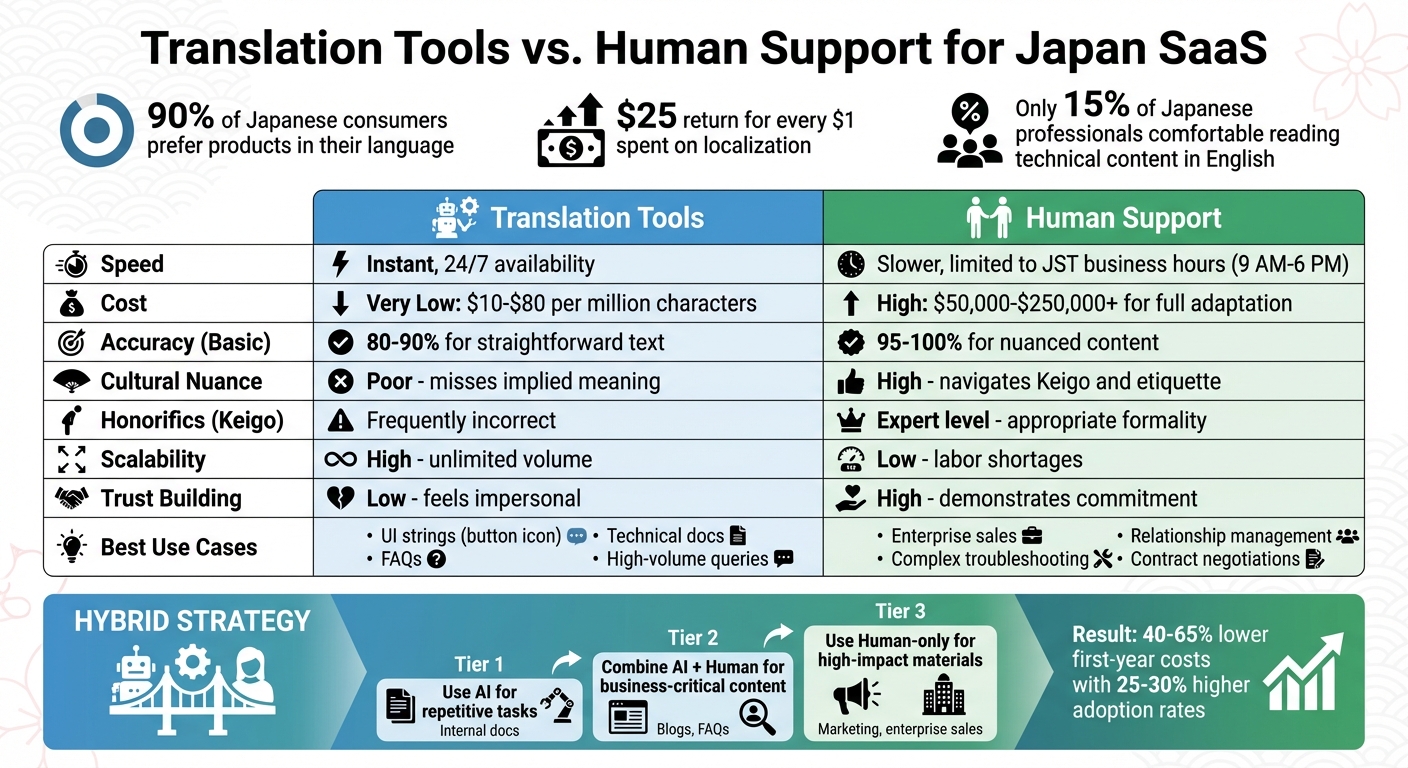
Translation Tools vs Human Support for Japan SaaS: Complete Comparison
Translation Tools for Japanese SaaS Support: Pros and Cons
AI-powered translation tools have become a popular choice for SaaS companies aiming to expand their Japanese support services quickly. These tools promise efficiency, cost-effectiveness, and scalability. However, they also face notable challenges, especially when addressing Japan’s specific language and communication nuances. Below, we explore the benefits and limitations of these tools in detail.
Benefits of Translation Tools
Speed is unmatched. AI translation tools provide instant results, enabling support teams to handle basic customer inquiries in real time. This eliminates the delays typically associated with human translation, which can significantly improve customer satisfaction in high-demand scenarios.
Cost savings are substantial. AI translation can cut costs by as much as 80% compared to human translation workflows. For example, professional English-to-Japanese translation costs range from $0.15 to $0.40 per word, while using Google Translate API costs approximately $20.00 per million characters. To translate a 10,000-word help center article, human translation could cost $500.00 to $4,000.00, whereas AI tools accomplish the same for just a few dollars.
Scalability is seamless. These tools can process large volumes of content – such as help center articles, FAQs, and technical documentation – in minutes rather than weeks. Modern AI platforms achieve 80–90% accuracy for straightforward content, especially when combined with translation memories and glossaries that ensure consistency in tone and terminology. Some systems even optimize translation engines for specific tasks, like legal documents or marketing materials.
While these advantages are compelling, it’s important to consider the challenges in meeting Japan’s high-context communication style.
Drawbacks of Translation Tools
Cultural context is a major hurdle. Japanese communication relies heavily on nuance and implied meaning, which AI tools often fail to capture. Literal translations can miss emotional tone or intent, making them less effective in customer service, where understanding subtle cues is essential.
Handling honorifics is problematic. Japanese includes three levels of Keigo (respectful language): Sonkeigo, Kenjougo, and Teineigo. Misusing these levels can make a brand seem impolite or unprofessional, damaging trust with customers. Translation tools frequently struggle to determine the appropriate level of formality for a given situation, leading to awkward or even offensive language.
Structural differences create errors. Japanese uses a Subject-Object-Verb sentence structure and incorporates three writing systems (Hiragana, Katakana, Kanji). A single word in English might require different particles depending on the context, and machines often misinterpret this. Additionally, choosing the wrong script for a loanword or technical term can signal to users that the product lacks proper localization for the Japanese market.
Text expansion disrupts layouts. Japanese translations can be 30% to 50% longer than their English counterparts. This can cause issues with UI elements like buttons, menus, and support ticket interfaces, leading to overlapping text and layout problems if not properly accounted for during design.
Understanding these limitations is essential for developing a support strategy that aligns with Japan’s unique communication requirements.
Comparison Table: Translation Tools
| Dimension | Translation Tools Performance |
|---|---|
| Speed | Instant; available 24/7 for unlimited volume |
| Cost | Very low – $10.00 to $80.00 per million characters vs. $0.15–$0.40 per word for humans |
| Accuracy (Basic Content) | 80–90% for straightforward text; improves with glossaries |
| Cultural Nuance | Poor; misses implied meaning and social context |
| Honorifics (Keigo) | Frequently incorrect; struggles to match formality to situation |
| Text Expansion Handling | Requires manual UI adjustments; 30–50% longer output |
| Best Use Cases | UI strings, FAQs, technical docs, high-volume repetitive queries |
sbb-itb-a752276
Human Support for Japanese SaaS Customers: Pros and Cons
Native Japanese support offers a level of cultural fluency that automated tools simply can’t match. However, this approach comes with its own set of challenges that SaaS companies need to weigh carefully when entering the Japanese market. While earlier discussions focused on translation tools, native support tackles deeper cultural subtleties.
Benefits of Human Support
Deep cultural understanding. Human agents excel at navigating Japan’s intricate honorific system, which includes Sonkeigo (respectful), Kenjougo (humble), and Teineigo (polite). They can adjust their language based on the customer’s role and social context, ensuring appropriate communication. Additionally, they understand Japan’s consensus-driven decision-making process, which is crucial for clear procurement discussions.
Building trust is key. In Japan, buyers value long-term relationships and reliability over quick transactions. Native support demonstrates a commitment to the market, while fully automated systems can come across as foreign and disconnected. Naoki Togawa from Nikkei Business Publications highlights this point:
"It’s easy to tell which vendors know what they are doing and are really committed to the market just through the quality of their materials".
Better at solving complex problems. Japanese communication often involves implied meanings and omitted subjects, which can confuse translation tools. Human agents are adept at interpreting these nuances. They’re also better equipped to handle technical issues like those related to the Japanese Input Method Editor (IME), a common pain point for SaaS users in Japan.
Personalization boosts loyalty. Globally, 75% of consumers are more likely to repurchase from brands that provide support in their native language. In Japan, this figure is likely even higher, given that 90% of consumers prefer products in Japanese, and only 50% would choose a global brand over a localized one.
Drawbacks of Human Support
Despite its advantages, human support has its limitations, particularly in cost and scalability.
Higher costs. Employing a native support team requires hiring specialized talent that comes with premium salaries. Fully adapting to the market can cost anywhere from $50,000 to over $250,000, depending on the complexity of the product.
Limited scalability. Japan’s aging population and declining workforce make it increasingly difficult to find qualified local support staff. Additionally, human support is restricted to business hours – typically 9:00 AM to 6:00 PM JST – which limits its ability to handle high volumes or provide round-the-clock service without significant investment in infrastructure.
Slower response times with fixed costs. Unlike AI, which can provide instant answers, human agents require time to research and resolve issues. This can lead to delays during busy periods. Moreover, maintaining a physical team involves fixed costs, such as salaries and office expenses. Some companies address this by using fractional support models, where local professionals are hired on a part-time or retainer basis to manage key relationships without the expense of full-time staff.
Comparison Table: Human Support
Here’s a quick overview of how human support performs across key dimensions in the Japanese market:
| Dimension | Human Support Performance |
|---|---|
| Cultural Understanding | High; easily navigates Keigo and business etiquette |
| Response Time | Slower; limited to JST business hours (9:00 AM–6:00 PM) |
| Cost | High; $50,000–$250,000+ for full adaptation |
| Ability to Scale | Low; labor shortages and hiring difficulties |
| Trust Building | High; demonstrates commitment and reliability |
| Accuracy (Complex Content) | 95–100% for nuanced, context-sensitive material |
| Best Use Cases | Enterprise sales, complex troubleshooting, relationship management |
Translation Tools vs. Human Support: Side-by-Side Comparison
Deciding between translation tools and human support often depends on the specific needs of a situation. Both options have distinct advantages, making one more suitable than the other in certain scenarios, especially in Japanese SaaS operations. Let’s break this down to help you determine the best fit for different support challenges.
When Translation Tools Work Best
Translation tools shine when you need to handle large volumes of repetitive content quickly. They’re perfect for tasks like translating UI strings, microcopy, and straightforward help center articles where speed is more important than perfect tone. For example, they can handle routine FAQs that pop up hundreds of times, offering instant responses without the expense of a full support team.
Cost efficiency is a major draw here. Translation tools are ideal for internal documentation, early-stage market testing, or gauging demand without committing to full-scale localization.
Another strong point is real-time messaging. These tools can provide instant replies in over 120 languages, which is great for simple customer queries that don’t require deep cultural understanding. Think about the thousands of basic questions around password resets or account settings – AI tools can tackle these with the speed customers expect.
When Human Support Works Best
On the flip side, human support is indispensable when cultural sensitivity and trust-building are crucial. In Japan, business relationships rely heavily on "shinrai" (trust), and native speakers are uniquely equipped to navigate the complex honorific system. They can appropriately use Sonkeigo (respectful), Kenjougo (humble), and Teineigo (polite) forms based on the customer’s role and situation.
For complex technical issues, human expertise is irreplaceable. Whether it’s troubleshooting Japanese Input Method Editors (IME) or assisting with local payment methods like "furikomi" (bank transfers) and "seikyu-sho" (invoice-based billing), AI tools often fall short. Only 15% of Japanese professionals feel comfortable reading technical content in English, making native-language support essential.
Human involvement is also critical in enterprise sales and contract negotiations. Japan’s data privacy law (APPI) and the consensus-driven decision-making process require a level of relationship-building and legal understanding that automated tools can’t replicate. High-quality localized materials and personal engagement show a real commitment to the market, setting serious vendors apart from those just testing the waters. This distinction is vital when evaluating different options for SaaS companies to enter the Japanese market.
Comparison Table: Translation Tools vs. Human Support
| Scenario | Translation Tools | Human Support |
|---|---|---|
| Routine FAQs | Best choice: Fast and cost-effective for high volume | Expensive overkill for basic repetitive tasks |
| Complex Troubleshooting | Poor; misses technical context and nuance | Best choice: Essential for empathy and deep problem-solving |
| Politeness (Keigo) | Inconsistent; often mixes formal and casual tones | Best choice: Ensures appropriate respect and business etiquette |
| Real-time Chat | Good; provides instant responses in 120+ languages | Slow; limited by staff availability and time zones |
| Trust Building | Low; can feel impersonal or "foreign" | Best choice: Demonstrates commitment to the Japanese market |
| Initial Market Validation | Best choice: Cost-effective way to test demand | Too expensive for MVP stage |
| Enterprise Sales/Contracts | Poor; cannot handle legal compliance or relationship nuances | Best choice: Required for APPI compliance and trust-building |
The next section will explore how combining these two approaches can help you maximize their strengths and achieve the best outcomes in the Japanese market.
Combining Translation Tools and Human Support
Supporting Japanese SaaS customers effectively requires blending AI-driven tools with the expertise of human professionals. Many successful companies use AI to handle repetitive tasks and create initial drafts, while human experts refine these outputs to ensure quality, address cultural nuances, and build the trust that Japanese customers value. This balanced approach leverages the speed of AI while relying on local professionals for their cultural and linguistic insight.
AI for Initial Sorting, Humans for Quality Control
Hybrid workflows are designed to maximize efficiency by assigning AI the bulk of repetitive tasks – like generating UI strings, processing support documentation, and answering FAQs. Human experts then step in for creative adjustments, nuanced language refinements, and thorough quality checks. This combination can significantly boost productivity, with teams increasing their output from 2,000–3,000 words to 5,000–8,000 words per day when using AI-assisted drafting alongside human post-editing.
A common strategy divides content into three tiers:
- Tier 1: Internal documentation is handled entirely by machine translation.
- Tier 2: Business-critical materials, such as blogs and FAQs, use a hybrid approach.
- Tier 3: High-impact content, like marketing campaigns, relies solely on human translation.
Advanced AI tools now include quality scoring systems to identify low-confidence translations – typically the bottom 10–20% – so human reviewers can focus their efforts where AI struggles most.
For Japanese content, rigorous quality control is non-negotiable. Native speakers must review all customer-facing materials to ensure proper use of keigo (polite language) and culturally appropriate formatting. As Mia Comic from Lokalise explains:
"The future isn’t about AI replacing human translators. It’s about the two working together. AI handles the heavy lifting. Humans make sure it’s done right".
This hybrid model demonstrates how combining AI with human expertise can deliver both efficiency and cultural sensitivity, as illustrated by Nihonium’s approach.
How Nihonium Supports Combined Approaches
Nihonium has embraced the hybrid model by pairing machine translation for initial drafts with editing by native SaaS experts. This ensures that translations are not only linguistically accurate but also resonate with Japanese enterprise buyers’ expectations.
In addition to translation, Nihonium offers fractional sales support to address the relationship-building aspect of Japanese business culture – something AI cannot handle. Their local professionals are skilled in navigating the consensus-driven ringi approval process and the informal nemawashi stakeholder alignment, both of which are critical in Japanese enterprise sales cycles.
This dual strategy – technical localization and human-driven relationship management – allows SaaS companies to enter the Japanese market with 40–65% lower first-year costs compared to direct hiring, while still meeting the high-touch engagement standards expected by Japanese customers. Companies adopting this comprehensive localization approach often experience 25–30% higher adoption rates and 15–20% revenue growth in Japan, with an average return of $25.00 for every $1.00 invested.
Conclusion: Selecting the Right Approach for Japan
For SaaS companies eyeing the Japanese market, the decision between translation tools and human expertise shouldn’t be seen as an either-or choice. The smartest approach blends the speed and scalability of AI tools for repetitive, high-volume tasks with the precision and cultural insight of native Japanese professionals for customer-facing materials and relationship-building efforts. While translation tools can manage internal drafts efficiently, they often struggle with formal Japanese business etiquette and subtle cultural nuances. Combining these strengths ensures a more balanced and risk-conscious market entry.
Why does this matter? Localization quality isn’t just about language – it reflects your commitment to the market. A phased approach works best: start with basic translation validation, move on to refining strategic touchpoints, and eventually aim for full localization. This gradual strategy minimizes risks while maximizing returns. In fact, companies often see a return of $25.00 for every $1.00 invested in localization efforts.
Success in Japan comes down to balancing efficiency with cultural sensitivity. Nihonium offers a solution by using machine translation for initial drafts, followed by editing from native SaaS experts. Additionally, their fractional sales support helps navigate Japan’s relationship-focused business culture. This approach not only keeps costs in check but also delivers the personalized engagement that Japanese enterprise buyers value.
FAQs
What should I translate first for Japan?
Start by translating your product interface and core content – these are key to ensuring users can navigate and understand your offering. But don’t stop there. Adapting your content to align with cultural nuances and making technical adjustments are just as important to meet the expectations of Japanese users. To create a smooth experience and establish trust in the market, focus on localizing marketing materials, support documentation, and payment options early in the process.
When is native Japanese support required?
Having native Japanese support is key to breaking down language barriers in customer service. It allows for clear and precise communication, ensuring that customers feel understood and valued. Beyond just language, it also brings an awareness of Japan’s unique customs and expectations, which is vital in delivering assistance that aligns with the country’s high standards for service.
In Japan, customer service isn’t just about solving problems – it’s about building trust and showing respect. Native speakers can naturally navigate these nuances, creating a seamless and satisfying experience for customers.
How do I QA Japanese translations for keigo?
When reviewing Japanese translations for keigo (polite language), it’s essential to focus on the nuances of honorific, respectful, and humble expressions. Here’s how to ensure accuracy and appropriateness:
- Understand the context: Make sure the level of politeness aligns with the relationship between the speakers and the specific situation. For example, a business meeting demands a higher level of formality compared to casual conversation.
- Verify grammar and vocabulary: Pay close attention to the proper use of keigo structures, such as honorific prefixes (o- or go-) and suffixes (-sama, -san). Misuse can lead to awkward or incorrect expressions.
- Seek expert input: Have native speakers or professionals with cultural expertise review the translation. They can catch subtle errors and ensure the language feels natural and appropriate.
By carefully addressing these aspects, you can ensure that the keigo in your translations is both linguistically and culturally accurate.
 English
  Japanese