

SaaS Sales in Japan: The Impact of Resellers, Distributors, and Partners
Introduction
Sales in Japan are highly nuanced and one unique aspect is the high reliance on resellers, distributors, and partners. Resellers, partners, and distributors are a key part of selling software. They are so integral that even Zoom, a very product-led growth (PLG) driven company, relies highly on partner sales. In the US, their sales are 90% from direct sales and 10% from partners. In Japan, the sales are 30% from direct sales and 70% from partners.
Many SaaS companies will also have a dedicated partner sales team dedicated to managing the relationship with resellers, partners, and distributors. 18 of 20 top public Japanese SaaS companies have a partnership program. These engagements can be highly rewarding and can significantly impact a company’s long-term success. We’ll be looking at four companies and the impact of resellers, distributors, and partners.
Rakus
Starting with Rakus, which offers a suite of back-office services, has been able to leverage resellers and distributors.
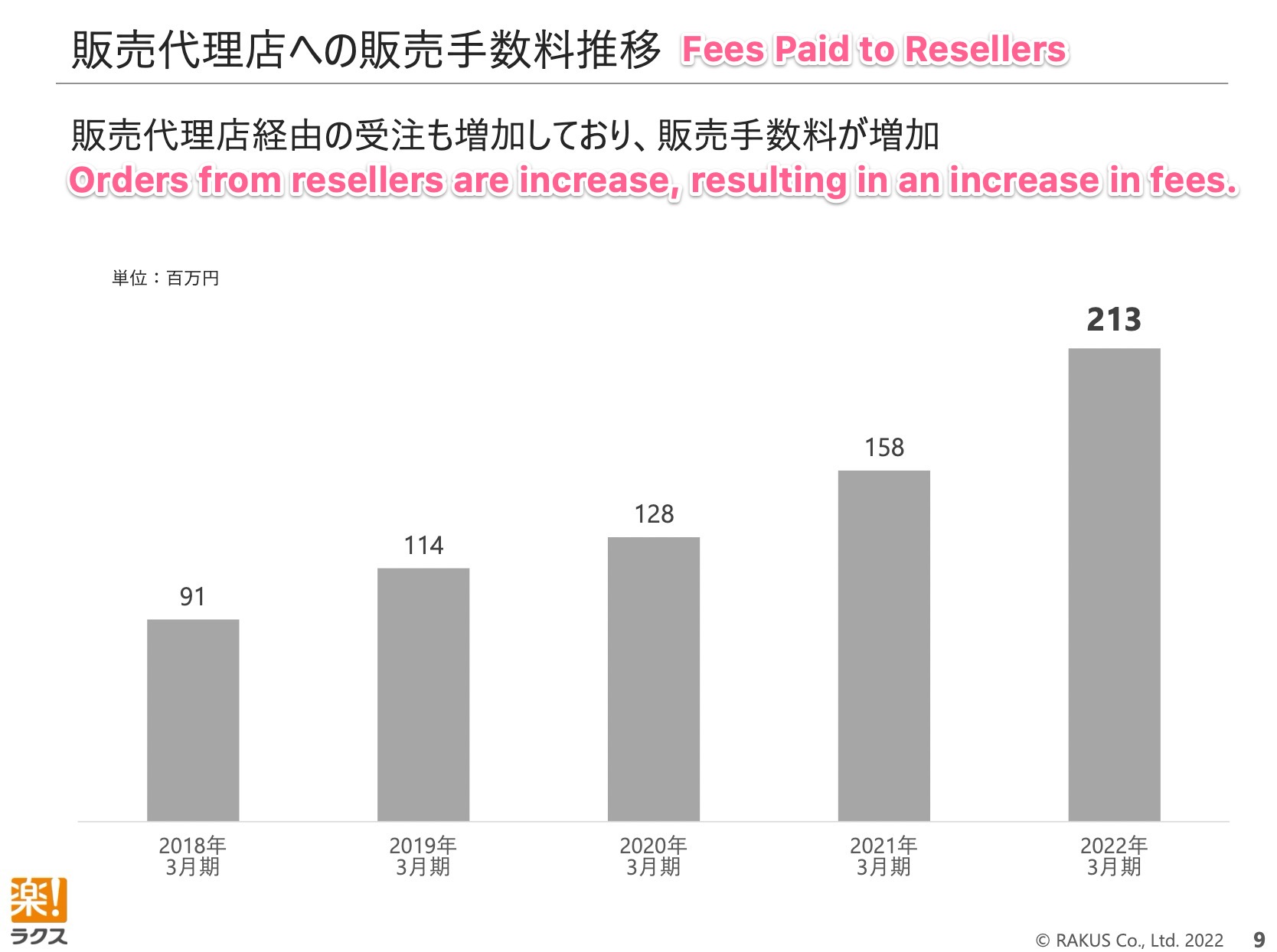 Image source: Rakus’ FY2022 Earnings Presentation
The fees paid out to resellers was 213m JPY of FY2022 of $1.78m (assuming 120 yen per dollar). The payments have increased by 234% since FY2018. Though the reseller fees are not disclosed, the fee payments give a sense of the magnitude of sales from the reseller. If we assume a 20% fee, the sales from resellers would be 1065m JPY or $8.9m.
Safie
Safie provides cloud-based security camera software. Safie also benefited greatly from partners. 43% of Safie’s revenue in FY2021 was from direct sales efforts. For Safie, partner sales are a larger portion of overall sales with 57% coming from partners.
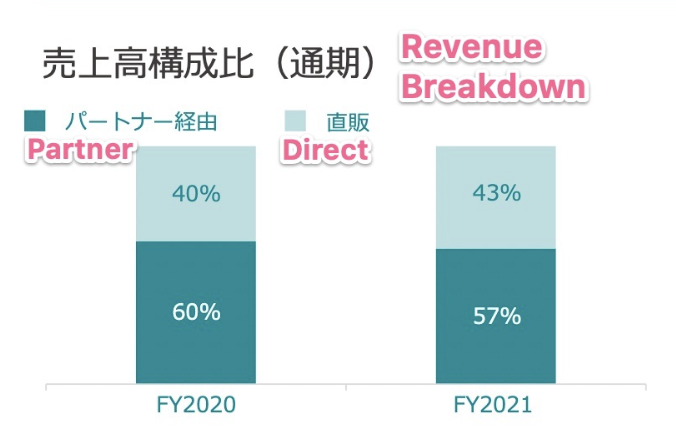
Image Source: Safie’s FY2021 Earnings Presentation
In FY2021, Safie’s overall sales were 8.4b JPY. About 4.8b JPY came from partner sales. One of Safie’s partners is SECOM, Japan’s largest security company. Though there was no data available before Safie’s partnership with SECOM, given the niche that Safie and SECOM operate in, this partnership likely played a big role in Safie’s growth.
Cybozu
Cybozu offers a suite of SaaS products including a no-code app builder (Kintone). For Cybozu, partners have been an integral part of their growth.
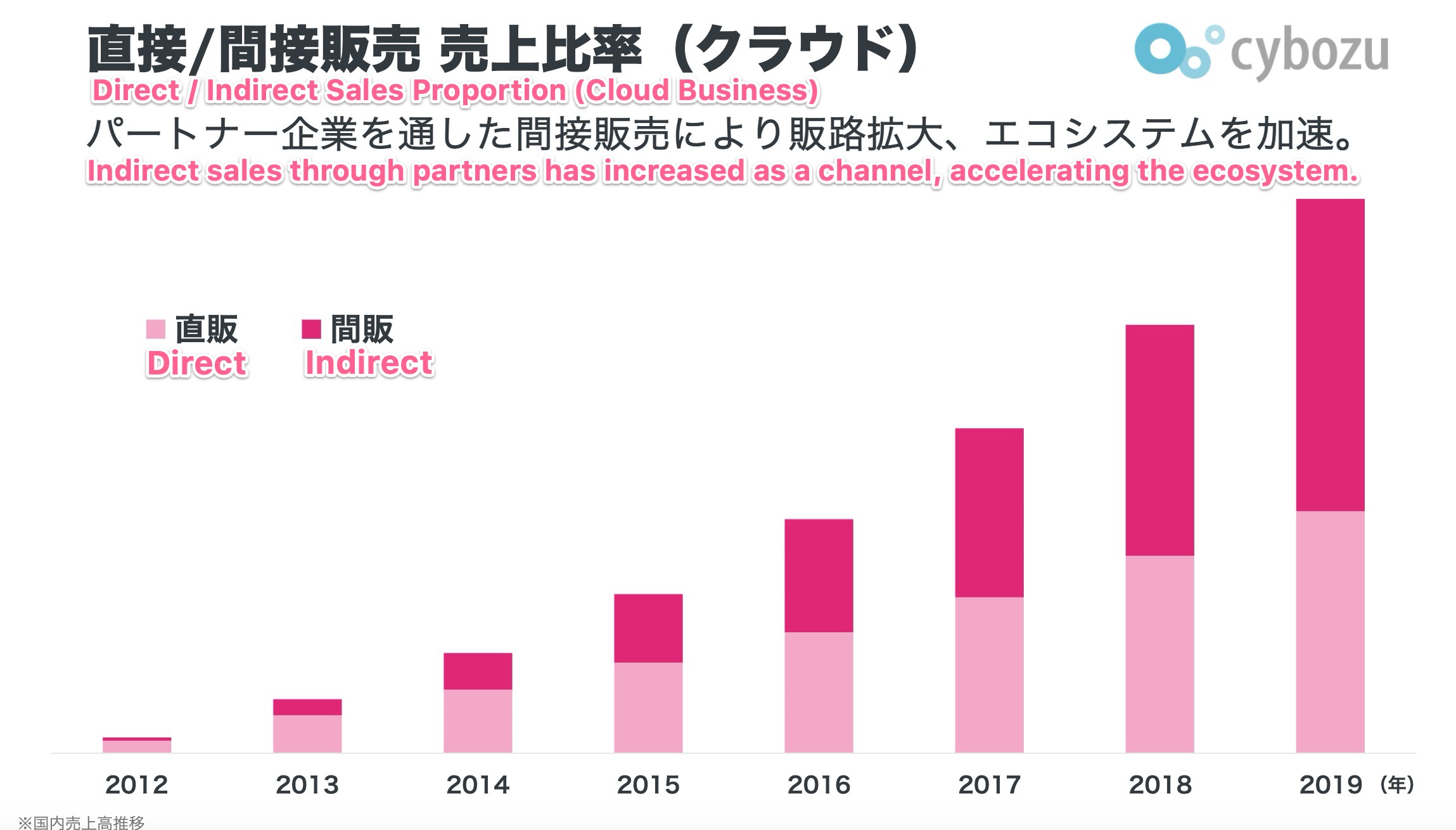 Image Source: Cybozu’s FY2019 Earnings Presentation
Initially, direct sales were a larger proportion of their sales, but in 2017, partner sales became an equal source of revenue. After 2017, partner sales eclipsed direct sales as a sales channel. This trend continued for Cybozu and, as of FY2023, partner sales compromised 62.9%.
 Image Source: Cybozu’s FY2023 Earnings Presentation
Though partner sales have proven to be a strong channel for Cybozu, a ton of work goes into building such a robust channel and ecosystem. Cybozu has roughly 450 partners and over 350 integrations. The robust revenue from partners is a result of building out an ecosystem of partners and creating the integrations. From partners, Cybozu generated 8.4b JPY ($56m assuming 150 JPY per USD exchange rate) in 2023. On average, each partner generated 18.7m JPY (roughly $125k).
AI Inside
AI Inside offers a suite of products that helps companies accelerate digital transformation (DX). AI Inside launched a partner program in December 2017. Since then, they have brought on over a hundred partners and partner sales comprise a significant portion of their sales.
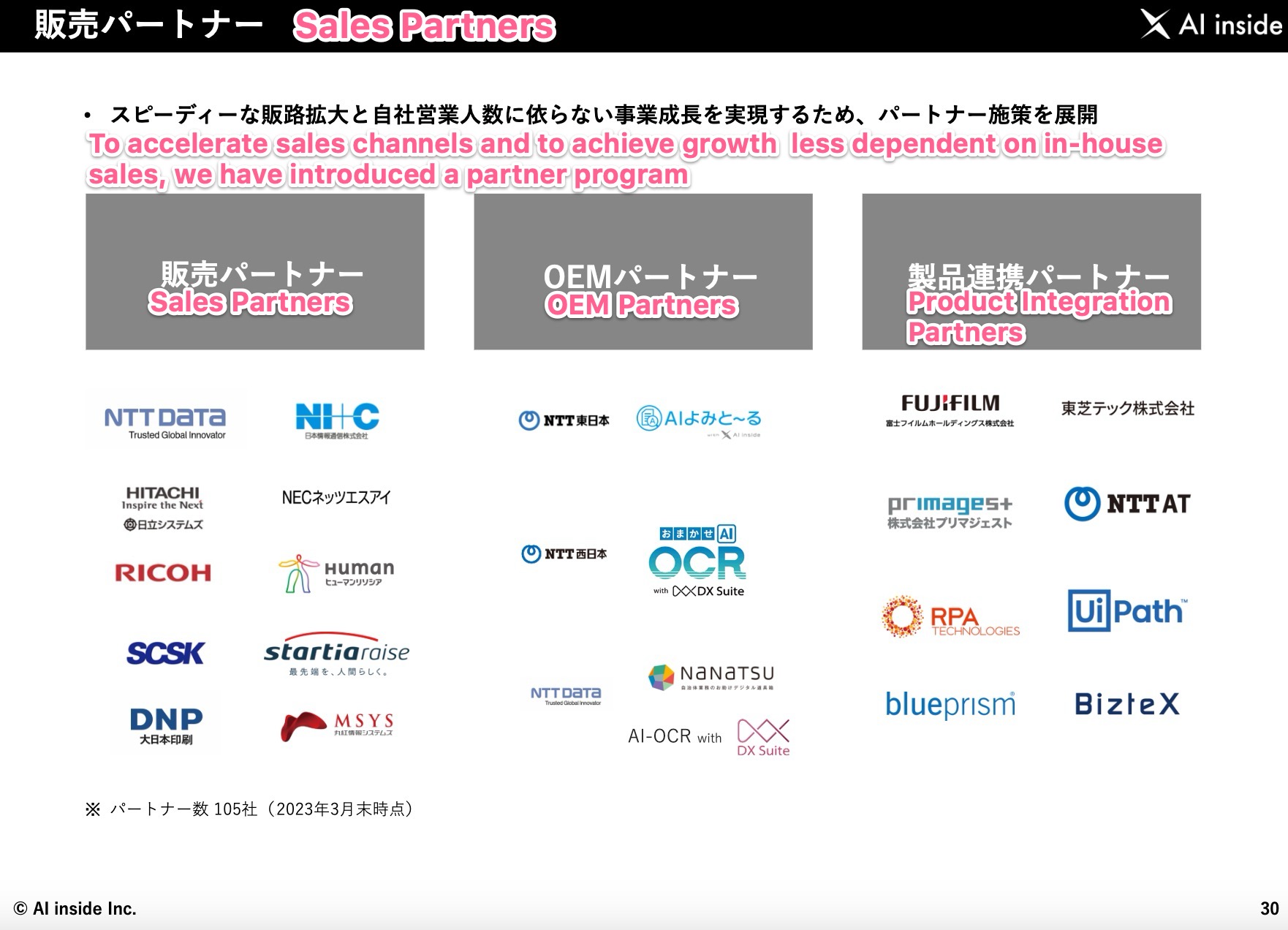 Image Source: AI Inside’s FY2021 Earnings Presentation
The partner sales strategy has proven to be a success for AI Inside. In FY2023, partner sales were 34.9% of their total sales. Direct sales were still the leading channel at 46%.

Image Source: AI Inside’s FY2023 Earnings Presentation
AI Inside expected that the partner channel would provide access to more enterprises. In FY2021, it expected that the Average Contract Value (ACV) would increase by 47% due to its partner sales program.
 Image Source: AI Inside’s FY2021 Earnings Presentation
Takeaways
1. Working with partners, resellers, and distributors can be highly rewarding and should not be ignored as a sales channel. For some companies, the partner channel becomes larger than direct sales.
2. Initially, direct sales are necessary. Having product market fit is required to bring on resellers, partners, and distributors to show that there’s value in the partnership. Successful direct sales leads to successfully bringing on partnerships.
3.Partner programs shouldn’t be taken lightly. The most successful programs have 100+ partners and a dedicated partner sales team. Both Cybozu and AI Inside have 100+ partners that they work with.
4. Partner sales is also more than bringing on new partners. At a certain level, it becomes building an ecosystem. Part of Cybozu’s success comes from building 350+ integrations.
5. Partner strategies are not one-size-fits-all. For Safie, being in the security space, partnering with the largest security company in Japan is a match made in heaven. Understanding who would be impactful partners is important and will help create a win-win situation.
Conclusion
Working with partners, resellers, and distributors is not unique to Japan, but there’s a higher dependence on these channels in Japan. Partners, resellers, and distributors have access to companies that need new technology but may not know where to look (especially common with SMEs in Japan). Working through the Japanese sales landscape requires local expertise not only to support growth through direct sales but also to bring on and manage the relationship with partners. Many engagements with resellers, distributors, and partners end up stalling with very little results. To ensure the best results, it’s important to create a win-win relationship. Nihonium has successfully built relationships with partners, resellers, and distributors. If selling in Japan is of interest, book a consultation here.
 English
  Japanese