

Social Media Platforms in Japan (2024)
Introduction
Social media is becoming a more integral part of digital marketing and a valuable channel to increase awareness and to acquire new customers. Increasing brand awareness on social media platforms is becoming an integral part of marketing and go-to-market strategies and adds a layer of robustness to SEO and SEM strategies. Each platform has a unique audience using the right platform is imperative to effectively reach the specific audience. Some platforms have similarities to their global user base, while other platforms have a Japan-specific use case. Nonetheless, social media is an important channel for GTM in Japan.
Social Media Platform Stats
X (Twitter)
Japan has the second largest X (Twitter) users in the world. X (Twitter) has 66.5 million Monthy Active Users (MAUs) in Japan, only lagging the United States at 106.2 million users.
It’s common for a single user to create multiple accounts (often staying anonymous) using them for different social situations. X (Twitter) is also quite versatile in how users engage the platform. Users may use it purely socially and casually, but some users derive business insights from X (Twitter). The platform is commonly used to find honest reviews of products. It’s also quite common to use X (Twitter) as a business channel since LinkedIn penetration is very low in Japan.
Though Facebook isn’t the most popular among younger generations, it is frequently used for maintaining business connections. Facebook has 26 million MAUs with many business users using the platform as a casual alternative to LinkedIn. You’ll commonly see business-related and personal posts coming from the same account. The largest cohort of users are in their 30s, 40s, and 50s.
LinkedIn is not a common platform that the average Japanese person uses with only 3 million MAUs. Though LinkedIn is ubiquitous for businesses in other countries, its reach is much smaller in Japan. LinkedIn is primarily used by people who have more than 5 years of work experience (84% of the users) and have some involvement with international businesses.
Instagram has 66 million MAUs. The platform has younger users, primarily in their teens and 20’s. Instagram is the original platform for influencer marketing. Instagram ads have a high viewership in Japan with 60% of users saying that they don’t mind the the ads.
The strong versatility of content with posts, reels, and stories makes it a great platform to portray a story and, ultimately, to build a brand. The platform also makes it easy for users to make purchases.
TikTok
Similar to Instagram, TikTok has a younger audience, primarily in their teens and 20s, with 27 million MAUs. Short-form videos are picking up as a preferred method of consuming content. TikTok (and Instagram) are not being used as alternatives to Google for search. TikTok is a great platform to reach younger audiences, but companies acquiring customers on TikTok need to understand that TikTok may be regulated in the future.
Youtube
YouTube has 70 million MAUs. Though YouTube may not be considered a traditional social media platform, it has an amazing reach spanning all age ranges. More companies are starting to advertise through short videos.
 Line
Line
It feels a little weird to include Line on this list as it’s more of a super app/messaging app, Line has the most MAUs of all social media platforms. Line has 96 million MAU. While Line has social media-like products, the app is primarily used for messaging. Line is best used for directly reaching the audience.
There’s a lot of opportunity marketing with Line. Companies will trade stamps in exchange for their contact information (adding end users to a marking drip campaign). It’s common to see restaurants provide a free dish, drink, or coupon in exchange for their Line contact. Some restaurants will go as far as requiring their Line information to access their menu by having the consumer order through the Line-enabled point-of-sales system.
Summary
Each platform has its unique user base in Japan. Depending on the audience, the effective platform is different:
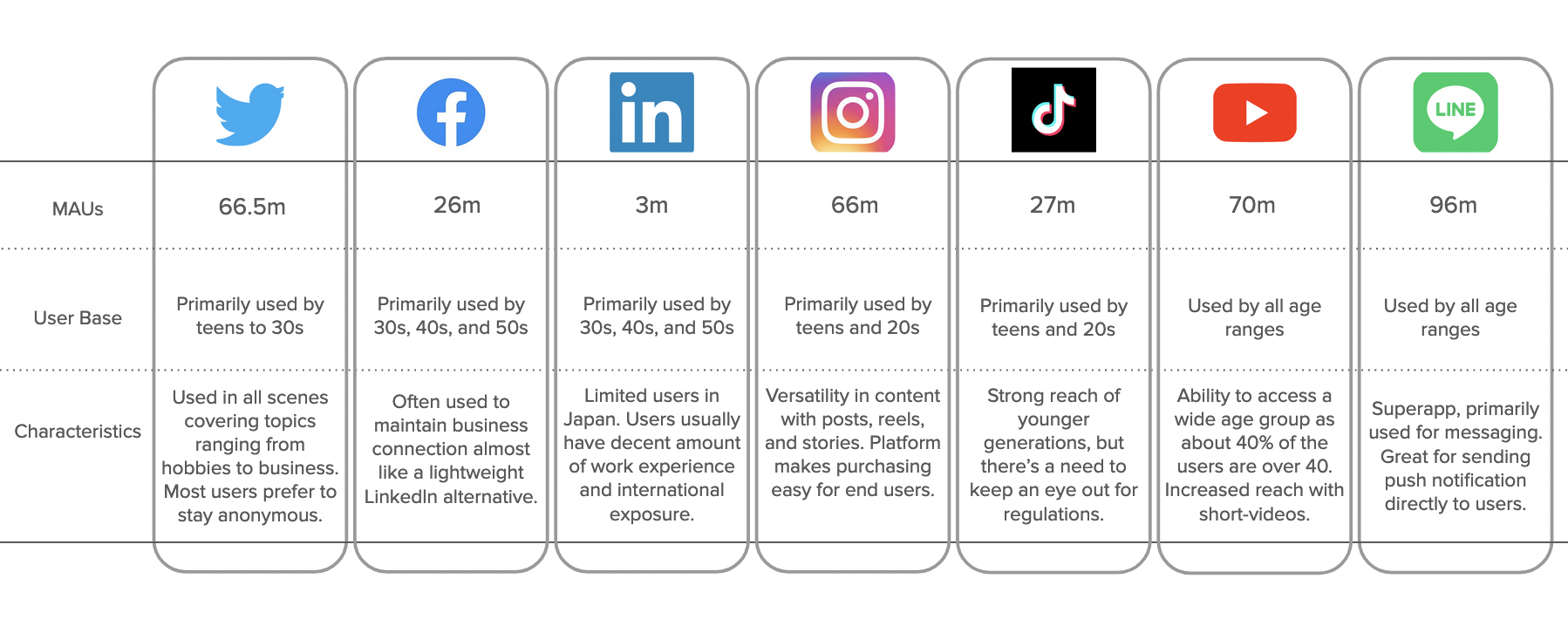 Marketing on Social Media Platforms
Marketing on social media is now quite important. Gaining the trust of the buyers is imperative to success in Japan and being active on social media is one way of showing that you’re active in the Japanese market.
Identifying the right social media channels is important to effectively reach the right audience. X (Twitter) has a wide reach but the audience may not be as targeted. X (Twitter) is great for building overall awareness, as it’s the platform with the most MAUs. Narrowing your target is particularly important for X (Twitter) to access the right people among the large user base. Twitter can yield positive results for both B2C and B2C companies, as long as the target is highly defined and narrowed down. Social media platforms are now doubling as search engines, so it’s also important to understand the local search engine market and how they may intertwine with social media.
B2B Buyer’s Social Media Platform
SiteEngine, a digital marketing agency in Japan, conducted a survey on the buying patterns of B2B businesses. Though the sample size is quite small (n=48), the results showed that X (Twitter), Instagram, and Facebook are most commonly used to research potential solutions/purchases. X (Twitter) has a ton of useful information and honest reviews. Since LinkedIn isn’t as common in Japan, users frequently share business-related best practices on X (Twitter).

Though LinkedIn has a small user base, the platform is highly targeted to business users and can yield positive results for B2B marketing.
Social Media Platforms for B2C
Though potential B2B buyers use Instagram for research, the platform is more commonly used for B2C. The versatile content sharing enables brands to build awareness. Especially for Instagram, influencer marketing is a common tactic to increase brand awareness. Consumer goods including, fashion, cosmetics, and food tend to perform well on Instagram.
Though YouTube plays a role in the B2B space, it’s also actively used in B2C marketing. YouTube is unique in the sense that people of all ranges are on the platform. Ads using short-form videos are becoming more ubiquitous. It’s also common to see companies partner with YouTubers.
Lastly, Line is great for directly reaching the audience with direct messaging. It’s common to see companies send messages highlighting specific campaigns or discounts.
Conclusion
Social media marketing is becoming ubiquitous in building a presence in Japan. Whether the presence comes from the company or a specific thought leader within the company having a presence is important. This shows that the company is active in the Japanese market. Social media also provides reach to certain audiences that may not access other channels. Social media users are casually consuming content. There may be less intent on these channels, but they are great in increasing awareness with their unique audiences. If you’re interested in implementing social media marketing as part of your go-to-market, book a free consultation here.
 English
  Japanese