

Introduction
Online marketing is a great way to acquire leads. The Online marketing space in Japan is similar to most markets. The Japanese Online marketing market is relatively small compared to the US. The relatively smaller market can be both a positive and a negative.
Online Marketing Market Size
Online marketing consists of paid advertisements through search and display networks. This could also include short-form videos on streaming and social media channels. Affiliate marketing may also be considered as part of digital marketing.
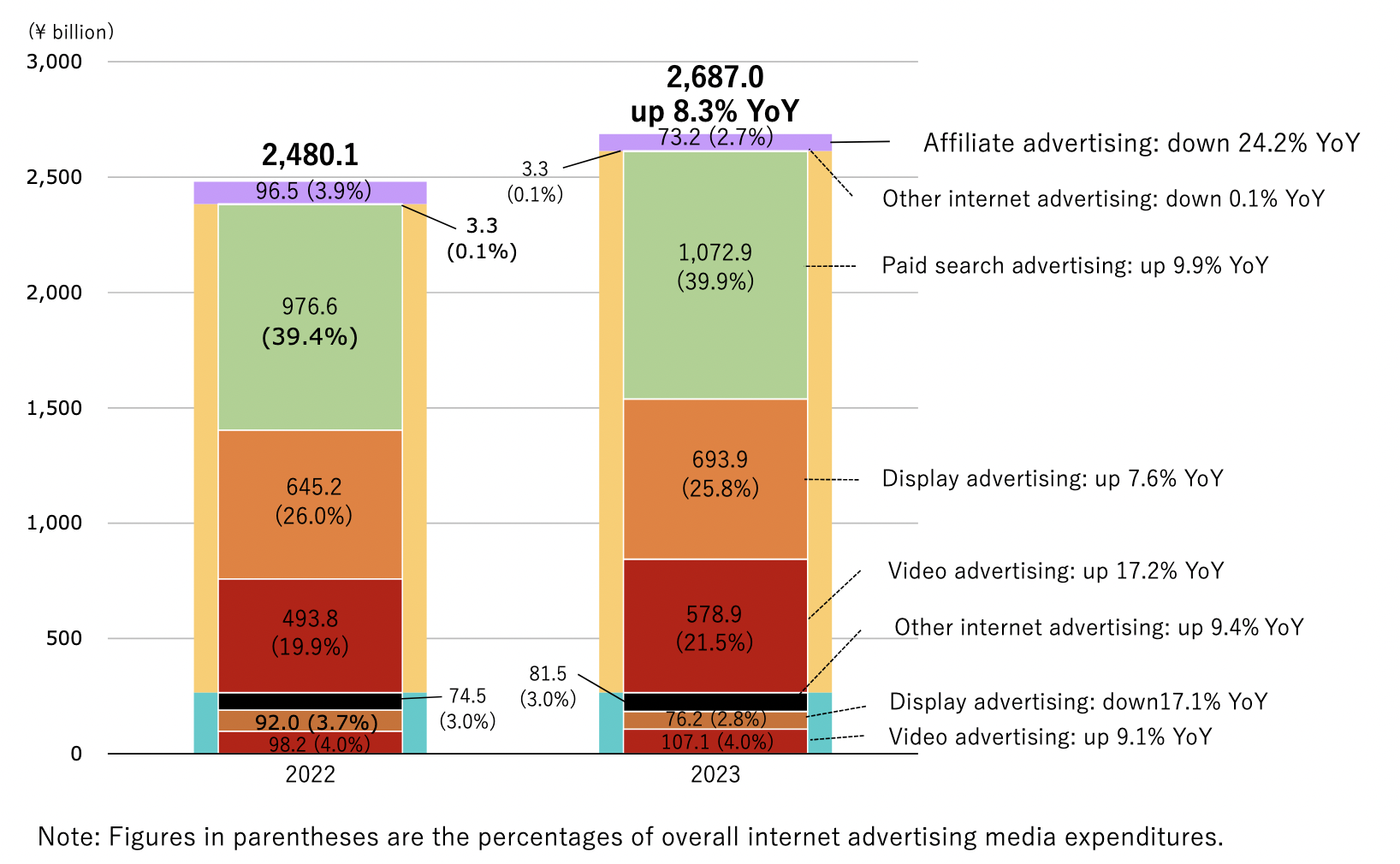
In a joint report by a few Japanese marketing agencies, including Dentsu, the overall market size in 2023 in Japan was reported at 2,687.0b JPY, up 8.3% from 2,480.1b JPY in 2022. This translates to a $18.5b market in 2023 and $17.1b in 2022, assuming a 145 dollar to yen exchange rate.
 The majority of online advertisements are performance-based. In 2023, the US online marketing market was over 10 times larger than the Japanese market at $225b.
 Pros and Cons of Search Ads in Japan
The Japanese market is much smaller, which can be both advantageous and disadvantageous.
Pro: Less Competition and Lower Costs
Since the online advertising market is not as crowded, the bidding process is not as intense. As a result, according to WordStream, the average cost-per-click in Japan is 47% less than in the US. The lower cost can be advantageous when calculating ROI. This does make a big assumption that conversion rates are the same in Japan and the US.
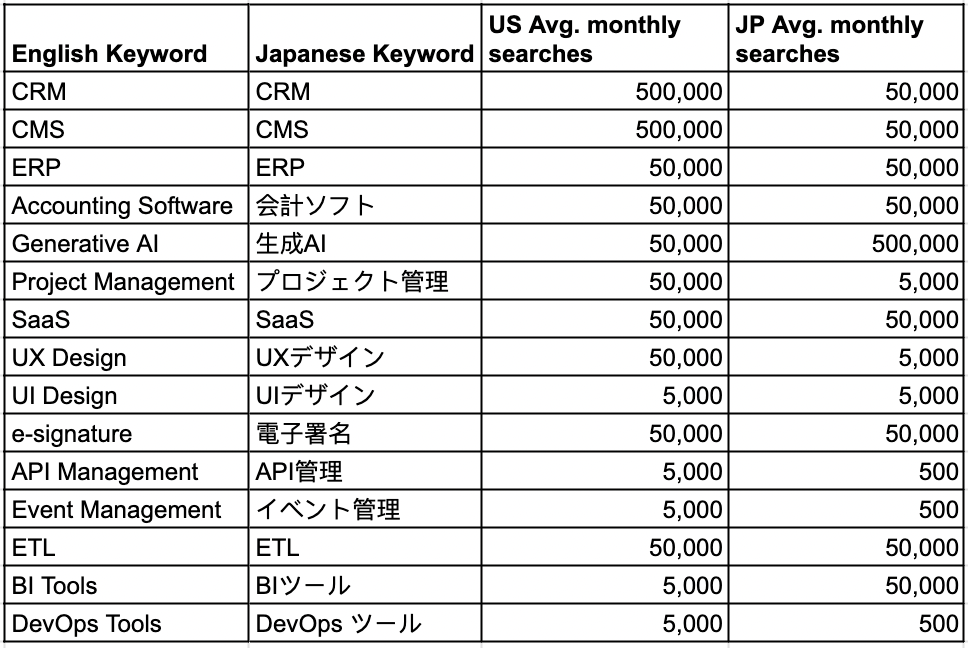
 You can see in the chart below the difference in costs for Japanese keywords and US keywords. The Japanese keywords are set in Japan and the US keywords are set in the US.
Con: Lower Search Volume
The disadvantage of search ads in Japan is the limited search. Depending on the keyword, you can saturate the market pretty quickly. The traffic is significantly smaller in Japan than it is in the US for most keywords.
 Evolving Mediums
The overall online advertising market is growing and is expected to continue to grow. Within the growth, there are some changes in trends.
The first is that the affiliate marketing channel is decreasing in size. On the other hand, search ads are growing. The most growth was seen within the video advertising within the performance marketing channel at 17.2% growth. This trend will likely continue as the medium of consuming content is changing. More video ads can be expected as more short-form video content is consumed.
 Choosing the Right Platforms
Choosing the right platform is important in any digital marketing strategy. Depending on your audience, the platform to run ads on may change, as social media platforms in Japan have different characteristics. Understanding these characteristics is important for successful campaigns. B2B and B2C will likely market on different platforms. These nuances should help in deciding the right platforms to run ads.
The cost-per-click tends to be lower in Japan but, in exchange, the traffic will be lower. It’s best to run ads on multiple platforms to take advantage of the lower costs and offset the limited traffic on each platform. It’s also important to combine SEO and SEM initiatives for the best outcomes.
Conclusion
The Japanese online advertising market is much smaller in Japan than it is in the US. This comes with both advantages and disadvantages. To make the most out of online marketing in Japan, it’s best to run ads on multiple channels to take advantage of the lower costs. If you’re considering putting an online marketing strategy and would like to consult local experts, book a call here.
 English
  Japanese