

SMEs Key to SaaS Adoption in Japan
Introduction
Small and Medium Enterprises (SMEs) make up 99.7% of all companies and employ 69.7% of the workforce. SMEs in Japan are a majority both in terms of number of companies and the number of they employ. Despite being the biggest portion of the Japanese economy, they are the most behind on IT and SaaS adoption.
SME Mindset on Technology
In the 2018 version of the “White Paper on Small and Medium Enterprises in Japan,” The National Association of Small and Medium Enterprise Promotion Organizations summarized that SMEs in Japan’s lack of IT adoption is a mindset issue:
“When SMEs are asked about specific issues in introducing IT, many say they do not see the benefits, or they cannot bear the cost of introducing IT. Based on this awareness… it is important for local IT makers and sales companies to encourage SMEs who they regularly work with, to introduce IT.”
The upfront costs of implementing new technologies are preventing IT adoption, even though there is a clear positive ROI. The lack of adoption is one reason SMEs are lagging in productivity compared to large corporations in Japan. Once SMEs realize the importance of adopting new technologies, IT providers will be especially important, as they are an important source of information for SMEs and provide as much as 43% of cloud solutions
SMEs Lagging in Productivity
Despite being the largest proportion of companies and the largest employers, SMEs are lagging in productivity compared to large corporations. The productivity of SME employees is at around 42% of large corporations.
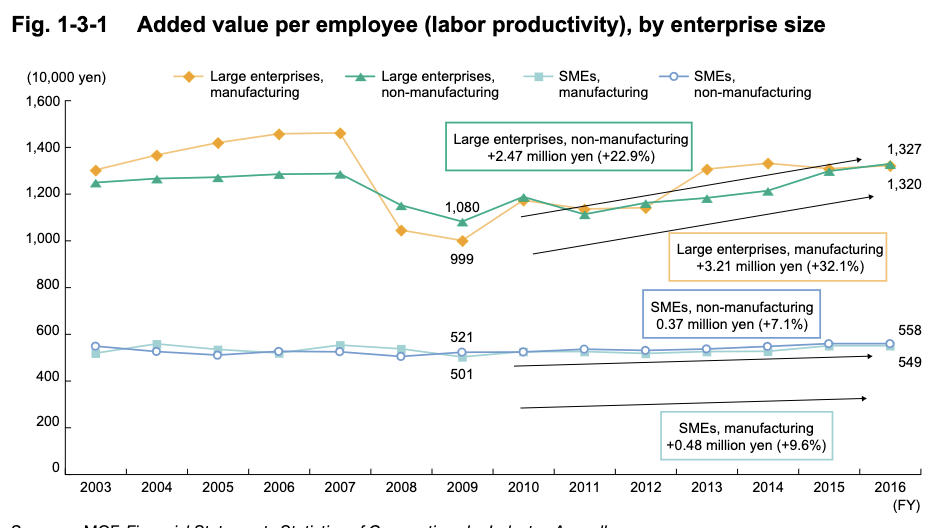 Source: White Paper on Small and Medium Enterprises in Japan
One reason for the underperformance is the limited technology available to SME employees. The mindset resisting the adoption of technology manifests itself in a serious gap in productivity.
Digital Transformation Dedicated Teams
The 2023 version “DX Whitepaper” created by the Information-technology Promotion Agency (IPA) shows that SMEs in Japan do not have dedicated departments or teams dedicated to DX. About 60% of companies with under 100 employees do not have a department or team dedicated to digital transformation. For companies with 101 to 300 employees, this number decreases to 30.7%, which is a huge improvement.
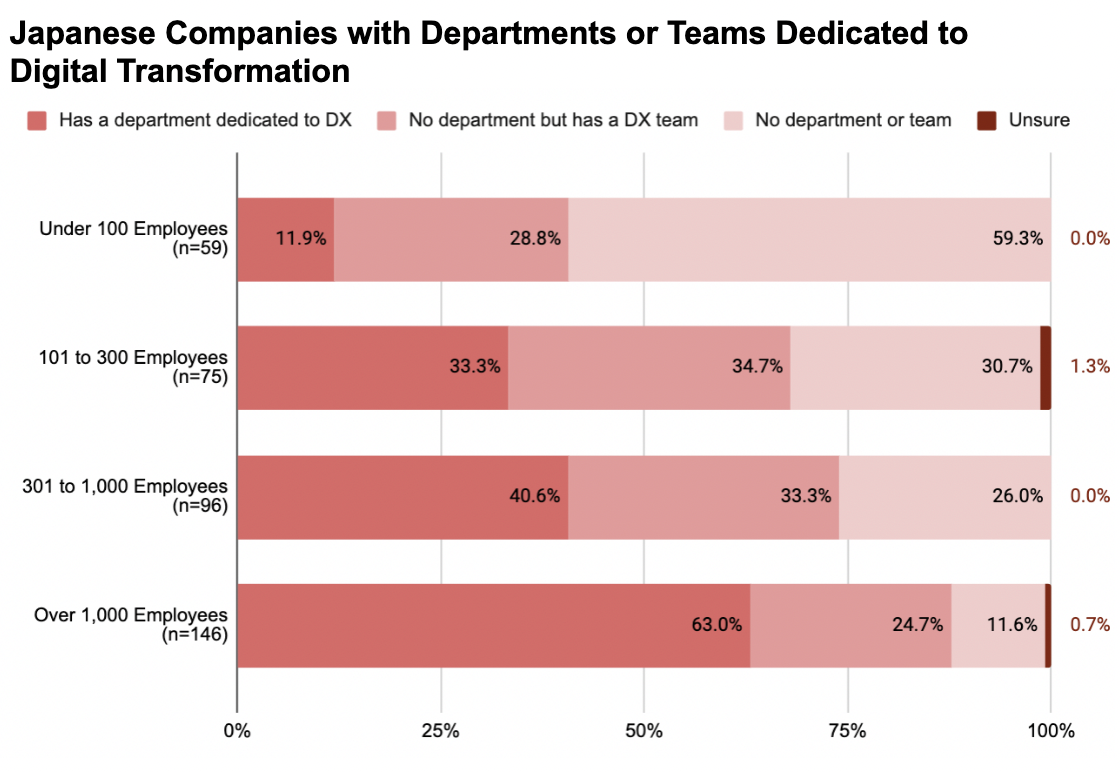 That being said, these numbers are significantly lower in the US. For companies under 100 employees, only 8.6% of the companies don’t have a department or team dedicated to digital transformation.
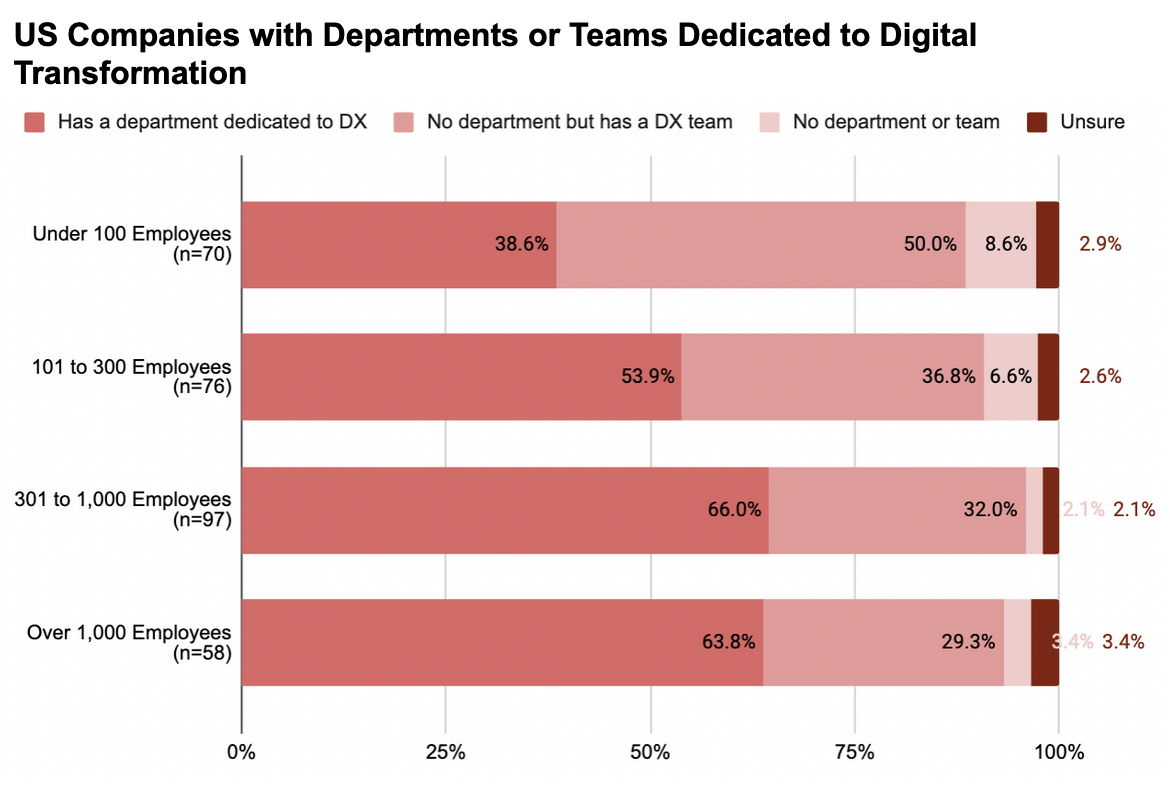 The level of digital transformation for SMEs in Japan is nowhere near the US. Given that the majority of the companies in Japan are SMEs, the key to further IT and SaaS adoption lies with SMEs. There are a few forcing functions that may drive further IT adoption by SMEs.
Catalysts to Drive IT Adoption by SMEs
The two forcing functions that may drive SMEs to increase IT adoption are labor shortages and increasing interest rates.
Labor shortages have been a large topic for Japan. With an aging population and declining birthrates, Japan has a looming labor shortage problem. The “2030 Problem” is widely discussed in Japan — In 2030, about a third of the Japanese population will be considered elderly (65 or above). DX is one of the main solutions to combat this problem by making each individual employee more impactful and productive.
The second catalyst is the recent increase in interest rates. This will increase the interest payments that the SMEs need to make. SMEs will have to somehow offset this increased payment. This may motivate SMEs to search for increased productivity, and by extension may adopt software at an accelerated rate.
Conclusion
SMEs are lagging large corporations in DX and IT adoption. That being said, SMEs have a serious urgency to adopt new technologies. Once SMEs start picking up SaaS tools, the adoption rates may explode! SaaS in Japan is still a blue ocean. Global SaaS companies have the opportunity to position themselves as a potential solution now, as SaaS adoption is likely to pick up in the coming years.
 English
  Japanese