
When expanding into Japan’s SaaS market, the right local partner can make or break your success. Japan’s business landscape is relationship-driven, with long sales cycles, high buyer scrutiny, and a preference for localized support. To avoid pitfalls, assess potential partners thoroughly. Key areas to focus on include:
- Alignment: Does the partner share your goals and understand your product’s target audience?
- Sales Capability: Can they generate leads, navigate Japan’s consensus-driven decision-making, and close deals?
- Localization: Do they have expertise in localizing SaaS products for Japan’s language, user preferences, and compliance laws?
- Compliance: Are they knowledgeable about data protection laws like APPI and industry-specific regulations?
- Communication: Can they manage cultural nuances, ensure transparency, and resolve conflicts effectively?
A structured evaluation using clear questions and scoring criteria helps identify the best fit. By focusing on these areas, you can build a partnership that supports a successful market entry in Japan.
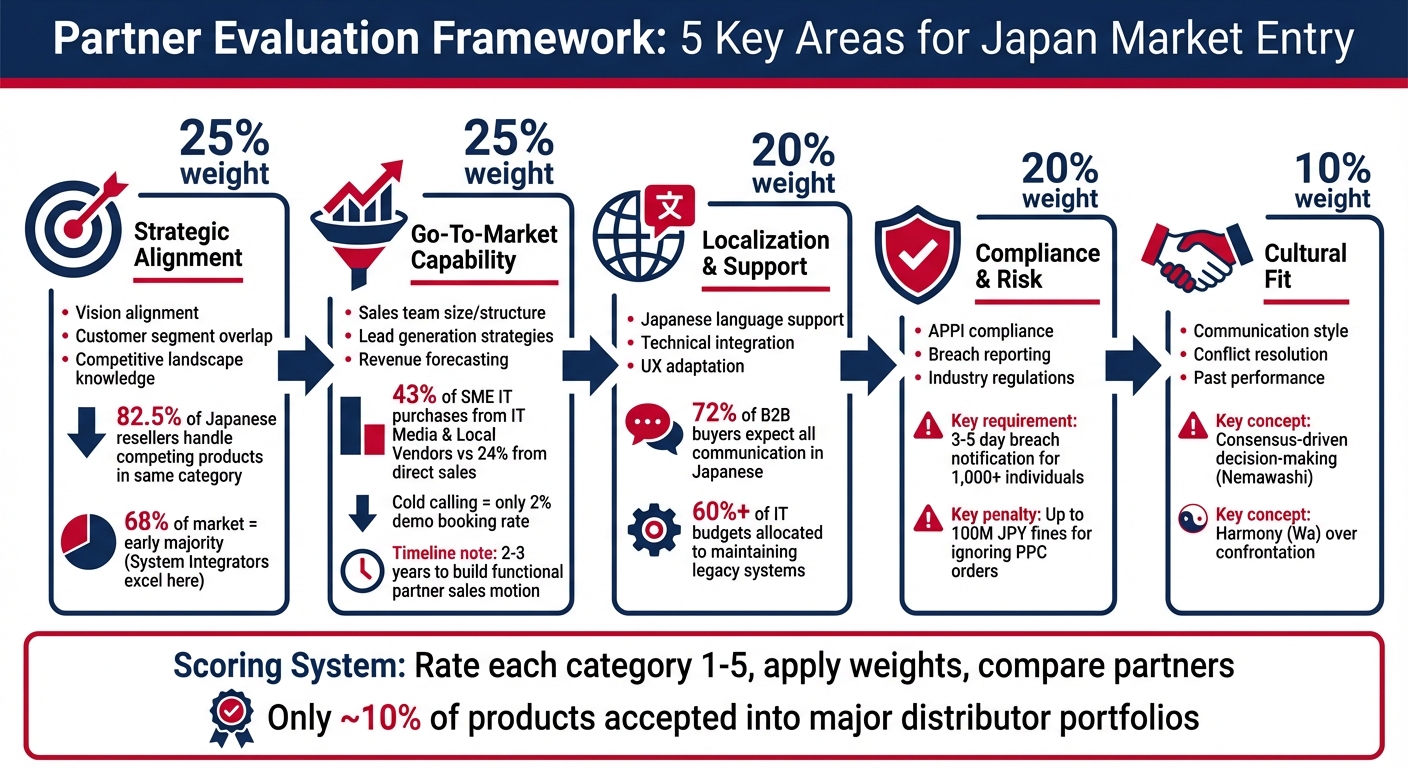
5-Step Framework for Evaluating Japan SaaS Partners
Questions About Strategic Alignment
It’s crucial to ensure your partner shares your vision for the Japanese market – any misalignment can derail your efforts. For instance, high-ACV platforms thrive with System Integrators who bring technical expertise and strong enterprise connections. On the other hand, transactional, lower-ACV solutions often perform better through resellers or digital marketplaces. Choosing the wrong channel can waste months chasing customers who are unlikely to convert.
Partner Vision and Market Focus
Ask: "What is your vision for the Japanese SaaS market, and how does it align with our business goals and long-term strategy?" This question helps you assess whether your partner truly understands your product category and identifies growth opportunities. Go beyond surface-level answers by digging into their geographic coverage. For example, how do they navigate keiretsu networks in Kansai or Chubu, where vendor selection heavily depends on relationship capital? A partner focused solely on Tokyo could miss out on enterprise opportunities in these regions, where business dynamics differ significantly.
It’s also important to clarify their role – whether they act as a reseller, integrator, or consulting partner. Each brings unique strengths. System Integrators are particularly effective at helping products transition from early adopters to the early majority, a segment that makes up about 68% of the Japanese market. If your solution requires customization or integration with enterprise systems, you’ll need a partner with the technical expertise to manage these complexities. Conversely, if your focus is on SMBs with a self-service model, a high-volume reseller or marketplace partner would be more suitable.
Customer Profile and Use Cases
Ask: "Which customer segments and use cases do you specialize in, and how do they overlap with our target audience and product offerings?" The Japanese market is sharply divided. Large enterprises often rely on trusted gatekeepers like System Integrators, while SMBs lean toward agile direct or digital channels. Your partner should demonstrate a proven track record with your target audience and provide concrete examples of their success.
Another key consideration is how your solution fits into their existing portfolio. Here’s a telling statistic: 82.5% of Japanese resellers handle competing products in the same category, and 44% manage between two and five competitors. This means your product will likely be positioned alongside alternatives. Ask how they see your solution complementing their current offerings rather than competing with them. Partners tend to favor products that enhance their revenue potential without creating internal conflicts. Also, confirm they only collaborate with companies that have established Product-Market Fit (PMF) in Japan, as their incentives are tied to commission and revenue share.
Competitive Landscape Knowledge
Another critical question to ask: "How well do you understand the competitive landscape in Japan, and what strategies would you recommend to differentiate our SaaS product in this market?" Japanese buyers are known for their thorough evaluations, including detailed security assessments, product demonstrations, and proof-of-concept tests. A knowledgeable partner should be able to outline common buyer objections and provide insights into competitor positioning.
Regional dynamics also play a role. For example, domestic telco platforms like NTT and SoftBank are often favored by established enterprises for their integrated billing and local support. Meanwhile, global marketplaces like AWS tend to attract internationally oriented firms and SMBs. Partners who understand these nuances can help you navigate the market effectively.
"Overseas vendors without strong localization or dedicated Japanese-language support quickly lose competitive advantage." – Yuga Koda, Nihonium
Finally, ask how they plan to leverage your "foreignness" as a strategic advantage. A strong partner will know how to position your global expertise as a unique selling point while ensuring localized support to meet Japanese expectations. Striking this balance can help you stand out without triggering the risk-averse tendencies that many foreign vendors encounter in Japan. These insights will serve as a foundation for evaluating your B2B SaaS sales strategy in the next stage.
sbb-itb-a752276
Questions About Go-To-Market and Pipeline Building
Once you’ve ensured strategic alignment, it’s time to dig deeper into your partner’s ability to drive revenue and build a strong sales pipeline. This is often where partnerships can falter – your partner might understand your market positioning perfectly but lack the resources or infrastructure to turn that insight into actual deals. In Japan, this challenge is particularly pronounced due to unique factors like lead generation strategies and the slower, consensus-driven sales cycles typical of B2B transactions.
Sales Team and Coverage
Ask: "What is the size and structure of your sales team, and how do they cover different industries and regions across Japan?" If your partner has only a handful of salespeople juggling multiple vendors, your solution may end up on the back burner. Compounding this, 82.5% of Japanese resellers manage competing products within the same category. This means your product will be vying for attention within their portfolio, making it essential to understand how they allocate resources and what incentives could keep your solution top-of-mind.
Regional coverage is another critical factor, often underestimated by foreign vendors. While Tokyo is the primary hub, regions like Kansai and Chubu hold lucrative enterprise opportunities, often tied to keiretsu networks where relationships are key. A partner with a narrow focus on Tokyo could miss out on these opportunities. Ask for examples of deals closed outside Tokyo and how they maintain relationships with decision-makers in other regions. This insight will also reveal how well their team is positioned to execute lead generation strategies.
Lead Generation and Marketing
Ask: "How does your team plan to generate and nurture leads specifically within the Japanese market, and what strategies have worked for you in the past?" In Japan, 43% of IT purchases by SMEs come from "IT-related Media" and "Local IT Vendors", while only 24% stem from direct sales. This highlights the importance of a partner with a multi-channel approach that blends digital outreach with relationship-driven tactics.
Successful lead generation in Japan often involves SEO/SEM, webinars, and localized case studies. But the execution details are where it gets tricky. For instance, Japanese buyers often rely on the ringisho process for internal consensus-building, which means calls-to-action like "Download Documents" are more effective than "Free Trial". Ask your partner how they’ve adapted their lead nurturing strategies to accommodate this decision-making process, and request examples of campaigns that successfully navigated these extended evaluation cycles.
Budget expectations are another critical point. Will your partner co-invest in joint campaigns, or will they expect you to shoulder all the costs? Clarifying this upfront avoids financial misalignment later. Keep in mind that cold calling has a low success rate in Japan – just 2% for booking demos. If your partner relies heavily on outbound tactics without a solid digital or content strategy, they may struggle to deliver results. A well-thought-out lead generation plan should naturally tie into realistic revenue expectations.
Revenue Targets and Forecasting
Ask: "Can you share your approach to setting and achieving revenue targets in Japan, including how you forecast sales and adapt to market changes?" Once pipeline strategies are in place, it’s crucial to evaluate how these efforts translate into tangible revenue. A strong partner should be able to outline specific revenue goals and explain their forecasting process. Discuss their revenue targets, methods for tracking key metrics like MRR, ARR, churn rate, and NRR, and how they adapt to market shifts. If they can’t provide clear projections or detailed metrics, it could signal a lack of capability.
It’s also important to clarify commercial terms and understand how they plan for different revenue scenarios – whether aggressive, conservative, or worst-case. Given that most resellers handle competing products, your financial incentives must be competitive enough to ensure your solution gets the priority it deserves. Be cautious of partners who offer overly optimistic projections without considering potential market fluctuations.
Finally, align on timeline expectations. Building a fully functional partner sales motion in Japan typically takes 2 to 3 years. Be wary of partners promising quick wins. Ask about their 30/60/90-day milestones for technical certification and sales readiness. How do they measure effectiveness through deal registration and pipeline tracking? These details will reveal whether they have a structured, methodical approach or are simply improvising.
Questions About Operations and Compliance
Once you’ve set your pipeline and revenue goals, the next step is to ensure your partner has the operational capacity and compliance knowledge to support your product in Japan. Even if a partner excels at sales, they might lack the technical expertise to implement your SaaS solution or fail to meet critical compliance requirements – both of which could derail your market entry.
Technical Implementation and Support
Ask: "What technical support capabilities do you offer, including Japanese-language support, integration, and maintenance?"
In Japan, 72% of B2B buyers expect all communication to be conducted in Japanese. This means your partner’s support team must not only be fluent in the language but also skilled in proper business etiquette and honorifics (Keigo) to meet the professionalism expected by Japanese enterprise clients .
Integration expertise is another key factor. Over 60% of IT budgets in Japanese businesses are allocated to maintaining legacy systems. Your partner should have proven experience integrating with local systems, such as ERPs, accounting platforms, and payment gateways like GMO and PayPay . Ask for examples of past integrations and how they managed technical challenges. Also, confirm whether their support team is available during Japanese business hours . Finally, assess their ability to adapt products to meet local user expectations by comparing reviews on G2 and ITReview.
Product Localization Experience
Ask: "What experience does your team have with localizing SaaS products for the Japanese market, including language, cultural nuances, and user experience adjustments?"
Localization goes far beyond simple translation. Japanese uses three character sets – Kanji, Hiragana, and Katakana – and follows a Subject-Object-Verb sentence structure, which is significantly different from English. Additionally, text often expands vertically rather than horizontally, which can disrupt UI elements like buttons and headers designed for English layouts .
"Japanese business users… often prefer detailed menus, more granular control settings, and in-depth support documentation compared to Western users, who may prioritize minimalism and automation." – Nihonium
Japanese users tend to favor more detailed menus and granular control options, so your partner must implement localized UX adjustments and adhere to industry-standard style guides . They should also understand local payment preferences. Integrating methods like furikomi (bank transfers), PayPay, and Line Pay is essential for reducing friction during checkout . Lastly, confirm your partner’s ability to navigate Japan’s legal and regulatory landscape.
Regulatory and Legal Knowledge
Ask: "How do you ensure compliance with Japanese data protection laws, such as the Act on the Protection of Personal Information (APPI), and other SaaS-specific regulations?"
Operating in Japan requires strict adherence to local data protection laws. The APPI applies to any SaaS provider handling personal data of individuals in Japan, no matter where the provider is based . Your partner should be familiar with breach reporting requirements; for incidents affecting over 1,000 individuals, you must notify the Personal Information Protection Commission (PPC) within 3 to 5 days, followed by a detailed report within 30 to 60 days.
Ask about their experience managing cross-border data transfers and securing necessary consents. If your SaaS targets industries like healthcare, finance, or telecom, additional regulations from agencies such as the Ministry of Health, Labour and Welfare (MHLW) or the Financial Services Agency (FSA) may apply. In some cases, breach reports must be filed within hours . A partner unable to clearly explain these requirements is a red flag. Non-compliance can result in fines of up to 100 million JPY if PPC corrective orders are ignored. Ensuring every aspect of compliance is covered is non-negotiable when entering the Japanese market.
Questions About Culture and Relationship Fit
Beyond technical expertise and market knowledge, the way your partner communicates and aligns with your business values can make or break the relationship. Japanese business culture operates on principles that might be unfamiliar, so understanding how your partner navigates these norms is essential for long-term success. It’s equally important to evaluate their communication style and conflict resolution methods to ensure alignment over time.
Communication and Decision-Making
Ask: "How does your company approach communication and decision-making when working with global partners, and how do you ensure transparency and alignment with our goals?"
In Japan, communication often involves subtlety, where public statements may not fully reflect underlying intentions. This approach, rooted in maintaining harmony, may require more probing during conversations to uncover deeper concerns.
Decision-making in Japan typically follows a consensus-driven process, which can seem slower compared to Western practices. Multiple stakeholders need to agree before moving forward, but once a decision is made, execution tends to be highly coordinated and efficient. To bridge the gap, ask how your partner collaborates with U.S.-based teams across time zones and whether they provide dedicated points of contact to address cultural differences. Additionally, confirm their readiness to offer bilingual documentation for agreements, as this helps avoid misunderstandings. Clear communication is just as important as market expertise for success in Japan. It’s also worth discussing how they handle disagreements since Japanese partners often prefer to address issues privately.
Conflict Resolution and Expectations
Ask: "What strategies do you use to address and resolve conflicts or misunderstandings in business partnerships, and can you provide examples of how you’ve successfully handled such situations in the past?"
In Japanese business culture, maintaining harmony (Wa) takes precedence over short-term wins or confrontational tactics. Disagreements are often communicated indirectly; for example, a pause or a carefully worded comment might signal strong reservations rather than mere reflection.
"A statement like ‘This needs a bit more thought’ can imply strong reservations." – One Step Beyond
Explore how your partner has handled disagreements with foreign vendors in the past. Effective partners often rely on Nemawashi, a behind-the-scenes process of building consensus before formal meetings, to resolve differences and avoid public conflict. They should also explain their follow-up practices, such as sending detailed emails within 24 hours of meetings to outline action items, responsibilities, and deadlines.
References and Past Performance
Ask: "Can you share references or case studies from previous partnerships that demonstrate your ability to build long-term, culturally aligned relationships with global companies entering the Japanese market?"
References can provide insights into how well your partner bridges cultural gaps. Request examples that highlight their experience with foreign SaaS vendors, as Japanese buyers are often cautious and may worry that overseas companies will exit the market if targets aren’t met quickly. A strong partner will likely have case studies showcasing collaborations with recognizable Japanese brands, which can provide the reassurance needed for Japanese committees to approve new vendors.
Focus on partners who have worked with companies at a similar stage and scale. For instance, in 2018, New Relic – then generating over $400 million in annual global revenue – teamed up with a local expert to form a joint venture, using local insights to scale effectively. Similarly, in July 2020, Braze partnered with a local firm after surpassing $100 million in global revenue, leveraging the collaboration to establish a foothold in the market before its IPO. Request at least two or three references you can contact directly, and ask about their experiences with response times, problem-solving approaches, and whether the partner delivered on commitments. Be cautious of partners who hesitate to provide references or only share vague success stories, as this could be a red flag regarding their track record.
How to Evaluate Partner Responses
To fairly assess potential partners, it’s important to rely on a structured framework. Without one, you might find yourself influenced by factors like charisma or polished English skills instead of focusing on their actual capabilities. A systematic approach keeps your attention on what truly matters for success in Japan.
Using a Scoring Framework
Start by designing a straightforward scoring system, such as a 1–5 scale, and apply it to weighted criteria. For instance, you could evaluate partners across five categories: Strategic Alignment (25%), Go-To-Market Capability (25%), Localization & Support (20%), Compliance & Risk (20%), and Cultural Fit (10%). Each partner’s responses and supporting evidence are then scored from 1 (unacceptable) to 5 (excellent) in each category.
For example, a partner with a proven track record in enterprise SaaS sales and localization might earn scores of 4–5, leading to a composite score above 4.0. On the other hand, a reseller with limited experience in SaaS and localization could fall in the 2–3 range. Adjust these weightings based on your specific needs. If you’re entering a highly regulated sector like financial services, for example, you might prioritize Compliance & Risk, increasing its weight to 30–35%.
Ask for concrete evidence to back up their claims – details like customer names, deal sizes, and sales cycle specifics. Dig into their processes: How do they forecast? What’s their approach to post-sale support? What are their escalation procedures? Partners who can’t clearly explain how they’ll prioritize your product should score lower in Strategic Alignment.
Be wary of partners who refuse to share critical data, restrict customer access, or make unrealistic promises. Keep in mind that only about 10% of products are typically accepted into a major Japanese distributor’s portfolio. Partners who seem overly eager without asking tough, relevant questions might not be selective enough to ensure a good fit.
Finally, compile your scores into a comparison table to make the evaluation process transparent and collaborative.
Comparing Partners and Making Decisions
A comparison table is a great way to summarize each partner’s numeric scores alongside brief qualitative insights. For example, under customer base, Partner A might have: "Score 5 – 30+ enterprise logos in manufacturing; strong renewal history", while Partner B might show: "Score 3 – primarily SMB; limited enterprise track record." This format makes trade-offs easy to spot at a glance.
Next, hold a cross-functional review workshop to discuss the scores and reasoning behind them. Involve key teams: sales can assess pipeline potential and account access, product and engineering can evaluate technical integration and localization needs, legal and security can review contract terms and compliance, and finance can analyze financial stability and commercial terms. This collaborative review ensures no critical risks or strengths are overlooked.
Document the final scores and the rationale behind your decisions. These records can be invaluable if you need to revisit why a particular partner was chosen or excluded. This is especially important given that building a fully functional partner sales strategy in Japan typically takes 2–3 years.
FAQs
What should I look for when choosing a partner to enter the Japanese SaaS market?
When choosing a partner to navigate the Japanese SaaS market, it’s essential to focus on their market knowledge and connections. Seek out a partner with a solid track record, established relationships with influential decision-makers, and hands-on experience in your specific industry. Their size and specialization also play a role – larger firms may be better equipped to handle enterprise-level clients, while smaller, more focused partners might thrive in niche markets.
Equally critical is ensuring alignment with Japanese business culture and values. Building trust in Japan often hinges on long-term relationships, adherence to formal etiquette, and a collaborative, consensus-driven approach. A partner who appreciates these cultural nuances and can authentically represent your brand will be instrumental in earning the confidence of local customers.
Lastly, evaluate their localization and compliance expertise. They should be capable of tailoring your product, marketing assets, and customer support to align with Japanese language and cultural preferences. Additionally, ensure they are well-versed in local regulations, such as the APPI, to manage data securely. The ideal partner will not only meet these requirements but also integrate seamlessly with your goals by offering operational support – like Japanese-language sales tools – and aligning with your overall market strategy.
What steps should I take to localize my SaaS product for the Japanese market?
Successfully adapting your SaaS product for Japan requires more than just translating words – it’s about tailoring your product to fit the cultural, linguistic, and technical expectations of Japanese users. Start by focusing on key customer-facing elements like your website, onboarding process, in-app interface, and marketing materials. Use the ¥ symbol for pricing, the YYYY-MM-DD date format, and commas to separate thousands (e.g., 1,000). Measurements should follow the metric system, and temperatures should be displayed in °C where applicable. Maintain a polite and formal tone, include honorifics, and ensure clear consent statements to align with Japanese business etiquette and data-protection requirements.
From a technical standpoint, your software must support Kanji and Kana characters, adjust UI layouts to accommodate longer text strings, and correctly handle date formats, number fields, and currency symbols. Rigorous testing across both desktop and mobile platforms is vital to ensure these adjustments work smoothly.
To improve the overall user experience, offer Japanese-language support channels, localized FAQs, and customer service practices that reflect Japanese norms – such as providing prompt, respectful responses. Partnering with localization experts can make a significant difference, ensuring your product feels natural and intuitive for Japanese users, from their first interaction to ongoing support.
What compliance requirements should SaaS companies know when entering the Japanese market?
Expanding a SaaS business into Japan means navigating the Act on the Protection of Personal Information (APPI). This law emphasizes the importance of securing clear consent for collecting and using personal data, encrypting and safely storing that information, and keeping detailed logs of processing activities and access. It also mandates adherence to cybersecurity rules, which include promptly notifying authorities and reporting incidents if there’s a data breach or unauthorized access.
To stay compliant, businesses should establish a thorough compliance program. This includes drafting robust data privacy policies, implementing risk management procedures, and conducting regular internal audits. For industries like finance or healthcare, additional regulations may apply. Collaborating with local experts or partners can be invaluable in setting up effective consent workflows and ensuring reporting structures meet legal requirements.
 English
  Japanese