

Breaking into Japan’s SaaS market requires patience, deep understanding of local business norms, and a long-term commitment. While Japan’s SaaS market is growing, reaching $10.5–$11.8 billion in 2024, the strategies that work in Western markets often fail here. Why? Japanese buyers value trust, relationships, and tailored solutions over speed and experimentation.
Key takeaways:
- Sales cycles are long: Deals can take 12–24 months, with extended proof-of-concept phases.
- Localization is critical: Everything – from the product interface to documentation – must feel tailored to Japanese standards, including compliance with local laws and data storage requirements.
- Trust-building is essential: Frequent in-person meetings, local partnerships, and a visible presence are expected before buyers commit.
- Decision-making is group-based: Unlike the U.S. or Europe, decisions in Japan involve multiple stakeholders and require consensus, adding complexity to the process.
Success in Japan demands a shift from short-term tactics to a patient, relationship-first approach. Companies like HubSpot have shown that investing in a local office and adapting to Japan’s unique business landscape can lead to stronger retention and long-term growth. If you’re serious about entering Japan, be ready to commit for the long haul.
How Decision-Making Differs Between Japan and Western Markets
If you’re a SaaS company eyeing the Japanese market, understanding how purchasing decisions are made there is non-negotiable. The differences aren’t just about process – they redefine how you sell, market, and support your product.
In Japan, the B2B decision-making process heavily relies on ringi and nemawashi. These are collaborative practices where proposals are circulated among multiple stakeholders – end users, line managers, IT, procurement, and even unions or works councils – before final approval is granted. Essentially, your internal champion must "sell" your solution internally, building consensus across the organization. This means customized materials, in-depth discussions, and a sales cycle that can stretch out for months compared to the faster pace seen in the U.S. or Europe. It’s a group effort, vastly different from the more streamlined approach of Western markets.
In Western markets, particularly the U.S., decisions tend to rest with a single economic buyer – like a CIO, VP of Sales, or department head. These decision-makers often act quickly, with fewer layers of approval to navigate. They prioritize time-to-value and are comfortable starting small, scaling only after seeing a clear return on investment (ROI). While Japanese buyers demand detailed documentation and high assurance before even a pilot rollout, Western buyers are more open to gradual improvements and flexibility from vendors. These contrasts ripple through every aspect of your go-to-market strategy.
Practical Implications for Go-to-Market Strategies
To succeed in Japan, your sales approach must focus on relationship-building, education, and reducing perceived risks – not just closing deals quickly. This means committing to frequent in-person meetings or video calls, hosting workshops for various departments, offering structured pilot programs, and providing comprehensive documentation in Japanese. Think security whitepapers, step-by-step implementation guides, and localized case studies. A slower sales cycle is the norm, but the payoff is worth it: stronger retention rates and more stable, long-term contracts.
Marketing strategies also need a serious overhaul. Western campaigns often rely on bold claims, free trials, and rapid experimentation. But in Japan, trust and credibility are everything. Delivering thought leadership content in Japanese, attending industry events, and hosting co-branded webinars with established local partners are all critical. Japanese buyers also prefer localized case studies featuring familiar Japanese brands, detailed ROI analyses, and stories of long-term success over quick wins. These efforts reinforce the relationship-first approach that’s essential for thriving in this market.
Companies willing to adapt – whether by setting up a local office, forming partnerships, or using fractional sales support from providers like Nihonium – are much better equipped to navigate Japan’s unique business landscape. Building durable, high-value relationships is the key to success in this market, and it requires patience, cultural understanding, and a long-term vision.
1. Long-Term Strategies in Japan
Decision-Making Culture
When it comes to SaaS purchases, Japanese B2B buyers take a meticulous and cautious approach. Their decision-making process, deeply rooted in the traditional ringi system, emphasizes consensus at every level. This means your solution will likely undergo thorough scrutiny by IT teams, security experts, procurement departments, business units, and executives before it gets the green light. The focus here isn’t speed but minimizing risk and ensuring dependability. If you’re hoping for quick wins, think again. Instead, arm your internal champion with detailed, Japanese-language documentation that outlines security protocols, implementation plans, and strategies for mitigating risks. This will help them navigate the approval process across all stakeholders.
Sales Cycle Length
Given the methodical decision-making process, sales cycles in Japan are significantly longer than in Western markets. While deals in the West often close within 3–6 months, enterprise sales in Japan can stretch to 12–24 months. On top of that, Japanese buyers usually insist on extended proof-of-concept phases – lasting anywhere from 3 to 6 months – to ensure the product meets their durability and reliability standards. To succeed, you’ll need to plan for these longer timelines, adjusting your pipeline and performance metrics to reflect a more patient, long-term approach.
Localization Needs
Translation alone won’t cut it in Japan. Buyers expect a fully localized experience across every touchpoint – everything from the user interface and onboarding flows to contracts, support, and documentation must feel tailored to their needs. Localization often involves adapting workflows to fit local business practices, such as hierarchical approval systems (using hanko), local calendar formats, and integrations with popular domestic tools. Many Japanese enterprises also require data to be stored within the country and demand compliance with local privacy laws. Services like Nihonium can be invaluable, offering both technical expertise and an understanding of local business norms. These efforts in localization are not just about functionality – they reinforce trust and lay the groundwork for long-term partnerships.
Relationship Building
In Japan, trust isn’t built overnight – it’s earned through consistent, in-person engagement. Regular visits, hands-on technical workshops, and open, honest communication go a long way in showing your commitment. Japanese buyers value vendors with a visible local presence, whether that’s through a physical office, local hires, or strong partnerships. Starting with fractional sales support, like what Nihonium provides, can be a cost-effective way to establish and deepen these relationships. Additionally, participating in industry events, hosting co-branded webinars, and committing to stable product roadmaps and long-term contracts all signal reliability. Be warned, though – sudden changes to pricing or features can quickly undermine the trust you’ve worked so hard to build.
2. Short-Term Strategies in Other Markets
Decision-Making Culture
In the United States and Western Europe, decisions tend to happen fast. Mid-level managers or small buying committees often handle SaaS purchases, focusing on measurable ROI. Buyers in these regions are open to trying out new tools, and if a product doesn’t meet expectations, they’ll switch vendors without much hesitation. This quick, straightforward process is a stark contrast to the slower, consensus-driven decision-making approach seen in Japan.
Sales Cycle Length
The speed of decision-making directly impacts the sales cycle in these markets, making it much shorter compared to Japan. For small and mid-market SaaS deals in the U.S. and Europe, sales cycles typically range from two weeks to two months. Even larger enterprise deals often close within 3–6 months. This efficiency is fueled by tools like self-serve trials, on-demand demos, and digital research, which allow buyers to evaluate products without needing lengthy, in-person meetings. The result? A fast-moving pipeline that helps companies quickly test revenue strategies, refine messaging, and scale successful tactics.
Localization Needs
Unlike Japan, where deep localization is essential, English-only products are often sufficient in Western markets. The U.S. alone accounts for about half of global SaaS spending. Add English-speaking regions like the UK, Canada, and Australia, and you’ve got access to a massive market without needing extensive localization. Many SaaS companies start with English-only offerings and add secondary languages like French, German, or Spanish only after they’ve gained traction. This lighter localization requirement allows companies to focus on speed and experimentation rather than deep cultural adjustments – a sharp contrast to the heavy localization demands in Japan.
Relationship Building
In Western SaaS markets, relationships are built differently compared to Japan. Instead of years of personal engagement, trust is earned through proven performance and a strong digital presence. Sales teams often close deals using virtual demos, email campaigns, and content marketing, with little to no face-to-face interaction. While ongoing customer success and support are important, the initial sale is typically more transactional. Buyers are comfortable making decisions based on product performance, peer reviews, and clear value propositions. This digital-first, scalable approach to relationship building allows companies to grow quickly without the extended trust-building process that Japanese buyers expect.
sbb-itb-a752276
Advantages and Disadvantages
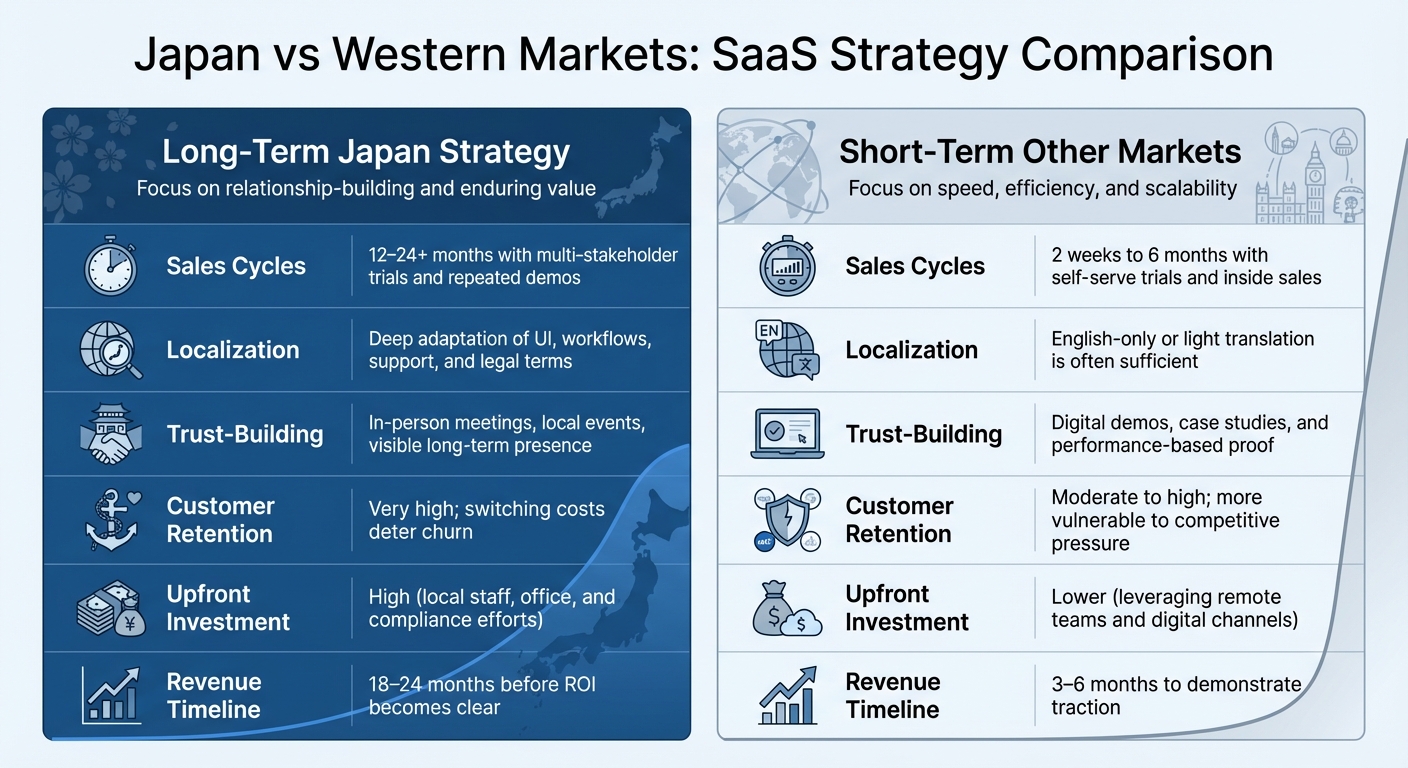
Japan vs Western Markets: SaaS Sales Strategy Comparison
Long-term strategies in Japan are all about building strong customer loyalty and maximizing lifetime value through deep local engagement. But here’s the catch: they require significant investments. We’re talking about hiring local staff, setting up offices, and tailoring products and services to meet local needs. This level of commitment can put pressure on cash flow, especially when paired with Japan’s notoriously long sales cycles – spanning 12 to 24 months or more. While these extended timelines create natural barriers to entry for competitors, they can also make it tough to hit the quarterly targets investors often expect.
On the other hand, short-term strategies offer speed and flexibility, particularly in Western markets. Companies can quickly test different revenue models, tweak their messaging based on real-time data, and scale up successful tactics within weeks or months. This approach demands less upfront investment and enables rapid customer acquisition, which is great for short-term growth. But there’s a downside: higher churn rates and a customer base that might be more sensitive to pricing. What works in the West doesn’t always translate well to Japan, though. Quick-win tactics and minimal engagement can damage a company’s reputation in Japan’s closely-knit business environment, where trust and relationships are everything.
Here’s a side-by-side look at how these strategies stack up:
| Aspect | Long-Term Japan Strategy | Short-Term Other Markets |
|---|---|---|
| Sales Cycles | 12–24+ months with multi-stakeholder trials and repeated demos | 2 weeks to 6 months with self-serve trials and inside sales |
| Localization | Deep adaptation of UI, workflows, support, and legal terms | English-only or light translation is often sufficient |
| Trust-Building | In-person meetings, local events, visible long-term presence | Digital demos, case studies, and performance-based proof |
| Customer Retention | Very high; switching costs deter churn | Moderate to high; more vulnerable to competitive pressure |
| Upfront Investment | High (local staff, office, and compliance efforts) | Lower (leveraging remote teams and digital channels) |
| Revenue Timeline | 18–24 months before ROI becomes clear | 3–6 months to demonstrate traction |
For companies ready to commit to a long-term presence in Japan, partnering with experts like Nihonium can be a game-changer. Nihonium provides a tailored approach to Japan localization, offering fractional sales support and go-to-market strategies. This phased method allows SaaS companies to start building relationships and adapting their products without immediately opening a full office. It’s a smart way to conserve resources while testing the waters in a market that rewards patience and persistence.
Conclusion
Expanding into Japan isn’t about applying the same strategies that work in Western markets. Success here depends on patience, a deep understanding of local needs, and a clear commitment to building trust over the long term. While sales cycles can stretch from 12 to 24 months and require significant upfront investment, the rewards are undeniable: higher customer lifetime value, reduced churn, and access to a SaaS market valued at $10.5–$11.8 billion – and still growing. Companies that view Japan as a long-term investment, spanning 5–10 years, are better positioned to secure sustainable revenue streams in a market where trust and relationships drive every deal.
This approach stands in stark contrast to the fast-paced, self-serve models often seen in the United States or Europe, where deals can close within weeks. In Japan, such tactics may be perceived as a lack of commitment. Japanese buyers expect meaningful localization and long-term engagement, making it essential to adapt strategies to the local context.
For SaaS executives, entering Japan means embracing a multi-year strategy. This includes crafting a detailed localization plan, developing a tailored go-to-market approach, and collaborating with experts who understand the intricacies of the region. Services like those offered by Nihonium – covering product localization, marketing funnel optimization, and custom market entry strategies – can help companies establish credibility and test the waters without immediately committing to a full-scale local presence. This measured, step-by-step approach minimizes risk while fostering the relationships that are critical to success in Japan.
The potential in Japan is immense, but it favors companies willing to focus on relationships rather than quick wins. By prioritizing trust, embedding local expertise, and demonstrating a steadfast presence, your SaaS business can tap into the enduring value of this dynamic market.
FAQs
Why are sales cycles longer in Japan compared to Western markets?
In Japan, sales cycles often take longer due to the intricate decision-making process that involves multiple layers of approval and input from various stakeholders. This approach highlights the priority placed on establishing trust and achieving consensus before any significant decisions are made.
Moreover, Japanese businesses value long-term relationships and thorough due diligence, which can naturally stretch the timeline for closing deals. While this demands extra patience, the result is often partnerships that are more stable and enduring over time.
What are the essential localization steps for SaaS companies expanding into Japan?
To thrive in Japan, SaaS companies must prioritize localization efforts that cater to the unique preferences of the market. This means adapting products to align with Japanese language requirements and cultural norms, ensuring that all content and documentation feel natural and relatable. Crafting a marketing funnel specifically for Japan is equally important. Strategies like SEO tailored to local search habits, engaging webinars, and targeted campaigns can help connect with the right audience. On top of that, implementing a localized sales process supported by knowledgeable professionals can not only boost deal closures but also nurture lasting customer relationships.
How is decision-making in Japan different from Western markets?
In Japan, decision-making typically relies on a consensus-driven process, where input is gathered from various stakeholders before arriving at a conclusion. Compared to Western markets, where decisions are often made more quickly and with a focus on individual authority, the Japanese approach is usually more structured and deliberate.
Although this method may take more time, it helps ensure team alignment and minimizes the chances of internal conflicts down the line. For SaaS companies looking to establish themselves in Japan, respecting and adapting to this process can lead to stronger partnerships and pave the way for lasting success.
 English
  Japanese