
Line Breaks: Subtle but Important Localization + SEO Best Practice in Japan
When localizing the website, product, or content, understanding proper line break usage is crucial. Not only does it affect readability, but it can also influence your site’s SEO performance. While the <br> tag itself doesn’t directly improve SEO rankings, misusing it can send negative signals to search engines. Possibly more importantly, the lack of proper line breaks can make the website or content look unprofessional and give a negative impression to the viewers. It is also a giveaway that the translations were done by a machine.
What Is the <br> Tag?
The <br> tag, short for “forced line break”, is used in HTML to insert a line break within text. It’s particularly useful when formatting content like addresses, poetry, or short phrases that require controlled line breaks. The <br> tag ensures each line appears on a new line without adding paragraph spacing.
SEO Implications of Improper Line Break Usage
Although the <br> tag itself does not directly impact SEO, improper use can have negative consequences:
1. Poor Readability: Excessive <br> tags can create fragmented text, making content harder for users to follow.
2. Negative Crawling Impact: Google’s crawlers evaluate page structure for readability. A poorly organized document using <br> tags in place of proper paragraphs may be interpreted as low-quality content.
3. Reduced User Experience (UX): Misplaced <br> tags can make content awkward to read on different devices, particularly on mobile screens.
Best Practices for Using <br> Tags in Japanese Content
1. Use <br> for Natural Breaks, Not for Spacing: Avoid using <br> tags to create artificial gaps in text. Instead, rely on proper paragraph structure and CSS for layout control.
2. Don’t Overuse <br> Tags: Frequent use of <br> tags can make your content feel cluttered and disrupt reading flow. Use them only when absolutely necessary, such as in lists or enhanced readability.
3. Ensure Mobile-Friendliness: Japanese content often appears in more compact layouts on mobile devices. Overusing <br> tags can disrupt that balance. Always preview your content on different screen sizes to ensure readability.
Consequences of Poor Readability
Though it was briefly mentioned in the post, possibly the most important aspect of the line break is the readability. The readability has implications that go beyond just the viewer’s ability to read. Take these examples:
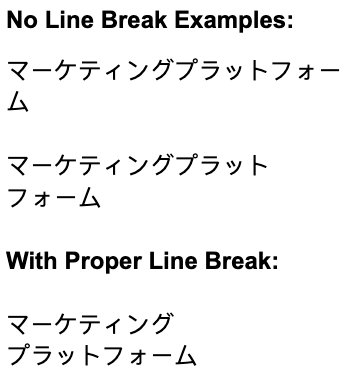
All three translate to “Marketing Platform”. Depending on the margin settings, there are multiple possibilities of how they may appear. Based on the breaks, this is the English equivalent of what it looks like for the viewer:
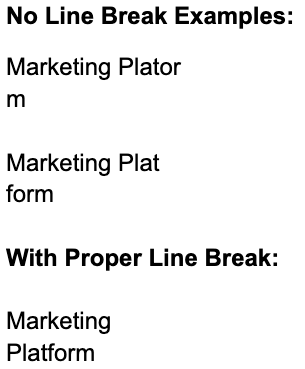
The third option with the line break is the most natural and missing these minor details can have a negative impact.
First, it gives the impression that the website lacks professionalism. Companies that follow best practices will be aware and on top of the presentation. Second, especially for companies that are new to entering the Japanese market, it gives the impression that there is no oversight by a Japanese teammate. Whether you actually do or don’t have a Japanese speaker on the team, missing this detail gives that impression, as most Japanese professionals will flag and fix this. Lastly, this gives the scent that you’ve copied and pasted machine translations. In a highly trust-based and detail-oriented culture, these minor oversights can lead to a loss of trust.
Unfortunately, implementing proper line breaks does not put you at an advantage, as this is a market standard. However, lacking proper line breaks will definitely put you at a disadvantage.
Conclusion
While the <br> tag may seem minor, its misuse can significantly impact content clarity and SEO performance. By properly using the <br> tags, you can create Japanese content that’s both user-friendly and search-engine optimized. The negative impact of the lack or improper use of implementing line breaks can lead to losing the trust of the viewers. When implementing a localization strategy, it’s important to consider line breaks. If you are looking for localization support, book a free consultation here.
 English
  Japanese