
Japanese and Western companies approach goals and workplace strategies very differently. Here’s a quick breakdown:
- Japan: Goals are intentionally set high to inspire effort and teamwork. Success is measured by dedication and process, not just results. Consensus-building (nemawashi) and long-term strategies like Hoshin Kanri and Kaizen are key.
- West: Goals are practical and measurable, often tied to individual performance and compensation. Approaches like OKRs and SMART goals focus on shorter cycles and adaptability.
Key Takeaways:
- Goal Philosophy: Japan values ambitious, long-term visions; the West prioritizes achievable, short-term results.
- Decision-Making: Japan uses collective consensus; Western firms favor top-down directives.
- Improvement Mindset: Japan emphasizes continuous, incremental progress (Kaizen); the West seeks quick wins through rapid changes.
For SaaS companies entering Japan, understanding these differences can help avoid misalignments, build trust, and align strategies with local expectations.
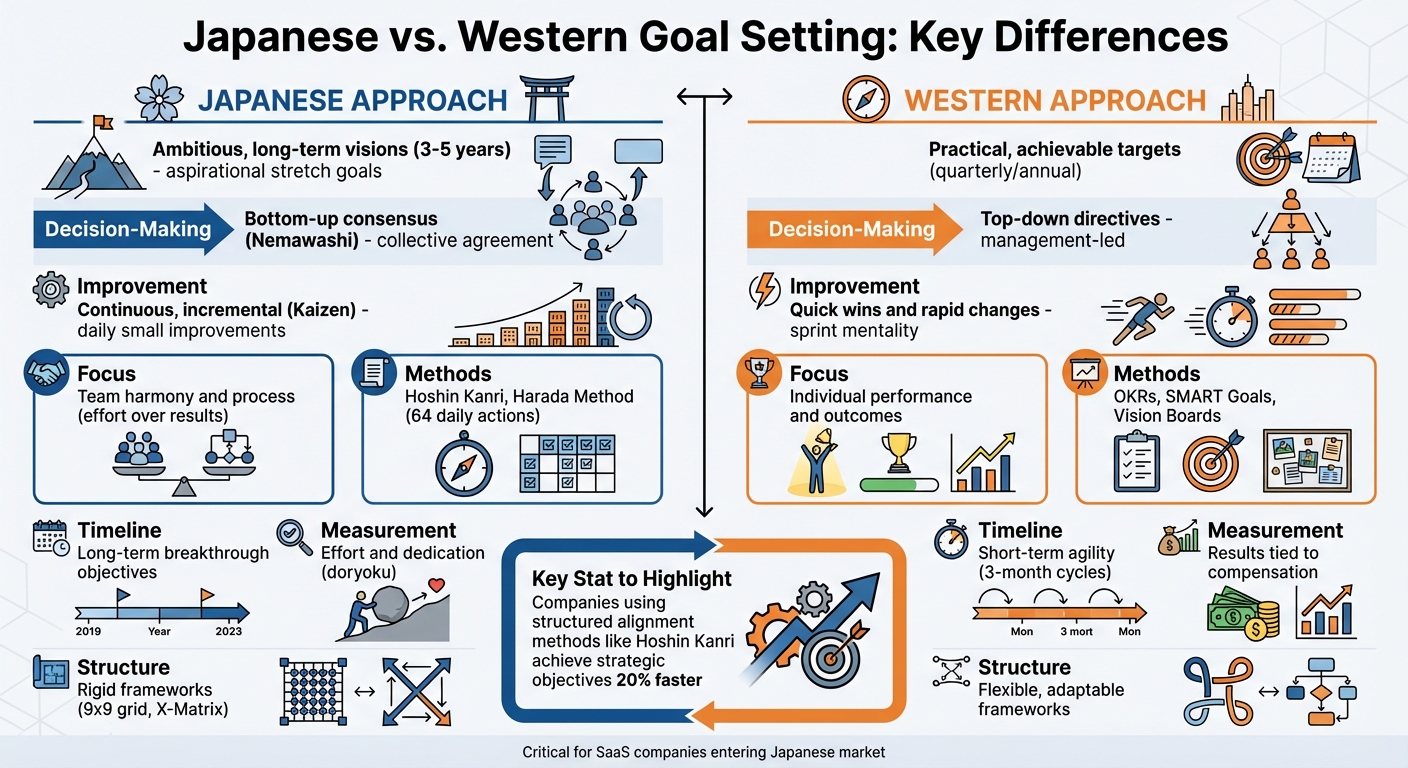
Japanese vs Western Goal Setting Approaches: Key Differences Comparison
Harada Method vs. Western Visualization Practices
Overview of the Harada Method
The Harada Method, created by Japanese athletics coach Takashi Harada, takes a structured and disciplined approach to goal achievement. Unlike Western practices that often rely on vision boards with motivational quotes or images, this method uses a strict 9×9 grid called "Open Window 64." This grid breaks a primary goal into 8 key pillars, with each pillar further divided into 8 specific daily actions – resulting in 64 actionable steps.
A well-known example of this method in action is Shohei Ohtani, a baseball player who, as a high school freshman in Japan, used it to visualize becoming the #1 draft pick for eight professional teams. His Open Window 64 grid included pillars like "Body Care", which detailed actions such as taking specific supplements and maintaining an ideal body weight, and "Mental Toughness." This meticulous system is credited with helping him reach extraordinary milestones, including becoming a two-time World Series champion and earning multiple MVP awards.
At its core, the Harada Method builds self-reliance by cultivating daily habits that lead to mastery. Ken Feldman, PhD, and Lean Six Sigma Master Black Belt, highlights this strength:
"The Harada Method’s strength lies in its comprehensive approach to personal development through self-discipline and accountability".
Next, let’s explore how Western visualization practices differ in their approach.
Western Visualization Practices
Western visualization techniques, such as vision boards, take a more open-ended and inspirational approach. These methods often involve creating collages or writing journal entries filled with aspirational imagery and motivational quotes. The focus here is on "thinking big" and "dreaming the impossible", with the aim of sparking excitement and motivation. However, these practices typically lack the detailed, measurable steps needed to turn ambitions into reality.
This lack of specificity can make it harder to sustain progress, especially in contexts like business, where Japanese methodologies often prioritize systematic, habit-based progress over individual, unstructured aspirations, a distinction also seen when comparing Japanese SaaS companies vs. global comps. The difference in philosophy is stark: Western visualization asks, "What do you want to achieve?" while the Harada Method counters with, "What daily actions will you take to get there?"
MindMap Journal sums it up perfectly:
"The Harada Method transforms ambitious goals into reality by breaking them into 64 specific, daily actions… The method forces extreme specificity and acts as a desire filter".
Comparison Table: Harada Method vs. Western Visualization Practices
| Feature | Harada Method | Western Visualization (Vision Boards) |
|---|---|---|
| Structure | Rigid 9×9 grid (Open Window 64) | Unstructured collage or journal entries |
| Focus | Daily habits and self-reliance | Aspirational goals and motivation |
| Actionability | 64 measurable daily actions | Vague intentions (e.g., "get in shape") |
| Timeframe | Long-term personal mastery | Often short-to-medium term or "dream-based" |
| Philosophy | Engineering success through discipline | "Thinking big" and "dreaming the impossible" |
sbb-itb-a752276
Hoshin Kanri vs. Western OKRs and SMART Goals
Introduction to Hoshin Kanri
Hoshin Kanri, which translates to "compass management", is a strategic approach designed to align a company’s long-term vision with its daily operations. Unlike Western frameworks that focus on quarterly cycles, Hoshin Kanri emphasizes breakthrough objectives over a 3–5 year horizon. A key feature of this method is the "Catchball" process – a collaborative dialogue between management and employees aimed at building consensus and shared ownership. As Liam Frady from iSixSigma explains:
"The Catchball Process is a cyclical process that facilitates two‑way communication from the top‑down and the bottom‑up… promoting ownership and engagement".
To bridge long-term goals with actionable steps, Hoshin Kanri uses visual tools like the X-Matrix and A3 Reports. Rooted in the Plan-Do-Check-Act cycle, it emphasizes ongoing improvement through regular management reviews. Research suggests that companies employing structured alignment methods like Hoshin Kanri can achieve their strategic objectives 20% faster. By contrast, Western frameworks such as OKRs and SMART Goals prioritize shorter-term adaptability and rapid iteration.
Western OKRs and SMART Goals
Western methodologies, particularly OKRs (Objectives and Key Results), are designed for fast-paced, agile environments. OKRs combine overarching strategic objectives with measurable key results, operating on quarterly cycles with frequent check-ins. This structure encourages a "fail fast" mindset, allowing teams to quickly pivot and adapt to changing circumstances.
SMART Goals, on the other hand, focus on creating objectives that are Specific, Measurable, Attainable, Relevant, and Time-bound. Rochelle Kopp highlights a key cultural difference in goal-setting approaches:
"In Japan goals are used to show employees a lofty vision, something to aspire to. The higher and more difficult-to-achieve the goal is, the more people are inspired to try to make it happen".
This underscores how Japanese frameworks like Hoshin Kanri encourage ambitious, long-term visions, while SMART Goals lean toward practicality and attainability. As Wouter explains, OKRs are designed with flexibility in mind:
"OKRs are designed to be flexible, allowing teams to adapt and pivot their goals as needed based on changing circumstances".
Comparison Table: Hoshin Kanri vs. Western OKRs and SMART Goals
| Feature | Hoshin Kanri (Japan) | OKRs (Western Approach) | SMART Goals (Western Approach) |
|---|---|---|---|
| Planning Horizon | 3–5 years (breakthrough goals) | Quarterly (3 months) | Short-term (annual/project) |
| Direction | Top-down with Catchball process | Hybrid (top-down & bottom-up) | Mainly top-down |
| Review Frequency | Monthly/quarterly | Weekly/biweekly | Annual or end-of-project |
| Collaboration | Consensus-seeking through Catchball | Public boards and transparency | Supervisor–subordinate agreement |
| Goal Philosophy | Ambitious and visionary | Aggressive "stretch" targets | Realistic and attainable |
| Visual Tools | X-Matrix and A3 Reports | OKR dashboards/templates | Standard performance review forms |
| Link to Compensation | Indirect (effort/attitude-based) | Often decoupled from salary | Directly linked to bonuses/pay |
| Primary Focus | Long-term strategy and process | Short-term agility and outcomes | Individual/task practicality |
This side-by-side comparison is particularly useful for SaaS companies looking to adapt their strategies through localization for the Japanese market. By understanding these differences, organizations can better align their planning processes with local expectations and cultural nuances.
Individualism vs. Collective Alignment
Japanese Collective Alignment
In Japan, the workplace revolves around team harmony and shared effort, a concept deeply rooted in the principle of wa (harmony). The belief is simple: working together as a cohesive unit leads to better results. Instead of focusing on individual accomplishments, Japanese companies place a higher value on team cohesion. Employees are often assessed based on their effort (doryoku) and the processes they follow, rather than just hard numbers or outcomes.
The decision-making process mirrors this collective approach. Through a practice called nemawashi, decisions are made via bottom-up consensus. This involves both formal and informal discussions to ensure everyone is on the same page and feels a sense of shared ownership. To inspire urgency and unite the team, companies sometimes set ambitious goals, a strategy referred to as koshi ni hi wo tsukeru, which translates to "lighting a fire underneath someone".
This emphasis on collaboration and harmony stands in stark contrast to the more individualistic approach seen in Western workplaces, a factor that significantly influences B2B SaaS sales in Japan.
Western Individualism in Goal Setting
Western systems, particularly in the U.S., tend to focus on individual accountability when setting goals. Goals are often structured to be realistic and achievable, following the SMART criteria. The reasoning is that unattainable goals can lead to frustration and demotivation. Performance evaluations typically zero in on measurable outcomes, with compensation tied directly to whether targets are met.
Decision-making in Western companies often follows a top-down model. Management sets the goals and communicates them to employees, retaining the final say. While this approach can streamline execution, it may result in less buy-in from the team. A case study from December 2024 illustrates this cultural divide. At a Japanese firm’s U.S. subsidiary, the yearly plan aimed for a 7% net margin and a 15% sales increase. The team achieved a 6% margin and 10% growth instead. American employees viewed this as a failure, calling the goals "unrealistic", while their Japanese counterparts focused on the effort made and saw room for improvement.
Studies show that workplace conformity scores are notably higher in Japan than in the U.S., reflecting Japan’s belief in the power of group cooperation. In contrast, Americans often emphasize personal control and individual achievement.
Long-Term Kaizen vs. Short-Term Optimization
Kaizen Philosophy and Practices
The Kaizen approach emphasizes a mindset of continuous, incremental improvement. Rooted in the Japanese philosophy of Kaizen, which means "change for the better", this method encourages employees at all levels to make small, daily improvements to their tasks rather than waiting for management-driven reforms. Toyota exemplifies this philosophy, believing every process has room for improvement and that all employees share responsibility in identifying better ways to work.
"Daily Kaizen asks every employee to become an investigator of their own workspace, embracing the mindset that no process is ever ‘good enough.’" – GLOBIS Europe
When incremental improvements aren’t sufficient, companies turn to Kaikaku, which involves bold, management-led transformations to achieve significant breakthroughs. A standout example is Toyota’s Global Body Line (GBL) project. By standardizing processes, Toyota managed to reduce model changeover costs by 70% and cut floor space requirements by 50%. This overhaul established a new foundation for future Kaizen-driven refinements.
Kaizen’s focus on ongoing effort aligns with Japanese goal-setting traditions. As Rochelle Kopp, Founder of Japan Intercultural Consulting, notes: "Whether or not the goal is ultimately achieved is less important than how hard people tried to achieve it". This philosophy also emphasizes fostering long-term, trust-based relationships with vendors, prioritizing stability over rapid, disruptive changes.
Western Short-Term Optimization
In contrast, Western companies often approach improvement with a sprint-like mentality. Strategies like "Rapid Improvement Workshops" or "Kaizen Blitzes" aim to achieve quick wins in a matter of days. While these methods can yield impressive short-term results, they may lack the sustained, cumulative impact that daily Kaizen habits can deliver.
This short-term focus is often driven by quarterly business pressures and investor expectations. Western firms tend to reward standout individual efforts and dramatic overhauls, favoring measurable, immediate outcomes over gradual, team-based problem-solving. Goals are typically designed to be realistic and achievable, minimizing the risk of employee frustration or burnout.
However, some Western companies have successfully integrated Kaizen principles. For instance, New Balance collaborated with the Toyota Supplier Support Center in 2003 to restructure an assembly line through five-day workshops. This effort cut cycle time by 18%, eventually reducing shoe production time from nine days to just eight hours and improving inventory turnover. Similarly, Lockheed Martin‘s Fort Worth plant applied Kaizen techniques to reduce the time taken to move parts from receiving to stock from 30 days to just four hours.
This juxtaposition of long-term Kaizen and short-term optimization highlights how cultural context shapes improvement strategies. For SaaS companies entering Japan, understanding these differences is crucial. Like the Harada and Hoshin Kanri methods, Kaizen offers valuable lessons on adapting strategies to align with local practices. This is a critical step in the SaaS GTM process in Japan.
Comparison Table: Kaizen vs. Western Optimization
| Feature | Japanese Kaizen Philosophy | Western Short-Term Optimization |
|---|---|---|
| Primary Focus | Incremental, daily improvements | Immediate financial results and quick paybacks |
| Timeline | Continuous, long-term "adaptive muscle" | Week-long "Blitzes" or structured sprints |
| Involvement | All employees (bottom-up investigation) | Management-led or expert-driven (top-down) |
| Goal Nature | Lofty, aspirational "stretch goals" | Practical, realistic, and achievable targets |
| Reward System | Emphasis on effort (doryoku) | Linked directly to goal achievement and bonuses |
| Risk Tolerance | Low-risk, stable, long-term relationships | High-risk, rapid iteration, and disruption |
What This Means for SaaS Companies Entering Japan
Adapting to Japanese Business Practices
Understanding how Japanese businesses approach goals can significantly shape your market entry and client relationship strategies. The structured, consensus-driven methods like Hoshin Kanri and the long-term improvement focus of Kaizen demand a different mindset compared to Western markets.
Expect longer sales cycles. Japanese enterprise deals often require multiple meetings – typically 4–5 – to build trust and reach a shared understanding. This process, known as nemawashi, involves informal groundwork to build consensus before any formal decision. It’s not inefficiency; it’s a deliberate way to ensure alignment. SaaS companies must adjust their internal KPIs to reflect this and resist rushing for quick closures. Rochelle Kopp, Founder of Japan Intercultural Consulting, highlights this mindset:
"Japanese realize that as long as they work toward goals diligently, they will not be penalized if the goals are not always attained".
Japanese companies often set ambitious goals to inspire teams rather than enforce deadlines. Additionally, since most operate on an April–March fiscal year, aligning procurement efforts with this timeline is critical.
Focus on reliability, not disruption. While Western marketing often emphasizes being "disruptive" or "fast-moving", Japanese buyers value stability, dependability, and round-the-clock support. Your messaging should highlight how your solution fits into the collective team’s goals and supports "The Plan" rather than stressing individual productivity gains.
Prioritize detailed documentation. Japanese buyers prefer thorough, professionally translated materials over high-level presentations. Prepare "ringi-ready" materials that include detailed business cases, cost-benefit analyses, and technical documentation. These materials are essential for the ringi process, where proposals circulate for review and approval, often requiring official seals (hanko) before decisions are finalized.
Bridging these gaps with effective localization is key to success.
Using Localization Services
Addressing these challenges requires a deep understanding of Japanese business culture and practices. Services like Nihonium (https://nihonium.io) specialize in helping SaaS companies navigate this unique market. Nihonium offers a range of solutions, including product localization, marketing funnel design, fractional sales support, and tailored market entry strategies.
Fractional sales support is particularly valuable in Japan, where the consensus-building process can be intricate. Local experts can map out stakeholder hierarchies early, identifying not only decision-makers but also key influencers like section managers and department heads. These professionals participate in nemawashi, providing critical technical and feasibility data at the right stages of the decision-making process. Timing is everything – introducing input after a decision has been made can disrupt harmony.
Data sovereignty and payment integration are also essential for Japanese enterprise clients. Many require data hosting within Japan, often on platforms like AWS Japan or Azure Japan, to comply with the Act on the Protection of Personal Information (APPI). Additionally, integrating local payment methods such as furikomi (bank transfers) and monthly invoicing is crucial, as these are preferred over Western-style credit card subscriptions. Localization services help manage these technical and regulatory needs while ensuring your product aligns with the Kaizen philosophy of steady, incremental improvement rather than sudden, disruptive changes.
Conclusion
Japanese and Western approaches to goal-setting highlight a deep contrast in values. Western strategies often prioritize individual accomplishments, quick results, and measurable returns, while Japanese methods focus on group harmony, steady effort, and long-term dependability. In Japan, the process (doryoku) takes precedence over the end goal, with ambitious visions created to motivate teams rather than serve as immediate, practical benchmarks. This ties back to earlier points about Japan’s emphasis on consensus-building and forward-looking strategies.
For SaaS companies looking to expand into Japan, these differences have a direct impact on market entry strategies. The consensus-driven ringi-seido system requires longer decision-making cycles, emphasizing trust-building. Partnerships play a critical role in this market – Cybozu, for instance, generated 62.9% of its revenue through partners in FY2023, while Zoom relies on partnerships for 70% of its Japanese sales, compared to just 10% in the U.S..
Adjusting internal goals and sales KPIs is essential to align with Japan’s unique business environment. This might involve extending timelines, prioritizing consensus-building, and shifting messaging from "disruptive innovation" to themes like "reliability" and "support." Strong local partnerships are also key – 18 of Japan’s top 20 public SaaS companies have partner programs in place. To bridge the gap between Japanese and Western styles, companies could adopt a dual-goal framework: pairing aspirational stretch goals (inspired by Japanese practices) with practical targets for performance evaluation (a Western approach).
To navigate these challenges effectively, collaborating with local experts like Nihonium can provide tailored insights. These partnerships can help align strategies with Japan’s business norms, fostering trust and creating a foundation for long-term growth in the country’s sophisticated B2B market.
FAQs
What strategies can SaaS companies use to align with Japanese goal-setting practices?
For SaaS companies looking to succeed in Japan, understanding and embracing local business norms is crucial. Japanese businesses emphasize long-term relationship-building, consensus-driven decision-making, and maintaining respect for the country’s hierarchical corporate structure. This contrasts with many Western strategies that often focus on bold, short-term objectives.
To navigate this landscape effectively, SaaS companies should prioritize realistic, incremental goals that align with Japan’s preference for steady, deliberate progress. It’s also important to recognize that sales cycles in Japan tend to be longer, typically spanning 12 to 24 months. This requires patience and a commitment to sustained effort.
Cultural practices like nemawashi (informal groundwork) and ringi (formal proposal circulation) play a key role in decision-making. These involve thorough preparation and ensuring all stakeholders are on board before moving forward. By showing cultural sensitivity, maintaining consistent engagement, and respecting these practices, companies can build trust and lay the foundation for lasting success in Japan’s SaaS market.
How does the Harada Method differ from Western goal-setting techniques?
The Harada Method and Western goal-setting techniques take distinct approaches, each with its own emphasis and structure. The Harada Method centers on self-reliance, building daily habits, and crafting detailed, long-term plans. It encourages breaking down goals into manageable steps, often using tools like an in-depth goal-setting sheet. This method emphasizes steady effort and personal development over time.
On the other hand, Western techniques often highlight the power of visualization – using mental imagery to spark motivation and boost confidence. These approaches tend to be less structured, focusing more on creating a vivid mental picture of success rather than mapping out a detailed plan. While visualization can play a role in larger frameworks, the Harada Method pairs it with disciplined routines and precise planning, offering a more structured path to achieving goals.
Why is building consensus so important in Japanese business culture?
Building agreement is a key aspect of Japanese business practices, as it helps maintain group harmony and ensures decisions have the backing of all involved. This process often includes nemawashi, an informal way of gathering input behind the scenes, and the Ringi system, where proposals are circulated for feedback and gradual approval. These methods highlight Japan’s focus on teamwork, respect for hierarchy, and thorough decision-making.
By emphasizing consensus, Japanese companies reduce risks, strengthen trust, and create decisions that are easier to execute and maintain over time. While Western business cultures might prioritize quick decisions and individual authority, Japan’s method supports long-term stability and fits its relationship-driven business style.
Related Blog Posts
- Japanese B2B Sales: Key Differences from Western Markets
- Western vs. Japanese SaaS Design: Key Differences
- Onboarding in Japan vs. the West: Key Differences
- Long-Term Perspective in Japan: Lessons for SaaS
 English
  Japanese