

Japanese SaaS support differs significantly from global practices in how it caters to customer expectations, communication styles, and service delivery. While global SaaS companies focus on scalability and efficiency through self-service tools and automation, Japanese users demand personalized, high-touch service rooted in their cultural norms. Here’s what you need to know:
- Language and Localization: Japanese users require fully localized interfaces, documentation, and support. Automated translations often fail due to the complexity of Japanese honorifics and cultural nuances. Poor localization signals a lack of commitment.
- Customer Service: Japanese support emphasizes proactive care, detailed problem resolution, and continuity with a single representative. Global models prioritize speed, scalability, and automation, often relying on chatbots and self-service.
- Sales and Retention: Japan’s consensus-driven sales cycles are lengthy and require extensive pre- and post-sales engagement. Trust-building is critical, with dedicated account managers maintaining regular contact. Globally, sales are faster and retention relies on data-driven automation.
- Customization Needs: Japanese companies expect software to adapt to their workflows and integrate with legacy systems. Global SaaS solutions are standardized, with limited flexibility but faster deployment.
Quick Comparison
| Feature | Japanese SaaS Support | Global SaaS Support |
|---|---|---|
| Language | Native-level, culturally sensitive localization | English-first, automated translations |
| Service Style | Personalized, high-touch, proactive | Scalable, automated, self-service |
| Sales Cycle | Long, consensus-driven, multi-stakeholder | Short, individual or small-team decisions |
| Customization | Extensive, tailored to workflows and legacy systems | Standardized, plug-and-play |
| Retention | Trust-focused, regular personal check-ins | Metrics-driven, automated churn prevention |
To succeed in Japan, global SaaS companies must shift from scalable models to personalized, localized approaches that align with Japanese business practices.
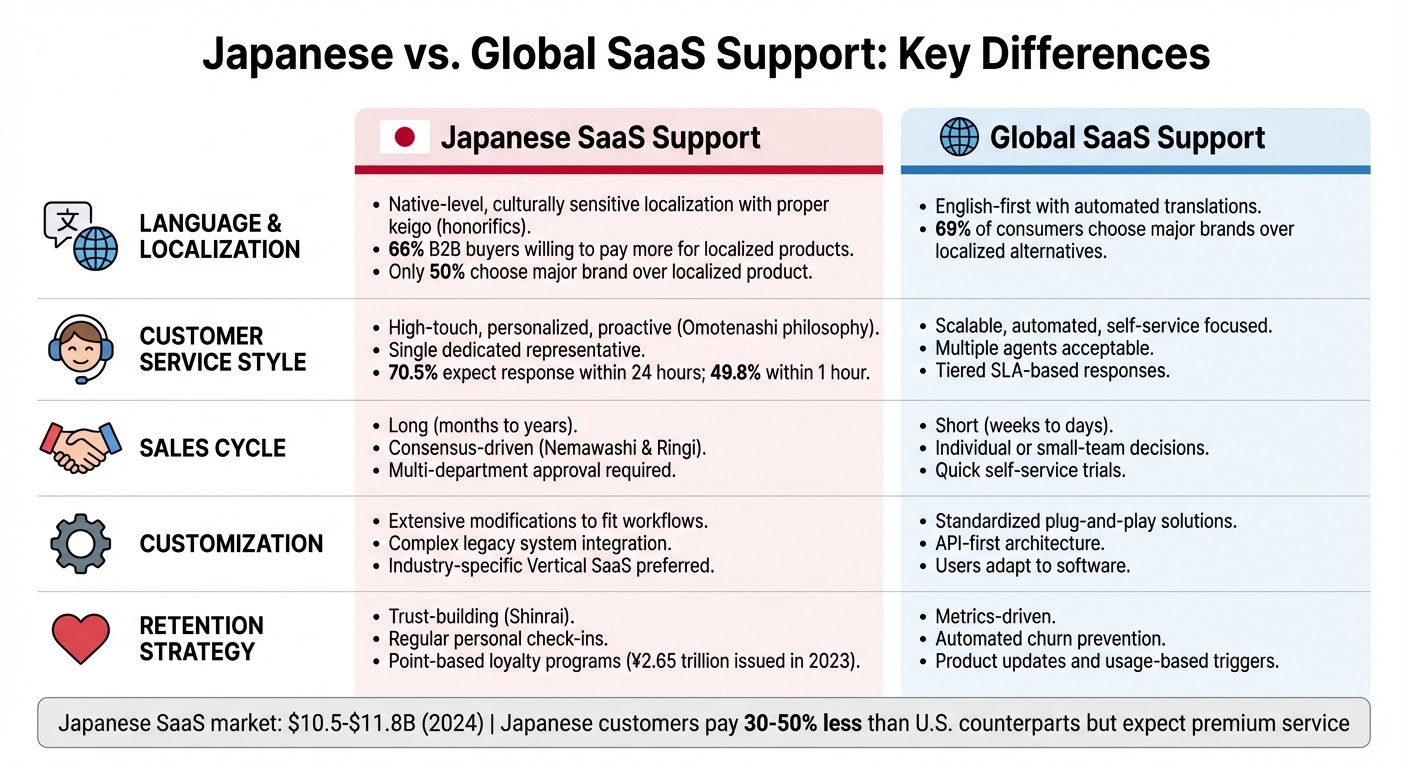
Japanese vs Global SaaS Support: Key Differences Comparison
Language and Localization Requirements
Language plays a crucial role in shaping how SaaS users interact with products. In Japan, complete localization is essential. Japanese buyers see poorly translated or partially localized content as a clear sign that a company isn’t fully committed to their market.
"There’s nothing worse than bad translation. It’s easy to tell which vendors know what they are doing and are really committed to the market just through the quality of their materials."
Naoki Togawa, Manager at Nikkei Business Publications
The data supports this sentiment. Japanese consumers overwhelmingly prefer native language support. While 69% of global consumers might choose a major brand over a localized product, only 50% of Japanese consumers would do the same. Additionally, 66% of B2B buyers in Japan are willing to pay more for localized products.
The Global Approach vs. Japan’s Expectations
Most global SaaS companies lean on an English-first strategy. They often rely on automated translations and self-service tools like chatbots, knowledge bases, and forums. This approach works in regions where users are comfortable with English or prefer minimalistic designs. However, this strategy frequently falls short in Japan.
Japanese localization requires more than just translating words – it demands a deep understanding of cultural nuances. The Japanese language includes three distinct levels of formality: Sonkeigo (respectful), Kenjougo (humble), and Teineigo (polite). These complexities make automated translation tools inadequate. Beyond language, Japanese users favor information-dense interfaces, complete with detailed menus and comprehensive, text-heavy documentation.
To meet these expectations, partnering with localization experts like Nihonium can make all the difference. Their services ensure that apps, content, and documentation align with the linguistic and cultural standards that Japanese users expect. This level of precision can turn localization challenges into opportunities for competitive advantage.
Japanese SaaS Support: Complete Localization
For Japanese users, every interaction must feel localized – from the user interface to help documentation and even live support. Anything less signals a lack of commitment to the market.
The Ringisho decision-making process further emphasizes this need. In Japan, SaaS purchases often require approval from multiple stakeholders, many of whom aren’t end-users and may not speak English. Localized websites, sales decks, and documentation are critical for securing committee approval.
Accuracy in localization is non-negotiable. Direct translations often fail to capture the nuances of honorifics and context. A single misstep in formality can damage a brand’s credibility. Professional native reviews ensure not only accuracy but also the trustworthiness of the materials.
A standout example comes from Mackerel, a Japanese infrastructure monitoring tool by Hatena. Between 2014 and 2018, Mackerel grew its customer base 29× by being the only fully localized solution. During this time, global competitors like New Relic and Datadog lacked Japanese UIs and support, giving Mackerel a significant edge. This allowed them to secure major clients, including Nintendo and NTT EAST.
Even for technical products like developer tools, Japanese users may accept English interfaces but still expect fully localized documentation. For non-technical B2B products, a fully localized UI and support experience are often mandatory. This includes phone and email support that adheres to Japanese standards of formality and structure.
Global SaaS Support: Multilingual and Automated
Global SaaS companies typically prioritize scalability and efficiency in their support systems. English serves as the default language, with multilingual support added through automated tools or limited human translation for key markets. Self-service models dominate, offering chatbots, knowledge bases, forums, and video tutorials accessible 24/7.
This model works in markets where users are comfortable with English or tolerate machine-translated content. Minimalist design principles – featuring clean layouts, ample white space, and simplified navigation – reduce the need for extensive text explanations.
However, automated translations often fail to capture cultural subtleties, and self-service systems clash with the Japanese expectation of omotenashi – a service philosophy rooted in proactive and personalized care. These differences highlight the stark contrast between localization strategies.
Comparison Table: Localization Depth vs. User Experience
| Feature | Japanese SaaS Support | Global SaaS Support |
|---|---|---|
| UI Design | Information-dense, detailed menus, granular controls | Minimalist, high white space, streamlined flows |
| Language Approach | Native-level keigo with professional review | English-first with automated or limited translation |
| Documentation | Detailed, text-rich FAQs | Concise, often video-based, usually English-only |
| Support Channels | High-touch, dedicated reps with Japanese phone support | Scalable, automated, self-service tools |
| Trust Building | Local presence and stability signals | Brand authority, rapid iteration, and global reach |
| Decision-Making Support | Localized sales decks for committee (Ringisho) approval | End-user focused (PLG) with minimal stakeholder materials |
sbb-itb-a752276
Customer Service Models and Support Channels
How companies approach customer support often reveals their underlying business philosophies. In Japan, the concept of omotenashi – a deeply ingrained service mindset – guides support practices. This approach focuses on anticipating customer needs and delivering personalized, proactive care, rather than simply reacting to issues as they arise. On the other hand, global SaaS companies tend to prioritize scalability and efficiency, relying heavily on automation and self-service tools to manage customer interactions.
"The service focus in Japan is on providing care rather than meeting expectations. No matter how small, doing whatever helps the customer feel better is crucial."
These cultural differences influence every aspect of the customer support experience, from communication channels to response times and problem resolution strategies. Let’s take a closer look at how Japanese SaaS companies vs. global comps differ.
Japanese SaaS Support: High-Touch and Personalized
In Japan, customer service is all about building trust and maintaining long-term relationships. This means customers expect a single, dedicated representative to handle their issue from start to finish. Transferring between departments or agents is seen as disruptive and can undermine the trust that continuity fosters.
For complex issues, phone support is the go-to channel. It’s typically staffed by native speakers trained in keigo (formal honorific language), ensuring both linguistic and cultural sensitivity. Email support also plays a significant role, with responses that are formal, highly detailed, and structured to outline clear next steps. Even chat support is expected to provide real-time assistance with precise, nuanced communication.
Response time is another critical factor. According to a survey, 70.5% of Japanese customers expect responses within 24 hours, while nearly half – 49.8% – expect a reply within an hour. Same-day acknowledgment is often the norm, and follow-ups at structured intervals (e.g., 24 hours and one week after resolution) help confirm customer satisfaction and prevent recurring issues.
When it comes to resolving problems, Japanese support teams place a strong emphasis on sincere apologies and thorough explanations of what went wrong. Simply offering compensation, such as credits or refunds, can come across as impersonal unless paired with these efforts to address the root cause.
Global SaaS Support: Scalable and Self-Service
Global SaaS companies, by contrast, design their support systems to scale efficiently, favoring automation and self-service over the personalized approach seen in Japan. Ticketing systems, self-service portals, and forums – primarily in English – form the backbone of this model.
The tone of global support tends to be transactional. For instance, US-based teams often adopt a warm, friendly style, akin to chatting with a helpful friend. The focus is on practical solutions, such as issuing credits, providing refunds, or offering immediate workarounds to resolve issues quickly and move forward.
While high-value enterprise customers may have access to a dedicated account manager, most users interact with different representatives depending on the issue. This approach optimizes efficiency but can feel impersonal compared to Japan’s emphasis on consistency.
Self-service tools are a cornerstone of the global model. Instead of dense, exhaustive documentation, these tools favor simple, searchable knowledge bases and community-driven forums. While this streamlined approach works well in markets that value simplicity, it contrasts sharply with Japanese preferences for detailed, information-rich resources that offer added reassurance.
The table below highlights some of these key differences in support channels and response expectations.
Comparison Table: Support Channels and Response Times
| Channel | Japanese Market Expectation | Global Market Approach |
|---|---|---|
| Phone | Preferred for complex issues; native speakers required (during local business hours) | Often secondary to digital channels; used primarily for high-tier support or sales |
| Formal keigo; detailed, structured responses with clear next steps | Direct and transactional; often utilizes standardized templates | |
| Chat | Real-time assistance with high linguistic accuracy and nuanced communication | Primary scalable channel; heavily automated with AI chatbots |
| Self-Service | Dense, content-rich documentation with exhaustive FAQs and guides | Simple, searchable knowledge bases and active forums |
| Response Time | 70.5% demand responses within 24 hours; 49.8% expect replies within one hour | Tiered based on SLA, with automated acknowledgments being common |
| Problem Resolution | Emphasis on sincere apologies and detailed root-cause explanations | Focus on practical solutions such as credits, refunds, or immediate fixes |
| Consistency | Single dedicated representative per issue ensures continuity | Multiple agents may handle issues, with transfers being acceptable |
Sales Cycle and Support Expectations
B2B SaaS sales in Japan stand in stark contrast to the approach seen in global markets. In Japan, buying decisions are deeply rooted in consensus-driven practices, shaped by frameworks like Nemawashi and the Ringi system. These cultural norms mean that decisions often require input and approval from multiple departments, extending enterprise sales cycles to months – or even years. This methodical process also demands extensive pre-sales support at every step, reflecting the importance of building trust and alignment.
"The playbook is not about speed; it is about sincerity. Technology may open the door; but in Japan, trust is what keeps it open."
Darsa Jhanwar, Associate at Vertex Ventures
In contrast, global SaaS sales are typically faster and more self-directed. Decisions are often made by individual users or small teams, with a focus on product-market fit and quick iterations. Trust-building exercises, which are central to Japanese sales, play a smaller role in global markets.
This fundamental difference in sales cycles also shapes the type of support required after purchase. Japanese buyers expect hands-on guidance throughout the entire process – from formal presentations and in-person meetings to comprehensive documentation tailored to the Ringi process. Sales materials must cater to non-technical executives who are part of the approval chain. Meanwhile, global buyers typically favor self-directed trials, relying on FAQs and product demos for quick decision-making. For Japanese clients, the sale is often just the beginning of a long-term partnership, involving dedicated account managers, regular updates, and even shared office hours for collaborative problem-solving.
Japanese SaaS Support: Extensive Pre- and Post-Sales Engagement
The lengthy and complex sales process in Japan underscores the need for highly personalized, localized support that extends far beyond the initial purchase.
Pre-sales efforts in Japan require patience and a deep understanding of cultural nuances. Companies must prepare exhaustive materials, including whitepapers, formal proposals, and cost-benefit analyses, which are circulated across departments to build the trust needed for consensus approval. After the sale, the support commitment only deepens. Japanese clients often see their purchase as the start of a long-term partnership, with expectations for phased rollouts, regular in-person meetings, detailed progress tracking, and proactive problem-solving – all delivered in a way that respects group harmony and business etiquette.
Global SaaS Support: Efficient and Self-Service Focused
In global markets, SaaS sales prioritize speed and simplicity. Decision-making is often centralized within small teams or driven by individual users, allowing for quicker approvals.
Pre-sales efforts in these markets rely heavily on free trials, self-service demos, and concise documentation. For lower-tier plans, sales cycles can be wrapped up in weeks – or even days. Once the purchase is complete, global SaaS companies typically shift customers to scalable support systems. These include knowledge bases, community forums, and automated onboarding processes. While enterprise clients may receive dedicated account management, most users interact with support through ticketing systems or self-service tools. The focus then shifts toward monitoring product adoption and identifying opportunities for expansion.
Comparison Table: Sales Cycle and Support Models
Here’s a side-by-side look at how sales cycle differences influence support strategies in each market:
| Feature | Japanese SaaS Sales Cycle | Global SaaS Sales Cycle |
|---|---|---|
| Decision Style | Consensus-driven (Nemawashi & Ringi); multi-department approval | Streamlined; individual or small team decisions |
| Cycle Length | Long (months to years for enterprise sales) | Short (weeks or days for self-service) |
| Primary Driver | Trust, stability, and group harmony | Product features, speed, and iteration |
| Pre-Sales Support | High-touch; formal presentations, face-to-face meetings | Minimal; self-service trials and demos |
| Documentation | Detailed (whitepapers, proposals for Ringi approval) | Simple (FAQs, trial access) |
| Stakeholders | Large committees, including non-technical executives | End-users and department heads |
| Post-Sales Approach | Long-term relationship; dedicated account managers, regular check-ins | Scalable support systems; focus on product adoption |
| Support Role | Continuous, proactive engagement | Metrics-driven adoption and growth |
Customization and Integration Requirements
The Japanese and global SaaS markets take very different approaches when it comes to customization and integration. Globally, users are more inclined to adapt to standardized software solutions. In Japan, however, businesses expect software to align with their unique workflows and often integrate it with existing legacy systems instead of replacing them outright. This results in a patchwork of tools that often rely on manual integrations or Excel-based workarounds. For instance, it’s common for Japanese companies to modify platforms like Salesforce so extensively that standard features, such as "Opportunity" and "Campaign", are no longer used as intended, transforming the platform to suit local processes.
"Japanese organizations prioritize modifying software to fit their existing workflows, regulatory requirements, and corporate structures." – 01GROWTH
Below, we’ll explore how Japanese and global SaaS approaches differ in their strategies for customization and integration.
Japanese SaaS Support: Heavy Customization and Legacy Integration
In Japan, businesses expect software to adapt to their processes, not the other way around. This demand for customization spans everything from workflow configurations to user interface preferences. Japanese users often favor detailed menus and highly specific controls instead of the minimalist, automated designs that are more popular in Western markets.
Integration needs are just as challenging. Japanese companies rarely replace legacy systems wholesale. Instead, they require seamless integration with these existing systems. A great example is Yamato Transport, which partnered with Accenture and Google Cloud to co-develop a custom Route Optimization System. This tool was specifically designed to handle Japan’s unique constraints, such as regional traffic, parking restrictions, and refrigerated delivery windows for their "Cool TA-Q-BIN" service.
Another standout example is Fast Retailing, the parent company of UNIQLO. They opted to build a custom cloud-first platform using AWS and Google Cloud, rather than using off-the-shelf ERP systems. This custom backbone integrates real-time data on sales, production, and demand forecasts across more than 3,600 stores, supporting their "LifeWear" production model. These examples highlight how Japanese enterprises prioritize solutions tailored to their operational frameworks rather than adopting standardized systems that might require them to change their workflows.
Regulatory compliance adds another layer of complexity. Customization must account for Japan’s strict rules, such as the Act on the Protection of Personal Information (APPI) and specific tax regulations like the "Invoice System" (インボイス制度). Additionally, there’s a growing trend toward Vertical SaaS – industry-specific solutions targeting sectors like retail, logistics, and agriculture. For example, Straker developed the SwiftBridge platform to help Tokyo Stock Exchange–listed companies comply with an April 2025 reform requiring bilingual (Japanese/English) financial disclosures.
These examples underscore the importance of deep market knowledge and the ability to meet complex local requirements.
Global SaaS Support: Standardized, Plug-and-Play Solutions
Global SaaS companies, on the other hand, focus on standardization to simplify implementation. Products are designed with plug-and-play integrations, leveraging standardized APIs and pre-built connectors to allow quick deployment. In these markets, businesses are generally expected to adapt their workflows to fit the software’s design. This approach enables providers to maintain a single codebase, roll out updates efficiently, and scale across multiple regions without extensive customization. Integration is typically managed through API-first architectures and ecosystem partnerships that ensure compatibility with widely used tools.
While this approach prioritizes scalability, it sacrifices some flexibility. Enterprise clients might receive limited configuration options, but the core product remains consistent across all users. Additionally, global markets are seeing a decline in "app sprawl", with organizations reducing the number of SaaS apps they use by 14% year-over-year. This shift reflects a preference for streamlined solutions that integrate cleanly into a simplified tech stack.
For global SaaS providers entering Japan, the challenge is balancing the need for customization with the scalability of their standardized model. Companies like Nihonium (https://nihonium.io) specialize in bridging this gap by offering localization and product adaptation services, and tailored go-to-market strategies for the Japanese market. The goal is to provide configurable solutions that address local needs without compromising the ability to deliver standardized updates.
This standardized approach enables rapid scaling across diverse markets.
Comparison Table: Customization and Integration Needs
| Feature | Japanese SaaS Support | Global SaaS Support |
|---|---|---|
| Customization Approach | Extensive modifications to fit local workflows | Standardized features; limited flexibility |
| Integration Strategy | Complex integration with legacy systems | Plug-and-play; API-first with pre-built connectors |
| Workflow Adaptation | Tailored to user processes | Users adapt to the software |
| UI/UX Preference | Detailed menus and granular controls | Minimalist, automated designs |
| Regulatory Compliance | Strict adherence to APPI and tax laws | Standard international privacy measures |
| Industry Solutions | Preference for Vertical SaaS (industry-specific) | Broad applicability of horizontal platforms |
| Maintenance Burden | High; requires ongoing customization support | Lower; benefits from standardized updates |
| Data Hosting | Domestic data centers (e.g., AWS Japan) | Global cloud infrastructure |
Relationship Management and Retention Strategies
Customer retention in Japan operates on a completely different wavelength compared to global markets. The cornerstone of Japanese business relationships is trust (Shinrai), which forms the foundation of long-term partnerships. Unlike the fast-paced, transactional nature of global SaaS models, Japanese companies prioritize stability and enduring vendor relationships.
In Japan, the purchasing process often involves multiple internal approvals. While this extended sales cycle can feel like a hurdle, the reward is worth the effort – once trust is established, partnerships can last for decades. These differences highlight the need for tailored retention strategies that align with cultural expectations in each market.
On the other hand, global SaaS companies typically rely on automated, data-driven systems to manage retention. Tools for churn prevention and self-service resources are designed to handle large customer bases with efficiency. However, this approach doesn’t always resonate in Japan, where 90% of consumers prefer products that communicate in their native language.
Japanese SaaS Support: Trust-Building and High-Touch Retention
Retention strategies in Japan revolve around personalized service and trust-building. Companies often assign dedicated representatives to maintain regular contact through proactive check-ins, in-person meetings, and even social events. This approach strengthens relationships and fosters loyalty. Communication follows formal protocols (Keigo), and account managers invest significant time in gaining consensus among stakeholders before proposing changes or upsells.
This level of engagement extends well beyond standard customer support. Japanese businesses expect account managers to offer hands-on guidance and maintain frequent personal contact to ensure tools and services are effectively integrated into their operations. Establishing a local presence, such as a physical office or subsidiary, is another key signal of commitment to the market. Companies like Nihonium (https://nihonium.io) specialize in helping global SaaS providers navigate these expectations by offering fractional sales support, account management, and tailored market strategies.
Another unique aspect of retention in Japan is the widespread use of point-based loyalty programs. In 2023 alone, Japanese companies issued reward points worth over ¥2.65 trillion. Many SaaS providers are now integrating their services into popular point networks like Rakuten or d POINT to deepen customer loyalty and secure long-term relationships.
By aligning retention efforts with these localized practices, companies can build partnerships that not only last but thrive.
Global SaaS Support: Metrics-Driven and Scalable Retention
Global SaaS retention strategies, in contrast, focus on scalability and efficiency. Automated churn prevention tools and standardized playbooks streamline communication, making it easier to manage large customer bases. These companies emphasize continuous product updates and use automated triggers to address potential churn risks.
Pricing structures are typically fixed-tier or usage-based, with decision-making often led by individuals or top-down directives. While this model is effective in many markets, adapting it to Japan’s preference for trust-based, personalized engagement poses a challenge.
"In Japan, how you sell often matters more than what you sell." – Darsa Jhanwar, Associate at Vertex Ventures
For global SaaS providers looking to expand into Japan, the key lies in balancing their scalable systems with the personalized, trust-oriented approach that Japanese customers expect.
Comparison Table: Retention Strategies and Account Management
| Feature | Japanese SaaS Support | Global SaaS Support |
|---|---|---|
| Primary Goal | Building long-term trust (Shinrai) | Scalable efficiency and retention |
| Support Model | High-touch; dedicated representatives | Data-driven; automated churn prevention |
| Communication | Formal (Keigo), indirect, and proactive | Direct, transactional, and reactive |
| Retention Strategy | Regular check-ins and social gatherings | Product updates and automated triggers |
| Decision Making | Consensus-based (Nemawashi) | Top-down or individual-led |
| Pricing Approach | Negotiated rates based on loyalty/commitment | Fixed-tier or usage-based pricing |
| Loyalty Mechanism | Relationship-led; point-based programs | Metrics-driven approaches |
| Local Presence | Physical office or subsidiary | Global cloud infrastructure |
Conclusion: Japanese vs. Global SaaS Support Differences
The contrast between Japanese and global SaaS support models goes far beyond language. It reflects differing priorities in relationship-building, service delivery, and how success is measured. While global strategies focus on scalability and self-service efficiency, Japanese customers expect personalized, high-touch engagement, tailored solutions, and a foundation of trust. Vendors that show a strong commitment through localized offerings and ongoing support can justify premium pricing – even though Japanese customers typically pay 30–50% less than their U.S. counterparts for similar SaaS products.
The challenges of entering the Japanese market are more complex than many global companies realize. Japan’s SaaS market, projected to be worth Japan’s SaaS market, projected to be worth $10.5–$11.8 billion in 2024, is still in its early adoption phase0.5–Japan’s SaaS market, projected to be worth $10.5–$11.8 billion in 2024, is still in its early adoption phase1.8 billion in 2024, is still in its early adoption phase. Many businesses in Japan lack dedicated operations teams, which means they rely heavily on vendors to provide complete operational frameworks and hands-on support. Without this comprehensive assistance, SaaS solutions risk being underutilized, leading to higher churn rates. These unique demands highlight the need for strategies specifically tailored to the Japanese market.
To succeed, companies need more than just translated materials – they must deliver support models aligned with Japan’s business culture. This includes adhering to formal communication styles like Keigo, navigating consensus-driven decision-making processes known as Nemawashi, and embracing the proactive service mindset of Omotenashi. For global SaaS companies looking to enter this market, partnering with experts like Nihonium (https://nihonium.io) can be a smart move. Nihonium offers fractional sales support, full localization services, and market entry strategies – helping businesses establish a presence without the steep $400,000+ annual cost of setting up a local office.
Ultimately, thriving in Japan’s SaaS market depends as much on the approach to selling as it does on the product itself.
FAQs
Why is localization critical for SaaS companies entering the Japanese market?
For SaaS companies looking to succeed in Japan, localization isn’t just a nice-to-have – it’s a necessity. Japanese customers have a strong preference for products and services that feel tailored to their language and cultural context. In fact, research shows that many Japanese buyers are unlikely to purchase products that aren’t available in Japanese. They also value localized communication, product reviews, and customer support.
But localization in Japan is about more than just translating words. It involves adapting to cultural subtleties, such as using polite and respectful language (keigo) and aligning with traditional business practices like consensus-building (nemawashi). These efforts go a long way in building trust, showing dedication to the market, and ultimately boosting conversion rates and fostering long-term customer loyalty.
By meeting Japan’s unique expectations and high standards, SaaS companies can lower barriers to entry and establish a strong foothold in one of the most demanding and quality-driven markets in the world.
What makes Japanese SaaS sales cycles different from those in global markets?
In Japan, the SaaS sales cycle is notably longer compared to many other global markets. This stems from a structured and consensus-driven approach to decision-making. Two key elements define this process: nemawashi and the Ringi system.
- Nemawashi refers to informal discussions held to secure the support of all relevant parties before any formal proposal is presented.
- The Ringi system involves circulating a formal proposal for review and approval by multiple senior stakeholders.
This method prioritizes group harmony, respect for hierarchy, and a cautious approach to risk. While this ensures thorough consideration, it also extends the timeline for reaching a final decision.
On the flip side, SaaS sales cycles in markets like the United States are much quicker. Here, decisions are often made by individual leaders or small teams who prioritize speed, return on investment (ROI), and rapid implementation. The evaluation process is shorter, and less formal documentation is required, allowing deals to close in weeks rather than months.
For global SaaS companies looking to enter Japan, patience and adaptability are key. Success hinges on building strong relationships and tailoring resources to align with Japan’s business culture. Companies such as Nihonium specialize in helping businesses navigate these challenges, ensuring they meet local expectations and operate effectively within the Japanese market.
What are the key elements for building trust with Japanese SaaS customers?
Building trust with Japanese SaaS customers hinges on understanding their expectations and delivering support that feels personalized and respectful. Start by emphasizing politeness and respect in all interactions. Use formal language and steer clear of direct criticism. Quick responses – ideally within the same day – paired with clear, thorough solutions go a long way in showing reliability.
Localization plays a key role. Japanese users overwhelmingly prefer communication in their native language, with over 72% favoring Japanese. This means your website, product interface, marketing materials, and legal documents should all be fully translated. Beyond language, adopting Japanese business practices can strengthen relationships. This includes creating detailed proposals, holding regular in-person meetings, and following proper etiquette, such as the exchange of business cards.
Another crucial element is compliance with local regulations, like Japan’s data protection laws (APPI). Offering secure solutions, such as domestic server options, demonstrates your commitment to customer safety. By addressing these aspects, your SaaS product can build credibility and become a reliable choice in the Japanese market.
 English
  Japanese