
Expanding into Japan? Your keyword strategy needs a complete overhaul. Japan’s search behavior is unlike any Western market, shaped by its unique writing systems – Kanji, Hiragana, Katakana, and Romaji – and cultural nuances. A simple translation won’t cut it. You need to understand how Japanese users search, the intent behind their queries, and the platforms they rely on.
Here’s what you need to know:
- Search Engines: Google leads with 75–80% of the market, but Yahoo! Japan still commands 20–25%, especially with older users.
- Writing Systems: Keywords can appear in multiple scripts (e.g., Kanji for formal searches, Katakana for technical terms). Each reflects different user intent.
- Mobile Dominance: 75% of searches are on mobile, making mobile-first optimization essential.
- Synonyms and Context: Keywords like "e-signature" may have multiple translations depending on the industry or user intent.
- Tools: Combine global tools like Google Keyword Planner with local platforms like Keywordmap for better insights.
Success in Japan requires aligning your keyword strategy with product localization and marketing. Use natural phrasing, integrate local search habits, and ensure your content resonates with Japanese audiences. This isn’t just SEO – it’s about building trust in a market that values precision and relevance.
How Japanese Language and Scripts Affect Search
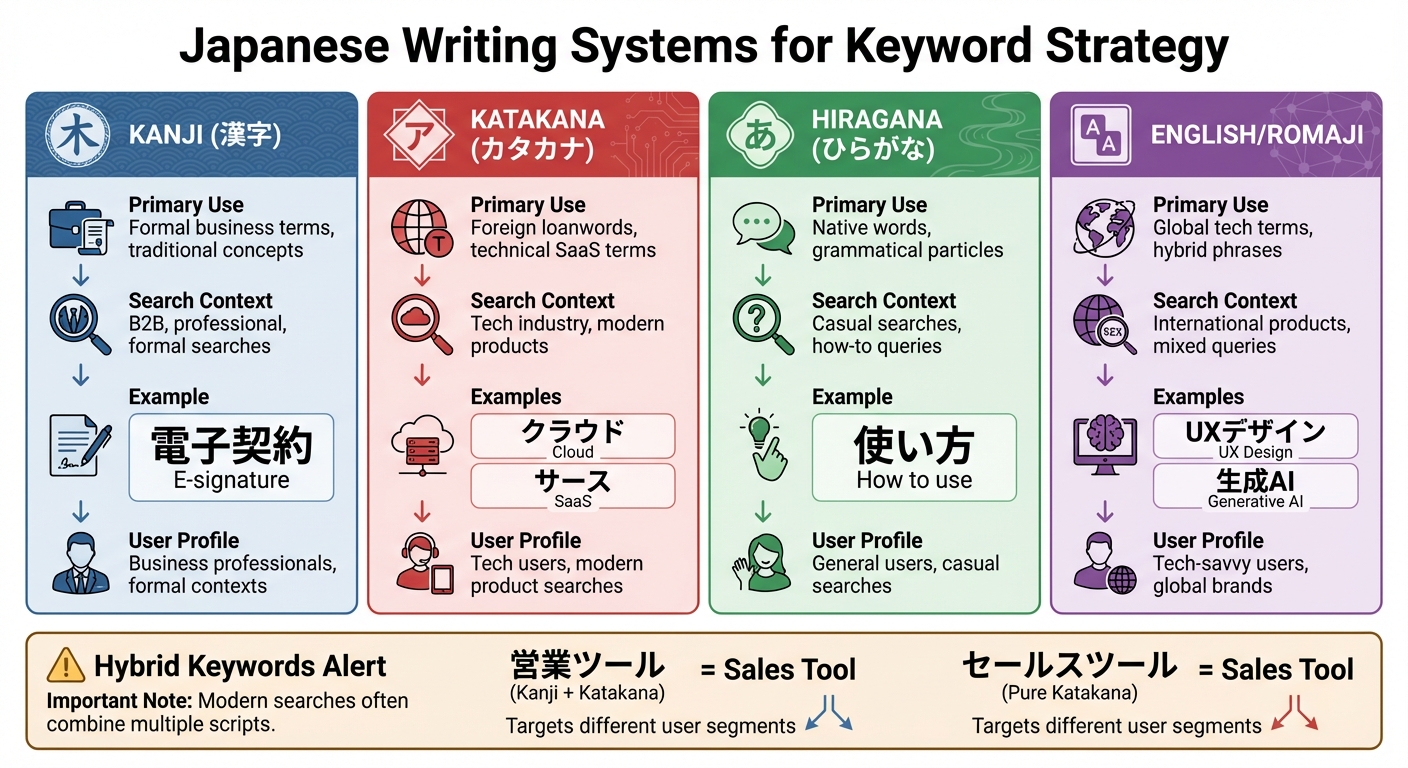
Japanese Writing Systems and Their SEO Applications: Kanji, Katakana, Hiragana, and Romaji
The Japanese language, with its multiple writing systems, presents a unique challenge for keyword strategies that most Western markets don’t face. Search terms in Japanese can appear in Kanji (Chinese characters), Hiragana (native syllabary), Katakana (used for foreign loanwords), or Romaji (Latin alphabet). Each script variation can lead to entirely different search results. This means keyword research in Japan isn’t just about translating terms – it’s about understanding user intent and the context behind their searches.
Working with Multiple Script Variations
The choice of script often reflects a user’s intent and familiarity with a specific product or topic. Kanji is commonly used in formal, professional searches, making it prevalent in B2B contexts. Katakana, on the other hand, is the go-to for technical terms and modern loanwords, such as those found in SaaS or tech industries. For more casual searches, Hiragana is frequently used, while Romaji often appears in global tech-related queries or brand names.
"Finding the Japanese keyword in the right Japanese writing system is the first step in successful SEO and SEM in Japan. Online translators almost always don’t get this right."
- Yuga Koda, Nihonium
The complexity grows even further with hybrid keywords, where multiple scripts are combined. For example, modern searches might mix English with Japanese characters, as in "生成AI" (Generative AI, combining Kanji and English) or "UXデザイン" (UX Design, blending English and Katakana). Even for a term like "sales tool", you might encounter variations like 営業ツール (Kanji + Katakana) or セールスツール (pure Katakana), each appealing to different user groups or professional contexts.
| Script Type | Primary Use | Example |
|---|---|---|
| Kanji | Formal business terms, traditional concepts | 電子契約 (E-signature) |
| Katakana | Foreign loanwords, technical SaaS terms | クラウド (Cloud), サース (SaaS) |
| Hiragana | Native words, grammatical particles | 使い方 (How to use) |
| English/Romaji | Global tech terms, hybrid phrases | UXデザイン (UX Design), 生成AI (Generative AI) |
The context of the search also impacts script usage. For instance, formal content often uses full Katakana, while casual searches may lean toward abbreviations. A thorough keyword strategy requires mapping out all script variations for each term and analyzing which forms are better suited for transactional versus informational searches. Automated translation tools typically fail to capture these nuances, as they cannot assess local search trends or the specific business context.
Grasping the importance of these script differences is the first step in tackling the broader challenges of Japanese keyword research, including synonyms and context-dependent meanings.
Managing Synonyms and Context-Dependent Meanings
In addition to script variations, Japanese keyword research must account for the wide range of synonyms and how their meanings shift depending on the context. For example, the English term "e-signature" can be translated as either 電子契約 (Denshi Keiyaku) or 電子署名 (Denshi Shomei). While both are correct, they cater to different industries or stages of the buyer journey, and each may have varying search volumes. Similarly, terms like 営業戦略 and 販売戦略 both translate to "sales strategy" in English but deliver completely different search results, requiring distinct optimization strategies.
"Japanese search behavior is distinct… Users often employ both Kanji and Kana forms, as well as mixtures of English loanwords."
- Yuga Koda, Nihonium
Context becomes even more critical in B2B SaaS, where formal language (Keigo) plays a significant role. Senior decision-makers often use longer, more polite search phrases, while younger users or mobile searchers tend to rely on casual abbreviations. Before committing to a specific Kanji variation, it’s essential to manually review search results to ensure they align with your product or service. If two synonyms generate different results on search engine result pages (SERPs), you’ll likely need separate landing pages tailored to each term. This detailed approach is what sets apart effective Japanese keyword strategies from basic translation efforts.
Mastering these intricacies is a foundational step before diving into tools and methods for Japanese keyword research.
Tools and Methods for Japanese Keyword Research
Effective Japanese keyword research requires a mix of global tools and local platforms to address the unique search behaviors of this market. Google Keyword Planner is a reliable choice for precise search volume data, but it only provides detailed figures if you’re running an active Google Ads campaign. Without one, you’ll see broader ranges like "100-1,000" instead of exact numbers.
Other global tools like Ahrefs, SEMrush, and Ubersuggest offer valuable insights, including competitive analysis and localized Japanese data. However, these tools sometimes miss the nuances specific to Japanese search behavior. This is where local tools come into play. Keywordmap, for example, excels at identifying subtle script differences and uncovering long-tail keywords, while User Insight focuses on understanding user intent and search journeys. These tools recognize how even small variations, like adding or omitting spaces between characters, can cause search volumes to shift significantly.
"In the case of Japanese, search volume often differs greatly depending on the keyword tool. The presence or absence of spaces often changes the value by several thousand units."
- Issey Morita, SEO Expert
Investing in paid tools is crucial to bypass the limitations of free versions. For those on a tight budget, Keyword Surfer, a free Chrome extension, provides search volume data directly on the search results page.
Best Keyword Research Tools for Japan
Choosing the right tool depends on your goals and budget. Google Keyword Planner is a great starting point for accuracy, especially if you’re already using Google Ads. For broader analysis, Ahrefs and SEMrush provide robust data for markets like Japan.
Japanese keyword research requires tools that can handle the intricacies of its language. Unlike global tools designed for Latin alphabets, Japanese platforms must account for Kanji, Hiragana, Katakana, and Romaji – all of which can impact search behavior. For example, "smartphone" might appear as スマートフォン (Katakana) or its shorter form, スマホ, and each variation can have vastly different search volumes.
Keywordmap is particularly effective for identifying these variations and finding long-tail opportunities that global tools may overlook. It’s especially useful for SaaS companies analyzing industry-specific terminology across sectors and seasonal trends. Meanwhile, User Insight helps map search journeys, showing how keywords align with different stages of the buyer’s decision-making process.
| Keyword Category | Monthly Search Volume | Characteristics | Example |
|---|---|---|---|
| Big Keywords | Over 10,000 | High traffic, very competitive | Website creation (ホームページ作成) |
| Middle Keywords | 1,000 – 10,000 | Moderate traffic, medium competition | Website creation company |
| Small Keywords | 100 – 1,000 | Lower traffic, easier to rank | Website creation company in Tokyo |
| Long-Tail Keywords | Under 100 | Specific intent, easiest to rank | Website creation company in Tokyo cost |
Using Q&A Sites and Consumer Platforms for Research
Keyword tools tell you what people are searching for, but they don’t always reveal the "why" behind those searches. This is where Japanese Q&A sites and consumer platforms shine. They provide insights into user intent, slang, and informal phrasing that standard tools might miss.
Yahoo! Chiebukuro (similar to Quora) is a valuable resource for understanding how people phrase questions about business needs and software solutions. These discussions often include casual abbreviations and unique phrasing that native speakers use naturally. For SaaS companies, this platform can help uncover long-tail keywords tied to different stages of the buyer’s journey.
"Active listening within relevant local digital forums provides vital context that cannot be obtained from search data alone."
- Yuga Koda, CEO, Nihonium
If you’re targeting developers or technical users, Qiita is more popular in Japan than StackOverflow. For trending topics and tech-related keywords, Hatena Bookmark is another useful platform. To keep up with real-time trends and generational language shifts, search hashtags on Twitter (X).
Pay close attention to how users mix scripts like Kanji, Hiragana, and Katakana. For example, a term like "クラウド管理" (cloud management) might appear in casual Katakana on one forum but in formal Kanji elsewhere. These variations reflect different intents and should guide your keyword strategy. Additionally, platforms like LINE OpenChat and BizReach are great for identifying business-specific terminology used by industry professionals.
Finding and Using Long-Tail Keywords
In Japan, long-tail keywords – those with monthly search volumes under 100 – are an essential strategy for SaaS companies. These terms are easier to rank for and often lead to higher conversion rates because they target users with specific needs.
To find these keywords, explore how terms are naturally combined in Japanese. For example, "sales tool" might be searched as 営業ツール (Kanji and Katakana mix) or セールスツール (Katakana only). Abbreviations, like スマホ for スマートフォン (smartphone), often become hidden gems for ranking.
Successful long-tail strategies combine business jargon, product categories, and task-specific needs. Instead of just targeting "cloud management", try phrases like "cloud management local invoice formatting", which reflect specific challenges faced by Japanese businesses. Adding modifiers like 初心者 (beginner), 上級者 (expert), or location-based terms can further refine your targeting and improve conversions.
To source these keywords, study live chat transcripts, customer feedback, and discussions on platforms like Yahoo! Chiebukuro. These sources often reveal how users describe their pain points, which can differ from formal business terms. Focus on queries related to local regulations and workflow terminology, as these tend to have lower competition but higher intent.
For new SaaS websites, targeting long-tail keywords is an excellent way to build domain authority. Keep in mind that top-ranking pages in Japan often feature 4,000–5,000 characters – longer than the typical sub-2,000 words seen in English SEO. Plan your content accordingly to meet this standard.
Since spacing variations can significantly impact search volume, avoid relying solely on Google’s suggestions, which often add half-width spaces between Japanese words. Instead, prioritize natural phrasing that mirrors how users describe their needs in forums and Q&A sites.
Optimizing for Japanese Search Engines
How Users Search on Google Japan and Yahoo! Japan
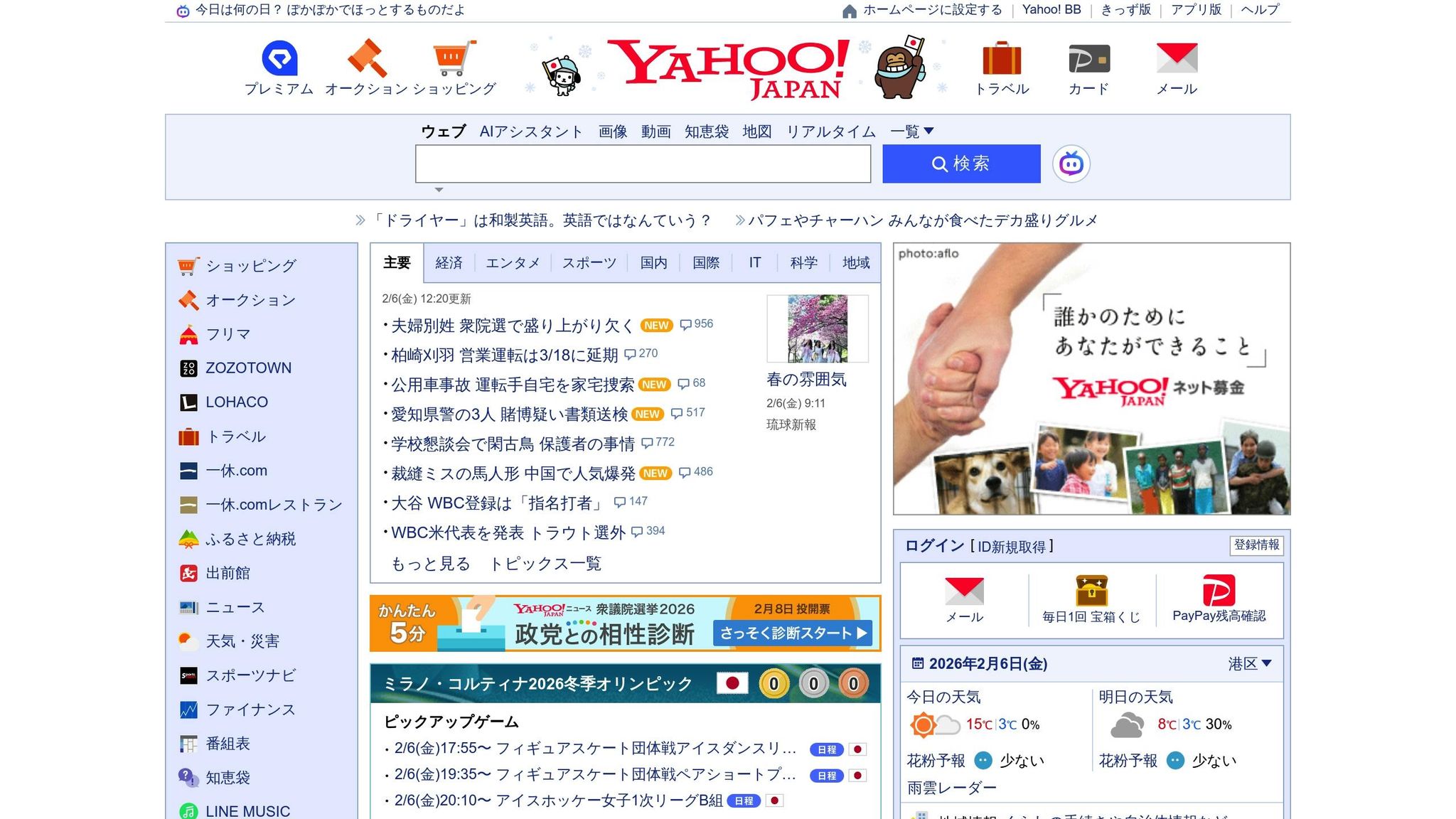
In Japan, Google leads the search engine market with about 80–90% of the share, while Yahoo! Japan holds around 10–15%. Since Yahoo! Japan has relied on Google’s search algorithm for organic results since 2010, optimizing for Google automatically benefits Yahoo! Japan as well. However, Yahoo! Japan’s audience trends older, with approximately 66% of its users over the age of 40. This demographic detail is crucial for SaaS companies planning ad campaigns. To connect with older decision-makers, consider Yahoo! Ads, while Google Ads may be better for reaching a broader audience.
Search behavior in Japan also differs from other markets. Japanese users often skip particles in their queries, relying instead on concise keyword strings, frequently influenced by auto-complete suggestions. Mobile optimization is especially important, as nearly 90% of Japanese internet users rely on smartphones for searches. This makes mobile-friendly design and page speed key priorities for better rankings.
Another important factor: the intent behind English terms often shifts when translated into Japanese. For instance, while "Gantt Chart" searches in the U.S. often focus on finding templates, Japanese users are more likely to look for articles explaining the concept. A simple translation of your strategy won’t cut it – you’ll need to align your content with the specific intent of Japanese users.
These search habits provide a foundation for customizing metadata and on-page elements to better meet local expectations.
Localizing Metadata and On-Page Elements
Understanding these unique search behaviors is the first step in tailoring your metadata and page content for the Japanese market. Effective optimization requires careful adjustments to align with local preferences and language nuances.
Japanese title tags have a recommended maximum of 28 characters, while meta descriptions should be around 90 characters for desktop and 49 for mobile. It’s a good idea to place your brand name at the end of title tags, leaving room for descriptive keywords upfront. Brand trust plays a significant role in Japan, so this approach helps establish credibility. Using a .jp or .co.jp domain further signals your commitment to the Japanese audience and improves trust with both users and search engines.
"Japanese keywords are a little trickier than keywords in English due to the three distinct writing systems. The three writing systems are Hiragana, Katakana, and Kanji."
- Yuga Koda, Nihonium
To optimize effectively, use a thoughtful mix of Kanji, Hiragana, Katakana, and English loanwords in your metadata. For B2B SaaS, it’s also essential to use formal Japanese (Keigo) in on-page content to match the professional tone expected in corporate environments. Don’t forget to implement hreflang attributes, which help search engines differentiate regional content and prevent duplicate content issues across your global site.
Additionally, Japanese characters require more vertical space and larger font sizes for readability compared to Latin scripts. Ensure your URLs are descriptive and encoded in UTF-8 to display Japanese characters correctly. However, avoid using Japanese characters in the domain name itself, as this can make URLs harder to copy and share.
sbb-itb-a752276
Connecting Keyword Strategy with SaaS Localization and Marketing
Matching Keywords with Product Localization
To truly connect with your audience, it’s crucial to integrate keyword research into every corner of your product. For example, Japanese users expect the language in your product interface – like dashboard labels, tooltips, and help sections – to match the exact terms they use when searching. If someone searches for "業務効率化ツール" (business efficiency tools), your product should reflect that same terminology. Mismatched terms can erode trust, especially in a market where precision is highly valued.
Localization isn’t just about translating words. It’s about ensuring that every element – buttons, navigation menus, error messages, user interface, documentation, and FAQs – uses consistent, localized keywords. For B2B products, this also means incorporating polite and formal language (keigo) where appropriate. For instance, if keyword research shows that users commonly search for "クラウド管理システム" (cloud management system), your interface should adopt this phrase instead of a literal translation from English. This approach ensures that high-volume search terms are embedded in your product while addressing user needs with guides and content that feel intuitive to native speakers.
Additionally, technical support for double-byte characters is a must for Japanese localization. Variants of keywords – such as kanji versus katakana versions – should be tested to target different user segments and stages of the buyer journey. Collaborate with native experts to ensure that the terms and phrasing you choose fit naturally within the context.
When your product localization aligns with your keyword strategy, you create a seamless experience that builds trust and strengthens engagement, setting the stage for effective marketing funnels.
Building Marketing Funnels with Localized Keywords
Localized keywords aren’t just for SEO – they’re the backbone of a cohesive marketing funnel. From awareness to conversion, using localized keywords consistently across blog posts, landing pages, and webinars ensures that your messaging resonates at every stage. Japanese users, for instance, often rely on Google Japan and Yahoo! Japan for business-related searches, frequently using long-tail queries that mix Japanese and English. Your funnel should capture these users by addressing their intent at each stage. Use broad, educational keywords for top-of-funnel content like blogs, and shift to more specific, action-oriented keywords for mid-to-bottom funnel content like webinars or case studies.
In Japan, the B2B buying process often involves the "Ringisho" system, where decisions are made collaboratively by multiple stakeholders. To support this, your keyword strategy should emphasize terms that encourage downloads of detailed resources, such as case studies or whitepapers. These materials should address regulatory concerns and provide the depth of information that evaluation committees look for.
An excellent example of this approach is Nihonium’s market entry strategy. They combine keyword research with funnel creation to ensure localized keywords are consistently used across SEO content, webinars, and sales materials. Their approach also includes technical SEO best practices, like implementing hreflang tags and using .jp domains, while tailoring content to meet cultural expectations. This comprehensive strategy ensures sustained lead generation and a strong market presence in Japan.
Conclusion and Next Steps
Main Takeaways
Crafting a winning keyword strategy for Japan requires a thoughtful approach that respects the country’s unique language and cultural dynamics. Japan’s multiple writing systems – hiragana, katakana, and kanji – mean you need to test keyword variations across these scripts to reach all segments of your audience effectively. Using local keyword tools is also key to understanding diverse user intents and search behaviors.
Mobile searches dominate in Japan, and Yahoo! Japan remains a significant player in the market. This makes precise targeting essential. Your keyword strategy should work hand-in-hand with your product localization efforts. When your product and content are consistently localized, it builds trust and creates a smoother user experience. Additionally, applying localized keywords throughout your marketing funnel aligns with Japan’s consensus-driven buying process, setting a strong foundation for success in the market.
How Nihonium Can Help with Your Strategy
Navigating the complexities of the Japanese market is no small task, and having the right support can make all the difference. Nihonium specializes in helping global SaaS companies succeed in Japan. They combine keyword research, product localization, marketing funnel development, and B2B SaaS sales support to provide a complete solution.
Whether you’re evaluating the market, localizing your product and content, or driving leads through SEO and partnerships, Nihonium’s tailored strategies ensure your approach matches the realities of the Japanese market. By aligning search, localization, and sales, they help you build credibility and drive conversions in Japan’s competitive B2B SaaS space.
FAQs
How do Japan’s unique writing systems impact keyword strategy?
Japan’s writing system is a fascinating mix of complexity and function, heavily influencing keyword strategy. It uses three scripts: Kanji, Hiragana, and Katakana. These scripts often work together in keywords, each serving a distinct purpose. For instance, Kanji is used to convey precise meanings (e.g., 電子契約, Denshi Keiyaku), Katakana is preferred for foreign loanwords (e.g., UXデザイン, UX dezain), and sometimes, a combination of both appears within a single keyword. This unique blend demands strategic attention to ensure the keywords remain relevant and effective.
Why does this matter? The choice of script directly impacts how Japanese search engines interpret and index keywords. Kanji adds depth and specificity, Hiragana often handles grammatical elements, and Katakana is the go-to for foreign or modern terms. To create a successful keyword strategy in Japan, it’s essential to consider the product, audience, and search habits. Selecting the right script in the right context can significantly boost visibility and engagement in this linguistically rich market.
What are the best tools for Japanese keyword research?
To dive into keyword research for the Japanese market, a few tools stand out for their usefulness and precision. Google Keyword Planner is a dependable choice, offering data on search volume and keyword ideas specifically tailored to Japan. Pair this with Ubersuggest, which adds features like keyword difficulty ratings and competitor analysis, making it a great companion to Google Keyword Planner. If you need quick insights, Keyword Surfer – a browser extension – lets you check search volumes directly in Google search results.
For a broader approach, Keyword Tool.io is excellent for finding Japanese keywords across platforms like Google, YouTube, and Bing. However, it’s crucial to understand the unique aspects of Japanese writing systems – Hiragana, Katakana, and Kanji. Using tools that accommodate Japanese input and provide localized suggestions will help you craft a keyword strategy that resonates with the audience. By combining these tools with a deep understanding of the market, you can boost your visibility in Japan’s SaaS landscape.
How can I create a keyword strategy that aligns with product localization in Japan?
When localizing your keyword strategy for Japan, understanding the local language, traditions, and search habits is key. Japan’s unique writing systems – Kanji, Hiragana, and Katakana – play a major role in how users search online. On top of that, English loanwords are often part of everyday searches. For example, using Kanji terms like 電子契約 (Denshi Keiyaku) for "e-signatures" or hybrid terms like 生成AI (Seisei AI) for "generative AI" can make your content feel more relevant to Japanese audiences.
It’s also important to move beyond simple translations. Instead, adapt your keywords to reflect how Japanese users naturally phrase their searches. Search habits often lean toward culturally specific expressions and conversational language. By capturing these nuances, your keywords will not only improve your content’s visibility but also help establish trust and connection with users. This approach makes your SaaS product more relatable and engaging for the Japanese market.
 English
  Japanese