

If you sell SaaS in Japan, your payout model should match your sales motion first, not your channel playbook from the U.S. In most cases, CPA fits self-serve, CPL fits sales-led lead gen, and revenue share, hybrid, or tiered payouts fit enterprise and partner-led deals. That’s because Japan B2B sales often take 3 to 18 months, involve 11+ stakeholders, and often move through partners.
Here’s the short version:
- CPA works best when the payout happens close to cash collected, usually on the first paid subscription
- CPL gives partners earlier pay, but puts more risk on you if leads don’t close
- Revenue share fits long sales cycles and partner-led enterprise deals, where partners help with approval, rollout, and renewal
- Hybrid gives an upfront payout plus a share of revenue, which often fits $10,000 to $100,000 ACV
- Tiered payouts work best when you already have enough partner volume to justify extra tracking and admin
A few points shape the math in Japan:
- About 43% of Japanese SME SaaS purchases start on local review sites
- About 70% of SaaS sales in Japan move through partner channels
- Many resellers carry competing products, so low commissions can push them to another vendor
- Weak Japanese-language UX, docs, support, pricing, or approval materials can hurt conversion and retention fast
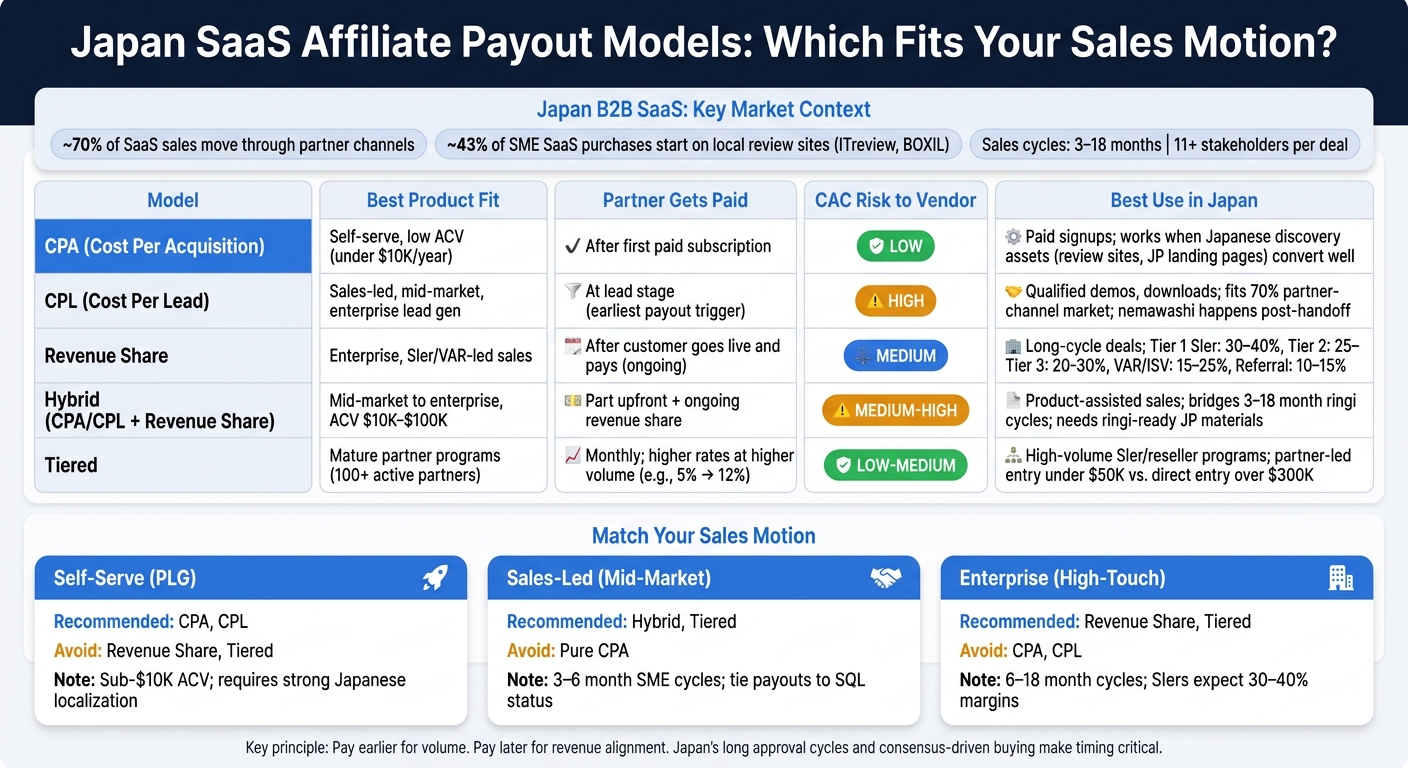
Japan SaaS Affiliate Payout Models Compared: CPA vs CPL vs Revenue Share vs Hybrid vs Tiered
Quick Comparison
| Model | Best fit | When partners get paid | Main risk to you | Best use in Japan |
|---|---|---|---|---|
| CPA | Self-serve, low ACV | After a paid conversion | Lower CAC risk, but partner interest may be low | Paid signup or first subscription |
| CPL | Sales-led, mid-market, enterprise lead gen | At lead stage | Highest risk from low-quality leads | Qualified inquiries, demos, downloads |
| Revenue Share | Enterprise, SIer/VAR-led sales | After customer goes live and pays | Slow payback | Long-cycle deals with partner support |
| Hybrid | Mid-market to enterprise | Part upfront, part after revenue starts | More payout complexity | Product-assisted sales in Japan |
| Tiered | Mature partner programs | Usually monthly | Margin pressure and more admin | High-volume SIer and reseller programs |
My takeaway is simple: pay earlier when you need volume, and pay later when you need tighter alignment with closed revenue and retention. In Japan, that choice matters more because long approval cycles and local buyer expectations can turn a good payout model into a bad one if the funnel is not set up for Japan.
sbb-itb-a752276
1. CPA
Cost Per Acquisition (CPA) means affiliates get a fixed fee when a referred user completes a set conversion event, such as a free trial signup, a qualified demo booking, or a first paid subscription. It’s a simple model: you pay only when a conversion happens. That helps keep vendor costs predictable and affiliate earnings steady.
In Japan, though, CPA tends to work best when the conversion event sits close to actual revenue.
Best Product Motion
CPA is usually a good fit for self-serve, low-ACV products, often under $10,000 per year, where a user can buy without going through formal procurement.
That matters in Japan. The ringi approval process often means that even a very interested user can’t complete a purchase on their own. Because of that, CPA tends to get weaker once ACV climbs past roughly $5,000 unless a sales team helps move the deal along. In other words, for Japan, the payout trigger matters just as much as the product motion.
Payment Timing
In Japan, it makes more sense to pay CPA on the first paid subscription, not on the trial signup. That helps protect margin and screens out low-intent leads.
CAC Risk
CPA brings the lowest CAC risk because payment comes after conversion. The flip side is simple: affiliates can be picky. If your product hasn’t found product-market fit in Japan, performance-only partners are less likely to put effort behind it.
Japan Localization Dependence
CPA results depend a lot on local discovery. 43% of Japanese SME SaaS purchases start on local IT review sites like ITreview and BOXIL. That means affiliates tend to convert better when buyers can research the product on their own in Japanese.
A few things help here:
- Japanese landing pages
- Local review platforms
- Approval-ready ROI, security, and proposal materials
These assets make it easier for buyers to move from interest to purchase.
If CPA sits too close to revenue for your motion, CPL moves the payout earlier in the funnel.
2. CPL
Cost Per Lead (CPL) pays affiliates when they bring in a qualified lead, usually a qualified inquiry or a document download, instead of making them wait for a signed deal. In plain English: the payout happens earlier in the funnel. That shifts the risk on both sides. Use CPL when CPA sits too close to booked revenue, but revenue share pushes payment too far down the line.
Best Product Motion
CPL works best for sales-led and enterprise products, especially in a hybrid or product-assisted sales motion. In Japan, a lead often marks the start of the sales process. Nemawashi and ringi usually happen after the handoff, which makes CPL a good match for Japan’s channel-led motions. About 70% of SaaS sales in Japan move through partner channels, so this model lines up with how many deals come together there. For high-ACV products, it also gives consultants and advisors a clear reason to make warm introductions.
Cash-Flow Timing
CPL pays before a contract is signed, which makes it the earliest payout trigger among the core affiliate models. That matters because B2B sales cycles in Japan usually last 3 to 18 months. Compared with revenue share, CPL separates payment from the full subscription lifecycle. That can make it easier to bring in partners and keep them engaged when the sales cycle drags on.
CAC Risk
CPL brings the highest CAC risk among the core models because you’re paying for leads that might never close. If localization is weak, that risk gets worse fast.
Japan Localization Dependence
Japanese buyers expect Japanese-language UI, documentation, and support during the evaluation stage. Lead capture forms also need to comply with APPI. If you want CPL leads to turn into pipeline, affiliates and sales teams need material that helps with internal approval, such as:
- Japanese-language ROI documentation
- Security compliance sheets
- Case studies that internal champions can use for consensus-building
When payout needs to track closed revenue instead of lead volume, revenue share is the next model to look at.
3. Revenue Share
If CPL pays for pipeline, revenue share pays for retained revenue.
With revenue share, affiliates earn an ongoing cut of subscription revenue for as long as the customer stays active. So instead of a one-time payout, the partner gets paid month after month – or year after year – based on retention. That changes the incentive in a big way: the partner isn’t just rewarded for making an intro. They’re rewarded when the customer sticks around. In Japan, that link matters because partners often shape implementation, internal approval, and renewal.
Best Product Motion
Revenue share is the best fit for enterprise and sales-led products in Japan. Around 70% of enterprise software sales in Japan move through partner channels such as Systems Integrators (SIers) and Value-Added Resellers (VARs). That’s a big deal because Japanese enterprise buyers often want a trusted middle party to help deals move through ringi and internal consensus. Partners tend to perform best when they already have those buyer relationships.
For self-serve products, revenue share shows up less often. In that part of the market, lower-margin referral deals – usually 10–15% – are more common.
Cash-Flow Timing
Revenue share has the slowest payback among the core models. Commissions start only after the customer is live and paying, and they continue only while the subscription renews. Japanese B2B sales cycles often last 3 to 18 months, and enterprise deals can take even longer. That’s exactly why partner incentives carry so much weight here.
Typical partner margins land in the 20–40% range of subscription revenue, based on the SIer tier. That makes this model a strong match for partner-led enterprise sales.
| Partner Type | Typical Revenue Share | Target Segment |
|---|---|---|
| Tier 1 SIer | 30–40% | Fortune 500, Government, Finance |
| Tier 2 SIer | 25–35% | Mid-to-large Enterprise |
| Tier 3 SIer | 20–30% | SMB and Regional Enterprise |
| VAR / ISV | 15–25% | Niche / Category-specific |
| Referral Partner | 10–15% | Early-stage leads |
CAC Risk
Vendor CAC can stay low, but there’s a catch. 82.5% of Japanese resellers sell competing products. So if your share rate is too small, partners may just push another vendor instead. Koda puts it plainly:
"If the revenue share is too low, the reseller has no incentive to sell. Especially if your product is new to the market and has no local presence, negotiating too heavily on the revenue share may have adverse effects."
One practical setup is to offer 30% in year one, then 15% on renewals. That keeps the reward for new customer acquisition high without giving away the same rate forever.
Japan Localization Dependence
Revenue share rises or falls with localization quality because Japanese buyers care deeply about reliability and long-term vendor support. In many cases, partners fill the gap with Japanese-language technical support, local billing in JPY, and implementation help that the vendor doesn’t yet have on the ground.
Partners are also picky. Only about 10% of products usually make it into their catalogs because they guard client relationships closely. To win a place there – and to keep commissions coming through renewals – vendors need:
- Japanese-language onboarding
- JPY billing
- APPI-compliant data handling
- ringi-ready proposals
Miss those basics, and retention can slide. When retention drops, the partner’s recurring commission drops too.
If you need earlier payout without giving up revenue alignment, hybrid is the next model.
4. Hybrid
Hybrid keeps revenue tied to results, but it pays partners sooner.
It blends an upfront CPA or CPL with ongoing revenue share. So the partner gets paid at the start, then keeps earning a percentage of subscription revenue for as long as the customer stays active. That two-part setup helps on both sides: partners get cash in sooner, and vendors still keep retention tied to partner earnings.
Best Product Motion
Hybrid works well for products that can generate demand on their own but still need sales to get the deal across the line. That makes it a strong match for Japan. The product brings in the lead, and the sales team closes it through ringi and group buy-in.
Best fit: ACV of $10,000 to $100,000.
Cash-Flow Timing
The upfront payout gives affiliates money earlier. The revenue share gives them a reason to stay involved through Japan’s long 3-to-18-month sales cycle.
CAC Risk
The upfront payment puts more acquisition risk on the vendor. The revenue share softens that by linking part of partner earnings to retention.
Japan Localization Dependence
A hybrid model only works if the product can turn local demand into pipeline. In Japan, that means partners need _ringi-ready materials:
- Japanese-language ROI documentation
- Security compliance sheets
- Localized case studies they can circulate internally
When payout needs to grow with partner volume or performance, tiered models give you tighter control.
5. Tiered
Tiered payouts increase commission rates as affiliates close more deals. A program may start at 5% and climb to 12% as monthly closed-deal volume grows.
That kind of sliding scale gives top partners a clear reason to put your product ahead of a rival’s. In Japan, that matters a lot because resellers often sell competing products. If you want partners to give you more attention, this setup can help.
Best Product Motion
Tiered structures fit enterprise and sales-led motions best. In Japan, that usually means working through Tier 1 and Tier 2 SIers, since they bring the inside relationships needed to move through the slow, consensus-driven ringi approval process.
Self-serve PLG products don’t fit as well. They skip the high-touch middle layer these programs are built to reward.
Cash-Flow Timing
Payouts are usually settled monthly. New business often earns a higher rate, while renewals tend to pay less.
CAC Risk
Tiered models push a large share of acquisition work to partners, which helps keep direct CAC low for the vendor. Partner-led entry often costs under $50,000 in year one, while direct entry often runs above $300,000.
The catch is margin. You’re usually giving up 20% to 40% to the channel.
Japan Localization Dependence
Tier 1 SIers often pass on products that aren’t localized. They usually expect a Japanese UI, JPY pricing, and Japanese training materials.
If affiliates want to reach higher performance tiers, they also need ringi-ready sales assets they can share inside the buyer’s organization, including:
- ROI documentation
- Security compliance sheets
- Localized proposal templates
Those materials make it much easier for partners to sell through Japan’s internal approval process. The next question is how this performs across self-serve, sales-led, and enterprise motions.
Tradeoffs by Product Motion
A payout model that works in self-serve can fall apart in enterprise. That’s why payout timing needs to match your product motion.
In Japan, this matters even more. About 70% of SaaS sales flow through partner channels, and the market’s consensus-driven buying style turns payout timing into a risk-control issue, not just a commission choice. If you pay too early, you can burn budget on deals that stall. If you pay too late, partners may lose interest.
Here’s how the main models line up across self-serve, sales-led, and enterprise motions in Japan:
| Product Motion | Most Suitable Models | Least Suitable Models | Why It Fits in Japan | Key Guardrails |
|---|---|---|---|---|
| Self-Serve (PLG) | CPA, CPL | Revenue Share, Tiered | High volume, low ACV (sub-$10,000); works only when Japanese discovery assets convert fast | Set paid-only CPA triggers; require minimum usage thresholds before payout |
| Sales-Led (Mid-Market) | Hybrid (CPL + Rev Share), Tiered | Pure CPA | Bridges initial discovery and the 3–6 month SME sales cycle; gives partners time to help move deals through consensus building | Tie payouts to Sales Qualified Lead status; include clawbacks for early churn |
| Enterprise (High-Touch) | Revenue Share, Tiered | CPA, CPL | Aligns with SIers managing 6–18 month cycles and complex integrations; Tier 1 SIers typically expect 30% to 40% margins for ongoing support | Require ringi-ready materials in Japanese; include buy-back or transition clauses |
The pattern is pretty clear. CPA and CPL fit best when volume is high and deals move fast. Once you get into longer sales cycles, more internal buy-in, and partner-led support, you need a model that gives partners a reason to stay involved over time.
Strong Japanese localization and funnel support can help a lot here. Teams like Nihonium can make CPA and hybrid models more workable by improving conversion quality before the handoff. Next, weigh the pros and cons of each model in Japan.
Pros and Cons of Each Model
Payout timing should match how much work the partner does to move the deal forward. That’s the heart of the tradeoff.
| Model | Pros | Cons | Best For | Japan caveat |
|---|---|---|---|---|
| CPA | Predictable costs; rewards tangible results | Doesn’t reward long-term retention or growth | Self-serve, low-ACV products | Ringi cycles of 3–18 months can push payout too far from the partner’s effort. |
| CPL | Easy for partners to start; builds top-of-funnel pipeline | Lead quality varies; high friction in follow-up | PLG-led awareness; SME targeting | Nemawashi makes attribution harder because the real decision often happens before lead capture. |
| Revenue Share | Aligns long-term incentives; encourages high-quality leads | Unpredictable partner income; depends on retention | Enterprise SaaS; SIer partnerships | Japanese partners often expect 20%–40% margins to justify full-funnel ownership. |
| Hybrid | Pays for both lead gen and close; mitigates risk | Complex to manage; potential for channel conflict | Mid-market to enterprise SaaS; phased market entry | Requires Japanese ROI docs and proposals to support the internal champion. |
| Tiered | Incentivizes top performance; rewards partners who scale | Hard to track; can turn off smaller partners | Mature programs with 100+ active partners | Partners may want exclusivity or territory protection before committing to higher tiers. |
In Japan, revenue share and hybrid models usually work best for partner-led sales motions. They map better to long buying cycles and the amount of work partners put in behind the scenes.
CPA and CPL can still work, but only when your conversion assets are strong. If the handoff is weak or the buyer path is messy, partners may feel like they’re doing the hard part without getting paid for it.
Tiered payouts make more sense in mature programs with enough partner volume to justify the extra admin. If you don’t have that scale yet, the setup can become more trouble than it’s worth.
Conclusion
Choose your payout model based on how you sell, how long deals take to close, and how sure you are that customers will stick after launch. The tradeoff comes down to timing: pay earlier if you want volume, pay later if you want tighter alignment. That plays out in different ways depending on your product motion.
For self-serve SaaS, strong Japanese documentation comes first. If the product isn’t localized well, partner-led self-serve programs tend to stall. Once you have localized product-market fit, CPA or a conservative hybrid can make sense. But when a salesperson is needed to get the deal across the line, it makes more sense to move the payout earlier in the funnel.
For sales-led SaaS, CPL on qualified demos often works well. A hybrid model with a close-based kicker can also be a good fit. Paying earlier gives partners a reason to stay involved through Japan’s long approval process. And with larger deals, it helps to reward movement through the full sales cycle, not just the initial lead.
Enterprise SaaS usually fits a milestone-based hybrid or tiered payout structure. Long deal cycles call for payouts that keep partners engaged through implementation and renewal. Tiered or hybrid terms work well in partner-led selling because they reward steady effort across the whole cycle.
The practical takeaway is simple: don’t copy a payout model just because it works in the U.S. Build it around Japan-specific conversion rates, sales cycle length, actual retention confidence, and the maturity of your localization.
If your Japan foundation is still thin, Nihonium can help with localization, funnel setup, and fractional sales support before you lock in a payout model.
FAQs
How do I choose the right payout model for my sales motion in Japan?
Pick the model that fits your sales motion, product complexity, and how much control you want over the customer relationship.
For self-serve products with low contract values, CPA is often a good fit. It rewards clear conversions and helps keep costs predictable.
For sales-led and enterprise deals, revenue share is more common. In those cases, partners often handle long-term relationships and guide the full sales cycle.
A hybrid model can also make sense. For example, you might offer a higher first-year commission and a lower rate on renewals. It also helps to set clear account ownership and handoff rules early so you can avoid channel conflict.
When should I use hybrid payouts instead of pure revenue share?
Use a hybrid payout model in Japan when you want your partner’s incentives tied to growth goals, without taking on all the downside of a pure revenue-share deal.
This setup makes sense when a basic retainer won’t do the job, but both sides feel good about the product-market fit and the partner’s ability to bring in conversions.
What localization gaps hurt affiliate performance in Japan?
Localization gaps hurt affiliate performance in Japan because they chip away at trust and add friction at the worst possible moment.
Basic translation isn’t enough. If the UI feels awkward, the docs read like they were machine-swapped, or the onboarding material doesn’t fit local expectations, buyers can stall out fast. And in Japan, where trust carries a lot of weight, that slowdown can cost you.
The problem gets bigger in a consensus-driven buying process. Affiliates have a much harder time turning interest into action when sales collateral and proposals aren’t professionally localized. If the material doesn’t feel polished and native, internal buy-in becomes tougher.
A weak presence on local platforms like ITreview or BOXIL can also hurt trust. Buyers often look for signals that a company is active and credible in the local market. If those signals are missing, conversion gets harder.
Related Blog Posts
- Local vs Global SaaS Pricing: Japan Market Guide
- Channel Partners vs. Distributors in Japan SaaS Market
- Ultimate Guide to Content Partnerships in Japan
- How to Build Local Partnerships for SaaS Growth in Japan
 English
 Japanese