

Japan’s SaaS market offers immense potential, growing from ¥1.4 trillion ($9.6 billion) in 2023 to an expected ¥2 trillion ($13.7 billion) by 2027. But entering this market requires careful planning due to its unique business practices, regulatory landscape, and buyer expectations. Here’s what you need to know:
- Market Size & Segmentation: Focus on either large enterprises (high ACV, longer sales cycles) or SMBs (lower ACV, quicker adoption). Key industries include manufacturing, finance, and healthcare.
- Compliance: Understand strict data laws like APPI and certifications like Privacy Mark and ISMAP. Local hosting is often preferred.
- Localization: Go beyond translation – adjust your product interface, pricing, and support to meet Japanese preferences.
- Sales Model: Choose between direct sales, system integrators, resellers, or fractional sales based on your product complexity and budget.
- Relationships: Build trust through Nemawashi, social proof, and adherence to Japanese business etiquette.
- Local Presence: Establish a local entity (e.g., KK) and hire experienced talent. Expect high costs and extended timelines.
- Timelines: Break the process into phases – research, localization, setup, execution, and scaling – while validating demand at each step.
Japan’s market demands patience and precision. Success hinges on understanding buyer behavior, regulatory requirements, and the importance of trust. Avoid shortcuts and validate your strategy before committing resources.
1. Market Size and Target Segment Selection
Before allocating resources, it’s essential to assess market readiness. The earlier data on market size and SME adoption highlights where opportunities lie, but it’s crucial to remember that the market is far from uniform. Large enterprises often drive high-value contracts, but there’s also a vast, underutilized SME segment waiting to be tapped. This information is key to shaping your focus as you move forward.
Deciding between targeting large enterprises or SMBs is a pivotal choice. Large enterprises typically require partnerships with system integrators and offer higher Annual Contract Values (ACV). However, they operate through the consensus-driven Ringisho process, which can significantly extend sales cycles. On the other hand, SMBs are more flexible and often lean toward direct sales or digital channels, though they bring in lower ACV. High-ACV platforms are better suited for enterprises via system integrators, while SMBs respond well to transactional solutions offered through resellers or digital marketplaces. Matching your product’s complexity and ACV expectations to the specific demands of Tokyo and regional keiretsu markets is critical.
Geography plays a surprisingly significant role. Tokyo dominates IT spending and should be your primary focus, but regional markets like Kansai and Chubu operate within keiretsu – interconnected corporate networks that heavily influence procurement decisions. Entering these regional markets without a solid understanding of keiretsu dynamics can lead to delays. Gaining insight into these dynamics is essential for effective vertical targeting.
Target industries where demand is strongest. For example, manufacturing companies are seeking AI-powered predictive maintenance tools to address the anticipated labor shortage of 2.3 million workers by 2030. Meanwhile, the finance and healthcare sectors are focusing on security compliance and managing sensitive data. Additionally, the move away from traditional hanko (physical seals) and paper-based systems is fueling rapid adoption of electronic contract systems and Enterprise Performance Management (EPM) tools.
"Japanese companies are highly pragmatic and cautious when adopting new solutions. Therefore, it’s crucial to offer specific solutions to their actual challenges".
These regional and industry-specific insights are invaluable for fine-tuning your market entry strategy.
While early adopters represent a small slice of the market, the real scale lies in reaching the early and late majority. To succeed with these groups, you’ll need full localization and robust local support. Start by validating your approach through pilots or fractional sales efforts before committing significant investments like $400,000 for a local entity. This validation phase will help you pinpoint gaps between your global offering and the specific needs of Japanese buyers.
2. Compliance, Data Protection, and Security Standards
Japan enforces strict regulations around data protection and security, requiring businesses to comply with national and industry-specific laws. The Act on the Protection of Personal Information (APPI), overseen by the Personal Information Protection Committee (PPC), applies to all businesses handling personal data of individuals in Japan, including foreign SaaS companies. If a data breach impacts more than 1,000 individuals or involves malicious activity, it must be reported to the PPC. Updates to the APPI are expected in 2025 or 2026, focusing on stronger protections for minors’ data and introducing administrative monetary penalties similar to the GDPR.
Another key regulation is the Telecommunications Business Act, which imposes obligations on communication-facilitating SaaS platforms. Platforms with over 10 million free users or 5 million paid users are classified as large-scale and must appoint an information protection officer and conduct annual compliance reviews with the Ministry of Internal Affairs and Communication (MIC). For international data transfers, businesses must obtain user consent unless the receiving country has an adequacy decision. Additionally, many Japanese companies prefer data to be hosted locally – using services like AWS Japan or Azure Japan regions – to address data sovereignty concerns.
Certifications play a critical role in demonstrating compliance. The Privacy Mark, based on JIS Q 15001 and issued by JIPDEC, often signifies compliance levels beyond APPI standards. For businesses working with government clients, ISMAP certification is indispensable, requiring adherence to approximately 330 security benchmarks. Financial SaaS providers must align with the FISC Guidelines, while healthcare services must comply with the Pharmaceutical Affairs Law and related data protection rules.
Japan’s regulatory clarity provides a distinct advantage:
"For foreign companies, especially those in highly regulated industries like fintech, health tech, and software as a service, Japan’s transparency in governance reduces the risk of unforeseen legal hurdles." – Ulpa
To navigate these requirements, it’s essential to work with local legal experts to adapt privacy policies and security documentation to meet Japanese standards. In April 2025, Japan introduced the Active Cyber Defence Bill, which mandates critical infrastructure providers to promptly report incidents and allows pre-emptive actions against cyber threats. Establishing robust compliance measures ensures a smoother path to product localization and tailored sales strategies. Addressing these regulations is just as crucial as fine-tuning your market approach to align with Japan’s business landscape.
3. Product, Pricing, and Customer Support Localization
Localizing your SaaS product for Japan involves much more than simply translating text. Research shows that 90% of Japanese consumers prefer products with information in their native language (compared to a 76% global average). Additionally, only 50% of Japanese customers would choose a major global brand over a localized option (versus 69% globally), and 66% of B2B buyers are willing to pay more for well-localized solutions.
For your product interface, high-quality, native-level Japanese is essential. This includes using the correct honorifics (keigo) and avoiding machine translations. Native professionals should handle this work to ensure the nuances and cultural expectations are met. As Naoki Togawa, Manager at Nikkei Business Publications, puts it:
"Everything should be in high-quality, idiomatic Japanese. There’s nothing worse than bad translation. It’s easy to tell which vendors know what they are doing and are really committed to the market just through the quality of their materials and programs."
Beyond language, your UI must be adjusted to fit local preferences. Japanese text often requires more vertical space, and your interface should support surname-first name formats, Japanese-specific date and number pickers, detailed menus, and comprehensive on-screen information [5,17].
Pricing Adjustments
Adapting your pricing strategy is equally important. Pricing should be displayed in Japanese Yen and include tax to comply with the 2023 Qualified Invoice System [5,6]. For B2B clients, offering flexible payment options can make a big difference. This includes integrating bank transfers (furikomi), monthly invoicing cycles, and local payment gateways like GMO Payment Gateway or PayPay. Aligning your subscription model with Japan’s fiscal year (April 1–March 31) and offering multi-month pre-approvals can further ease adoption for corporate clients.
Customer Support Expectations
Customer support in Japan needs to be handled by native speakers familiar with local business etiquette. For technical products, providing detailed Japanese documentation is critical. While some developers might prefer English UI labels if translations fall short, localized onboarding guides and in-app instructions are key to preventing user drop-off during setup [8,16]. Additionally, enterprise clients often expect data to be hosted within Japan to meet local compliance requirements.
4. Sales Model and Distribution Channel Selection
Picking the right sales model for Japan is a crucial step in entering the market. Success hinges on aligning your product’s complexity and pricing with the unique buying practices in Japan.
Direct sales offers complete control over the process but comes with a hefty price tag. Setting up a local presence – typically a Country Manager and one additional hire – can cost around $400,000 annually, not including go-to-market expenses. This model is best suited for well-established global companies with strong brand recognition, though it does carry the risk of over-reliance on a single point of contact.
For high-ACV enterprise platforms, partnering with system integrators is often the way to go. These partners bring the technical know-how and trusted relationships needed to navigate the intricate procurement processes of large Japanese corporations. On the other hand, resellers are better suited for transactional, low-ACV solutions that have shorter sales cycles. Keep in mind, though, that major Japanese distributors are selective – only approving about 10% of the products they evaluate. This makes it vital to validate your product before committing to a channel partner.
Distributors typically specialize in specific territories or industries and act as the "Reseller of Record." They provide high-touch support, which is especially important in regulated industries. However, since they oversee the entire sales process, you’ll have less control over how your product is marketed and sold.
If you’re not ready to commit fully to a specific model, consider fractional sales support. This involves hiring part-time local professionals to test the market and manage leads without the financial burden of full-time employees. It’s a flexible way to gauge demand and fine-tune your go-to-market strategy. Even if your product thrives globally with a Product-Led Growth approach, Japan’s consensus-driven "Ringisho" procurement process often requires a sales-led or hybrid model. Fractional sales support can bridge this gap, offering a nimble strategy that aligns with your localized plans.
At Nihonium, we specialize in helping global SaaS companies tackle these challenges. Our tailored fractional sales support and localized go-to-market strategies ensure a cost-efficient and strategic entry into the Japanese market.
5. Business Relationships and Enterprise Sales Approach
Breaking into Japan’s enterprise market goes beyond picking the right sales model – it’s about building strong, trust-based relationships. Enterprise sales in Japan are notoriously time-intensive, often stretching over 18–24 months from first contact to a signed contract. This extended timeline is largely due to Japan’s consensus-driven decision-making process, which involves multiple stakeholders at every stage.
Japanese enterprises rely on a system called Ringi-seido, where proposals are circulated among various departments – IT, security, finance, and operations – before reaching senior management for approval. This hierarchical, consensus-based structure means you’ll need to win over not just one decision-maker but an entire network of influencers and gatekeepers.
A big part of this process happens before any formal proposal is submitted. This is where Nemawashi comes in. Through informal, one-on-one meetings with key stakeholders, you can gather insights, address concerns, and resolve potential objections early. These efforts can significantly shorten the lengthy sales cycle. Additionally, Japanese buyers place high importance on social proof. Local case studies, user communities, and Japanese-language thought leadership content can help alleviate concerns and build trust [10, 24].
Attention to meeting protocols is equally critical. Always provide agendas and materials in Japanese ahead of time to ensure alignment. Begin meetings with formal introductions, exchange business cards following proper etiquette, and focus on sharing detailed, precise information rather than engaging in hard selling. Japanese buyers value thorough answers, particularly on topics like security, system integration, and localized support, as these are common SaaS adoption blockers in Japan. Be mindful of indirect feedback – phrases like "it may be difficult" or "we will consider internally" often signal significant concerns [24, 25].
Another key factor is how Japanese enterprises prefer to buy. Many opt to work with trusted system integrators or local partners who handle integration, customization, and ongoing support. Partnering with established domestic companies through co-selling or reseller agreements can fast-track your entry into the market by leveraging their credibility and local connections [24, 25].
At Nihonium, we understand these challenges and offer tailored strategies to help global SaaS companies navigate the complexities of Japan’s enterprise market. From mastering Nemawashi to adhering to meeting protocols and building partnerships, our localized expertise ensures you establish the trust and credibility needed for long-term success.
sbb-itb-a752276
6. Local Presence and Team Building
Setting up a physical presence in Japan is a must for entering the market successfully. Without a local office, you can’t register your business, open bank accounts, apply for work visas, or hire employees. Essentially, your operations would be limited to non-revenue-generating activities like market research [33,34]. The next step is choosing the right legal structure to support your local operations.
Most SaaS companies opt for one of two options: a subsidiary (Kabushiki Kaisha or KK) or a branch office. A KK provides full commercial functionality with limited liability, while a branch office operates as an extension of the parent company, leaving the parent liable for its activities. Setting up a KK involves registration fees starting at around 250,000 JPY (approximately $1,670), with professional service fees typically ranging between 200,000 and 500,000 JPY (about $1,330 to $3,330). On average, establishing a KK takes about two months, while a branch office can be set up in roughly one month. To navigate the paperwork and registration, it’s wise to hire a judicial scrivener (shihoshoshi) [27,28].
Building a local team is just as essential. Start by hiring a country manager or lead salesperson who knows the market inside out and has a strong local network. Language skills alone aren’t enough – deep market knowledge is key. Be prepared to invest in competitive salaries: managerial roles average around 10 million JPY per year (approximately $66,700), while administrative positions range from 3 to 5 million JPY annually (about $20,000 to $33,400). As Estelle Nocos points out:
"Japanese companies often take a flexible approach to hiring, training individuals from diverse backgrounds… reflecting a commitment to lifetime employment and social responsibility".
If you decide to work with a recruitment agency, keep in mind that fees for managerial hires can go as high as 35% of the first year’s salary.
For foreign executives, obtaining a Business Manager visa involves meeting specific requirements: either investing at least 5 million JPY (around $33,400) in capital or hiring at least two full-time local employees. Additionally, you’ll need to demonstrate at least three years of management experience [31,32].
At Nihonium, we specialize in helping global SaaS companies establish their presence in Japan. From setting up entities and offices to building local teams, our tailored strategies and fractional sales support ensure you start on the right foot – avoiding costly mistakes while meeting the high standards Japanese businesses expect.
7. Entry Timeline, Key Milestones, and Risk Planning
Breaking your Japan market entry into five clear phases – research, localization, organizational setup, go-to-market execution, and scaling – can help you confirm market readiness before making significant investments. Each phase is designed with specific milestones to validate your progress and readiness to move forward.
This phased approach builds on earlier discussions about localization and extended sales cycles, ensuring you validate assumptions at every step. Here’s how it works:
- Research: Begin by mapping competitors and identifying your target audience. Partner with local experts and organizations like JETRO for discovery visits.
- Localization: Adapt your product, website, and documentation to align with local preferences. Ensure compliance with APPI regulations and set up local payment methods like bank transfers (furikomi).
- Organizational Setup: Choose the appropriate legal structure, often a Kabushiki Kaisha, and hire local talent to strengthen your team.
- Go-to-Market Execution: Launch localized SEO and SEM campaigns, attend tradeshows, and collect meishi (business cards). Securing your first customer during this phase is crucial.
- Scaling: Focus on creating local case studies to support the Ringisho process, a consensus-driven decision-making framework. Once you’ve established product-market fit, expand through resellers.
This step-by-step framework not only confirms readiness but also helps reduce risks at each stage.
Avoiding Premature Moves and Managing Risks
Jumping ahead, such as setting up a legal entity before validating market demand, can lead to costly missteps. Major risks include scaling too soon, inadequate localization, and failing to earn local trust. Keep in mind that Japanese decision-making typically involves 30–40% more management layers compared to U.S. companies, leading to longer sales cycles. Attempting to benchmark against global metrics can quickly become frustrating.
Vivien Dao, Growth Marketing Lead at Custom Media, underscores the importance of a fully committed approach:
"The APAC market is a constantly shifting region… If you want to play in it, you have to go all in. You can’t do it halfway, and hope that your US-based marketing messages or strategy are going to just magically resonate".
To mitigate these risks, focus on building strong relationships and set realistic timelines rooted in trust and understanding. Develop detailed documentation to support internal advocacy for your product during the Ringisho process.
How Nihonium Can Help
Nihonium specializes in guiding global SaaS companies through this phased approach with tailored market entry strategies. From validating initial demand to executing a full-scale go-to-market plan, Nihonium ensures you hit key milestones while avoiding costly mistakes that come from moving too quickly or skipping vital steps. This methodical approach ensures a smoother entry into the Japanese market, reducing risks at every stage.
Comparison Table
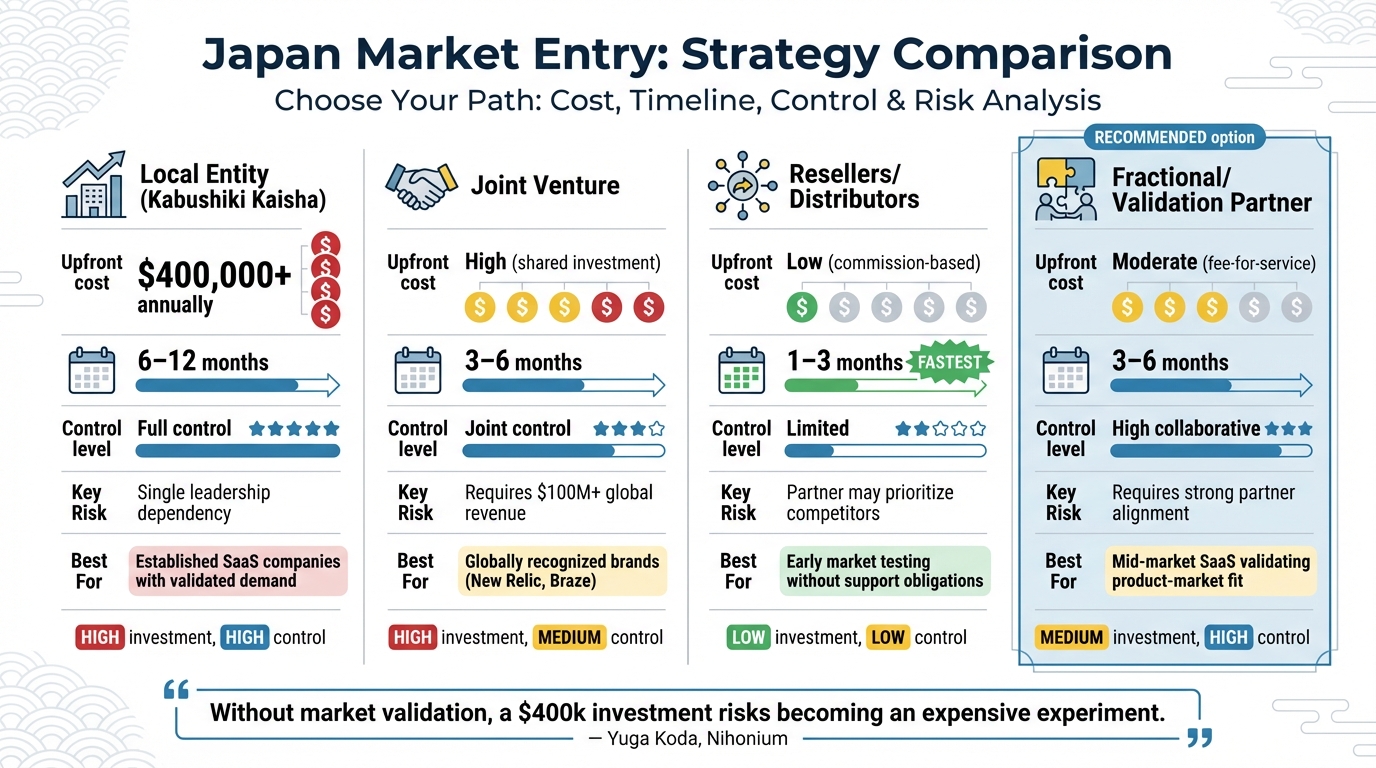
Japan SaaS Market Entry Strategy Comparison: Costs, Timeline & Risk Assessment
Choose the most suitable approach for entering the Japanese market by evaluating factors like cost, timeline, control, and risk. Below is a detailed comparison of four entry strategies to help you align your decision with your business goals.
| Entry Strategy | Upfront Cost | Timeline to Market | Control Level | Key Risk | Best Suited For |
|---|---|---|---|---|---|
| Local Entity (Kabushiki Kaisha) | $400,000+ annually | 6–12 months | Full control over brand, sales, and localization | Reliance on single leadership performance | Established SaaS companies with validated demand and significant budget |
| Joint Venture | High (shared investment) | 3–6 months | Joint control with a local partner | Requires $100M+ global revenue to qualify | Globally recognized brands like New Relic or Braze |
| Resellers/Distributors | Low (commission-based) | 1–3 months | Limited – sales process controlled by partner | Partner may prioritize competing products | Early market testing without customer support obligations |
| Fractional/Validation Partner | Moderate (fee-for-service) | 3–6 months | High – collaborative localization and GTM execution | Requires strong partner alignment | Mid-market SaaS companies validating product-market fit before full commitment |
This table is designed to guide your decision-making process, helping you weigh your market readiness against your strategic priorities.
Yuga Koda from Nihonium emphasizes the importance of validation before making significant investments:
"Without market validation, a $400k investment risks becoming an expensive experiment."
To minimize risk, Nihonium provides tailored strategies for localization, marketing, and fractional sales. These services allow businesses to test the waters without committing to costly infrastructure too early.
Conclusion
Breaking into Japan’s SaaS market requires careful planning and attention to seven key areas. Success depends on understanding SaaS adoption and market size, identifying target segments, and navigating compliance requirements – all while respecting the trust and relationship-driven nature of Japanese business culture. The Ringisho process, the necessity for precise localization, and the importance of establishing a local presence highlight that taking shortcuts can lead to expensive mistakes.
This approach comes with both financial and operational challenges. Setting up a local presence involves a significant upfront investment, which is why validating the market before fully committing is essential.
Japan’s SaaS market, while expansive and still largely untapped, presents exciting growth opportunities. These factors emphasize the importance of the tailored strategies outlined earlier.
FAQs
What compliance requirements should SaaS companies meet when entering the Japanese market?
When stepping into the Japanese market, SaaS companies face a landscape shaped by rigorous compliance standards, especially in data protection and cybersecurity. The Act on the Protection of Personal Information (APPI) outlines clear expectations: companies must secure user consent before collecting personal data, ensure it’s not used for unintended purposes, and implement strong security measures. There are also strict requirements around domestic data storage and third-party data sharing, which means having transparent privacy policies and robust internal controls is non-negotiable.
On the cybersecurity front, compliance with laws like the Basic Act on Cybersecurity is essential. This includes conducting regular risk assessments, addressing vulnerabilities, and establishing protocols for incident response. Beyond these general requirements, companies may need to navigate industry-specific regulations – for instance, those governing finance or healthcare. Other important steps include securing permissions for cross-border data transfers, appointing a local representative, and accurately handling tax reporting for transactions subject to Japan’s consumption tax. Keeping pace with regulatory updates and maintaining a well-structured compliance program can make all the difference in achieving success in this highly regulated market.
Why is localization more than just translation when entering the Japanese market?
Localization in Japan is about much more than just translating text. Japanese users expect products to reflect their cultural norms, business practices, and strict legal standards. This involves tailoring your user interface to accommodate Japanese writing systems, incorporating honorific language, adjusting pricing and payment methods to local preferences, and ensuring compliance with Japan’s privacy laws, such as the APPI. These steps help establish trust and credibility – qualities that are deeply valued by both Japanese consumers and businesses.
Beyond the product itself, effective localization also includes support channels, documentation, and marketing materials. These need to adopt a tone that aligns with cultural expectations, use messaging that respects hierarchical relationships, and feature case studies that resonate locally. Without this deeper level of adaptation, even a well-translated product can feel incomplete or unreliable, potentially discouraging customers during the early stages of engagement. By approaching localization as an ongoing, strategic effort, you can deliver a product experience that feels genuinely tailored to Japan, paving the way for long-term success in this distinct market.
What are the key challenges SaaS companies face when entering the Japanese market?
Entering the Japanese market as a SaaS business presents distinct challenges due to differences in language, business practices, and regulations.
First, localization is about much more than just translating words. To connect with Japanese customers, your product interface, website, and support materials must align with local language and preferences. This requires incredible attention to detail. Without it, you risk losing customer trust, which can directly impact engagement and conversion rates.
Second, Japan’s business culture places great importance on consensus and long-term relationships. Sales cycles often take longer, as decisions are typically made collectively. To navigate this, understanding formalities like proper etiquette, the use of honorifics, and the ritual of exchanging business cards is crucial. Additionally, many sales processes involve intermediaries, such as resellers, which means global strategies may need to be adjusted to fit local norms.
Finally, regulatory compliance can be a major roadblock. Japan has stringent data privacy laws, including the Act on the Protection of Personal Information (APPI), and strict requirements for product labeling and documentation. Beyond compliance, operational hurdles like establishing a local entity, hiring skilled employees, and managing tax obligations add another layer of complexity. Success in this market requires thorough preparation and a well-thought-out allocation of resources.
 English
  Japanese