
The State of the Startup Ecosystem in Japan
Startup Ecosystem in Japan
A startup ecosystem is said to have general factors, the business environments, entrepreneurs, opportunity, and funding. The business environment is the local infrastructure including laws, regulations, government initiatives, etc. The business environment essentially should provide ease in building a startup. Entrepreneur is the availability of the people who are looking to start a startup. Funding is the availability of capital to invest in the entrepreneurs and startups. Opportunity is the availability to facilitate the startup’s growth through pitch contents, accelerator programs, incubation facilities, etc.
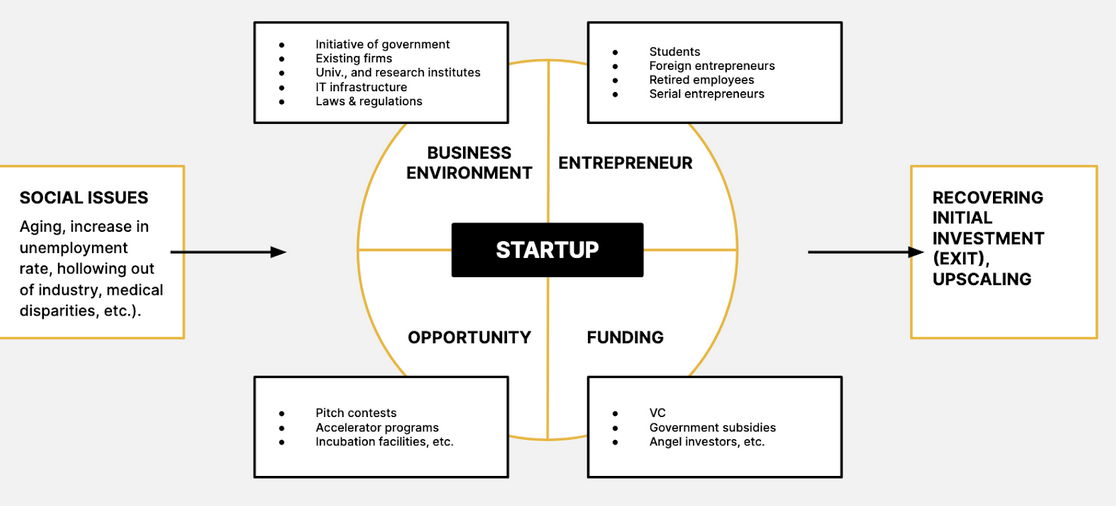
Source: Has the Startup Ecosystem in Japan Formed?
Compared to Silicon Valley, the most robust startup ecosystem, JETRO (Japan External Trade Organization) says that Japan only has one of the four factors, the business environment. The Japanese government is actively working on the business environment with friendlier policies for startups. For example, the J-Startup program was launched in 2018 by METI (the Ministry of Economy, Trade and Industry) aims to work with Japanese startups to empower them to be able to compete globally. Also, in the 2022 Basic Policy for Fiscal Management and Reform announced by the Japanese government, startups were one of five priority areas for investment. As startups are a priority, the government released a Startup Development Five-Year Plan (you can check the progress of the Startup Development Five-year plan here). The business infrastructure is actively being worked on and will hopefully facilitate more startups.
As for funding, more and more Corporate Venture capital (CVC) is entering the market. Corporations are looking to partner with startups to further develop existing research and development. Entrepreneurs will likely continue to be a problem for Japan.
Japan’s Potential as a Startup Hub
Japan has the potential to be a global startup hub. The appetite to spend on research and development is prevalent, but all the spending is done by corporations and not startups. If some of the spending is routed to startups (which we’re starting to see through CVCs), the ecosystem could see an uptick in new startups and technologies and ultimately more innovation. Alongside CVCs, traditional VCs will need to play a significant role as part of the ecosystem.
Japan is also positioned well since it has a number of science and technology clusters. The greater Tokyo area, Osaka-Kobe-Kyoto, and Nagoya rank in the top 12 clusters based on output, which is measured by patents and publications. Japan is still a top innovator in the science and technology space. If Japan is able to take further advantage of this environment through new startups there may be more innovation at a faster pace.
Table: Ranking of Science and Technology Clusters and VC Clusters Across Select Countries
 Source: World Bank: Tokyo Start-Up Ecosystem
Consequences of Lacking a Startup Ecosystem
The consequences of lacking a robust startup ecosystem can be severe. It can lead to a lack of competitiveness, which then leads to less productive research and development. Old technologies settle in and ultimately they start to see less innovation. This can be seen in both shorter and longer timelines. Starting with the shorter timeline, Japan has already seen less output in terms of patents being granted. Japan was the leader in patents granted in 2010, but China, the United States, and the European Union have overcome Japan.
On a longer timeline, in 1989, 7 Japanese companies ranked within the top 10 global companies in terms of market capitalization. Fast forward to 2019, the largest Japanese company sits at number 43. There are many reasons for this drastic change. Falling behind on building a startup ecosystem, and by extension slowing down on innovation, could be a possible driver. It makes sense that the Japanese government is prioritizing startups to revitalize innovation.
Opportunity for Global SaaS Companies
The Japanese ecosystem is getting more robust with proper government support and initiatives. That being said, the overall ecosystem is playing catch up and that includes the SaaS market. In 2019, there were 3407 investments in SaaS companies in the US compared to 156 in Japan. There is still a limited number of SaaS solutions in the market and plenty of room for global companies to be a real solution in Japan with the proper localization efforts. There are a few options on Japan entry — If you’d like to learn more about Nihonium’s, book a consultation here.
 English
  Japanese