

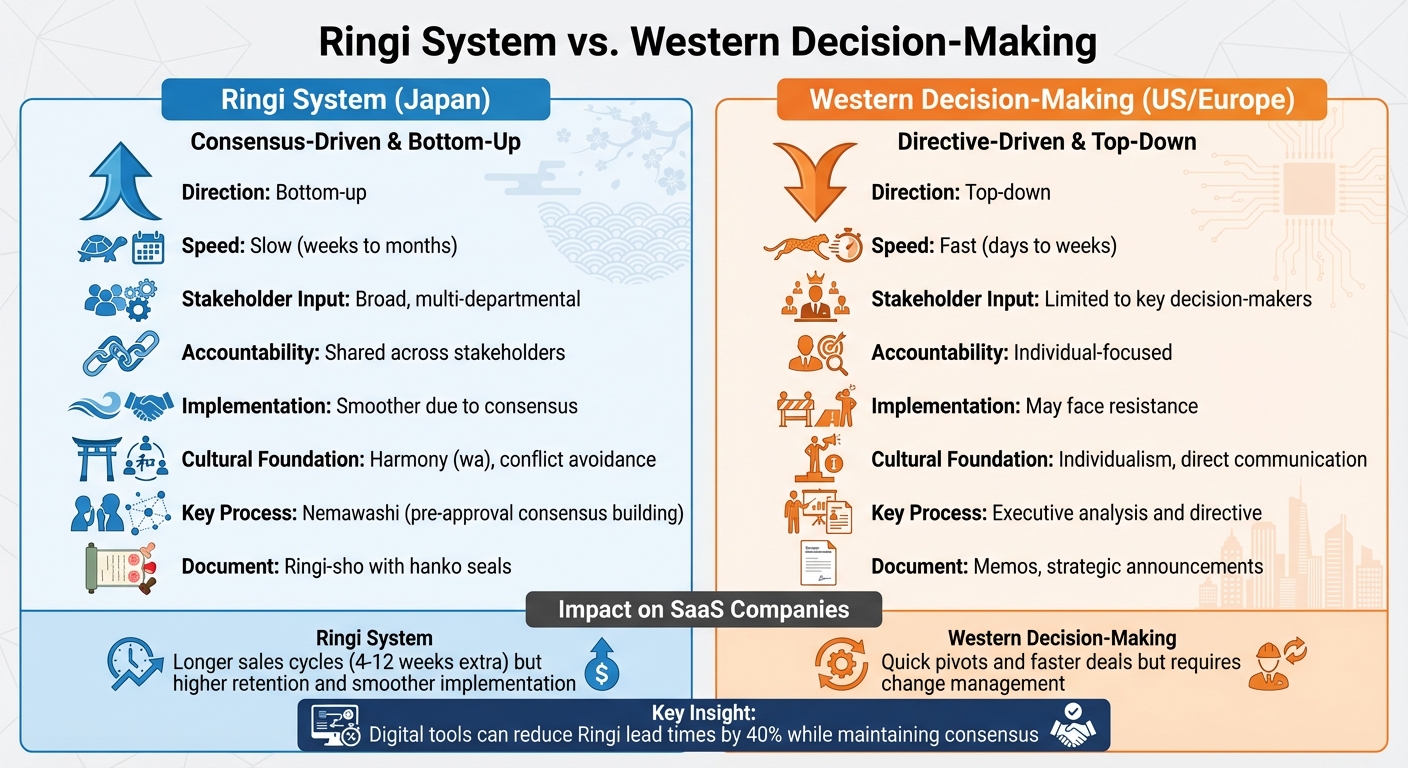
The Ringi system and Western decision-making represent two very different approaches to making decisions in organizations. The Ringi system, common in Japan, emphasizes consensus-building, starting from lower management and moving upward through structured approvals. In contrast, Western decision-making, especially in the U.S., is faster, centralized, and focuses on individual accountability.
For SaaS companies, understanding these styles is critical when entering new markets. Japanese businesses often require lengthy, multi-departmental reviews, making sales cycles longer but ensuring smoother implementation. Western companies prioritize speed and data-driven decisions, which can lead to quicker results but may face resistance during implementation.
Key Takeaways:
- Ringi System: Bottom-up, consensus-driven, slower but ensures alignment.
- Western Decision-Making: Top-down, fast-paced, focused on individual responsibility.
- SaaS companies must tailor their approach to fit these processes, especially when targeting Japanese markets.
Quick Comparison:
| Aspect | Ringi System | Western Decision-Making |
|---|---|---|
| Speed | Slow (weeks to months) | Fast (days to weeks) |
| Stakeholder Input | Broad, multi-departmental | Limited to key decision-makers |
| Accountability | Shared across stakeholders | Individual-focused |
| Implementation | Smoother due to consensus | May face resistance |
To succeed in Japan, SaaS companies should plan for longer timelines, provide localized materials, and respect the Ringi process. This approach builds trust and ensures better long-term outcomes.
Ringi System vs Western Decision-Making: Key Differences for SaaS Companies
The Ringi System: Bottom-Up Decision-Making
How the Ringi Process Works
Unlike top-down decision-making models, the Ringi system starts at the grassroots level, with proposals originating from frontline or middle management – those who are closest to the operational challenges.
Here’s how it works: A manager drafts a proposal, known as a ringi-sho, which lays out the problem, proposed solution, associated costs (in ¥), expected outcomes, and potential risks. This document is then circulated among relevant stakeholders, who review it and provide approval, rejection, or neutrality using their personal seal, or hanko. The position of the seal indicates their decision – right-side-up for approval, upside-down for rejection, or sideways for neutrality.
But the real magic happens before the ringi-sho even starts circulating. Through a process called nemawashi, the proposer meets privately with key stakeholders to explain the idea, gather feedback, and refine the proposal. By the time the document officially circulates, most concerns have already been addressed, making final approval by senior management more of a formality. This upfront effort not only smooths the process but also demonstrates how the system can be surprisingly efficient when done right.
For example, one foreign subsidiary digitized its Ringi system, reducing lead times by 40% while still maintaining the nemawashi process and multi-level approvals. Even so, in traditional companies, the full process for non-urgent matters can still take up to a month.
Benefits and Drawbacks
The Ringi system offers a mix of strengths and challenges, each worth considering.
On the plus side, the system builds strong consensus. Since many stakeholders are involved in shaping the proposal, implementation tends to go smoothly with minimal resistance. The multi-layered review process also helps identify risks early, leading to more thoughtful and realistic plans. For SaaS purchases, this collaborative approach can foster better cross-department cooperation and improve long-term retention.
However, the system isn’t without its downsides. Decision-making can be slow – often stretching out over weeks or even months – due to the need for extensive circulation and potential revisions. The emphasis on harmony can sometimes lead to groupthink, with stakeholders leaning toward safer, more conventional choices instead of exploring bold, innovative solutions. Additionally, preparing a detailed ringi-sho and conducting nemawashi can be time-consuming and frustrating for managers used to faster, top-down decision-making. Attempting to skip nemawashi or rush the process can backfire, leading to hidden resistance or stalled proposals.
| Aspect | Benefits | Drawbacks | Impact on SaaS Companies |
|---|---|---|---|
| Decision Quality | Multi-stakeholder review catches risks early | Conservative bias may limit bold solutions | Position as low-risk using case studies |
| Adoption & Buy-In | Broad consensus ensures smooth implementation | Reaching consensus can be slow and complex | Expect long sales cycles but high retention |
| Speed | Once approved, execution proceeds quickly | Full process can take weeks or months | Use pilot projects for urgent cases |
| Documentation | Clear decision record and rationale | High documentation burden | Provide ready-made Japanese proposal templates |
Western Decision-Making: Top-Down Authority
Core Principles and Assumptions
Western decision-making operates quite differently from the Ringi model. Here, authority is concentrated at the top, with senior leaders like CEOs, VPs, or department heads making the final decisions. These leaders are expected to have the strategic insight and expertise to guide the organization effectively, reflecting a hierarchical leadership structure.
This approach is built on three main assumptions. First, senior leaders have access to superior information and market insights, enabling them to make well-informed strategic decisions. Second, speed is crucial – in competitive industries, delays in decision-making can lead to missed opportunities. Third, individual accountability fosters innovation – when one person is clearly responsible for the outcome, it encourages ownership, whether the result is positive or negative. This is a stark contrast to Japan’s consensus-driven decision-making, where the process is intentionally slower to ensure alignment across all levels.
The Western model is designed for efficiency, though it can sometimes feel rigid. Executives analyze data, make decisions, and communicate them through memos, meetings, or announcements. Teams are then tasked with executing these directives, with success measured through KPIs and quarterly reviews. This system emphasizes clear communication and swift action. For example, in U.S. tech companies, a CEO might announce a strategic shift – like transitioning from on-premise software to cloud-first solutions – and expect teams to implement the change within weeks.
This approach aligns well with cultural values in the U.S. and Northern Europe, where individualism and low power distance are emphasized. Managers are expected to make quick decisions, gathering input when necessary but ultimately owning the outcome. Research, such as Hofstede’s cross-cultural studies, highlights that American managers are generally more comfortable making unilateral decisions compared to Japanese managers, who prefer broader consultation.
Benefits and Drawbacks
The top-down model excels in speed and clarity. Decisions that might take weeks in a Ringi-style process can be made in just days. This is a vital advantage for SaaS companies operating in fast-moving markets, where being slow to act can mean falling behind competitors. The emphasis on individual accountability also ensures that someone is clearly responsible for the outcome. Many companies use Management-by-Objectives (MBO) frameworks to link performance evaluations and bonuses directly to decision outcomes, reinforcing this sense of ownership.
However, this speed comes at a cost. Resistance to implementation is a frequent challenge. When decisions are made without involving frontline employees, it can lead to disengagement, passive resistance, or even active pushback. Studies indicate that top-down organizations face 15–25% higher failure rates due to resistance compared to more inclusive models. Additionally, by focusing decisions at the top, companies risk overlooking valuable insights from employees who are closer to customers or day-to-day operations. In markets like Japan, where consultation and harmony are highly valued, this can create significant friction during market entry.
| Aspect | Benefits | Drawbacks | Impact on SaaS Companies |
|---|---|---|---|
| Speed | Decisions are made quickly, often in days | May sacrifice thorough analysis for rapid action | Enables fast product updates and agile market responses |
| Accountability | Clear ownership of decisions and outcomes | Increased pressure on individuals; limited shared responsibility | Simplifies tracking performance and assigning credit |
| Flexibility | Leaders can pivot based on new data | Teams may view changes as abrupt or arbitrary | Supports quick adjustments to market demands |
| Implementation | Streamlined processes in hierarchical setups | Higher risk of team resistance | Requires effective change management and onboarding strategies |
| Employee Engagement | Works well for urgent decisions | Lower engagement compared to collaborative approaches | May need extra efforts to ensure long-term buy-in |
For SaaS companies targeting Western markets, the key to success lies in identifying decision-makers – often VPs or directors with budget authority – and presenting clear, data-driven proposals. Metrics like ROI, payback periods, or NPV can help secure swift executive approval. On the other hand, when entering markets like Japan, companies may need to slow down and adapt to the local preference for consensus-building, even as they maintain their internal agility. While the top-down approach offers speed and adaptability, it requires thoughtful change management to navigate challenges in more collaborative markets.
Ringi vs. Western Decision-Making: Side-by-Side Comparison
Main Differences Between the Systems
The key distinction between the Ringi system and Western decision-making lies in how decisions are initiated and authority is distributed. In the Ringi system, proposals typically start at lower or middle management levels and move upward for approval, with each stage marked by personal seals (hanko). Before this formal process begins, informal consensus-building ensures alignment. On the other hand, Western decision-making is more centralized, with executives making quick, top-down decisions based on input from select advisors. This approach prioritizes speed and individual accountability.
These differences reflect deeper cultural values. Ringi aligns with Japanese ideals of harmony (wa), shared responsibility, and avoiding conflict, where the process itself is as important as the outcome. In contrast, Western methods emphasize individualism, direct communication, and a focus on results. These contrasting structures shape how organizations strategize and operate.
What This Means for SaaS Companies
The slower, consensus-driven Ringi process requires SaaS companies to rethink their strategies for market entry and engagement in Japan. Unlike the rapid decision-making common in Western markets, the Ringi approach extends timelines for product localization, pricing decisions, and sales cycles. For instance, a pricing model that might be finalized in days in the West could take months in Japan, as multiple departments review and approve the proposal.
Sales cycles in Japan are also longer due to the need for consensus among a wide range of stakeholders. A company accustomed to closing deals quickly with a single decision-maker might face months of internal reviews within a Japanese organization. However, this thorough process has its benefits: once a decision is made, the shared accountability across various levels often leads to smoother implementation with minimal resistance. For example, digital tools have been shown to reduce the time required for the Ringi process by up to 40%, while still preserving its collaborative essence.
Full Comparison Table
| Aspect | Ringi System | Western Decision-Making | Impact on SaaS Companies |
|---|---|---|---|
| Decision Speed | Slow – weeks to months for multi-level approvals | Fast – days to weeks with centralized authority | Longer sales cycles compared to quick pivots |
| Stakeholder Involvement | High – broad participation across departments | Low to medium – limited to key executives | Requires early stakeholder identification |
| Risk Management | Proactive – risks addressed through multiple reviews | Reactive – risks handled by a central decision-maker | Fewer implementation challenges with Ringi |
| Accountability | Collective – shared responsibility among stakeholders | Individual – rests with a single decision-maker | Collective approach complicates performance metrics |
| Cultural Foundation | Harmony (wa), conflict avoidance, procedural fairness | Individualism, direct communication, results focus | Necessitates cultural adjustments for Japan entry |
For SaaS firms entering Japan, the takeaway is clear: the Ringi system necessitates longer timelines for decision-making and sales. To navigate this effectively, companies should focus on strategies like early stakeholder mapping, using digital tools to streamline approvals, and beginning consensus-building discussions during pre-sales. Firms such as Nihonium specialize in helping businesses bridge these cultural and procedural differences with tailored market entry plans and localization services.
sbb-itb-a752276
How SaaS Companies Can Adapt to the Ringi System
Practical Adaptation Strategies
To align with the Ringi system, start by mapping your sales stages to the Ringi process in your CRM. Assign owners, set clear timelines, and outline the necessary documents for each phase, such as "nemawashi prep", "ringi-sho creation", and "circulation tracking." Early on, create a stakeholder map for every Japanese account. This should identify who will initiate the proposal, the departments involved in reviews (such as IT, security, finance, and business units), and the final decision-makers.
Provide your local champion with a Ringi support pack. This should include a concise proposal document in Japanese, covering key elements like a clear problem statement, solution overview, cost breakdown in yen, risk assessment, implementation plan, and expected ROI. Format it so that sections can be easily copied into the customer’s internal ringi-sho template. Supplement this with materials such as security summaries, multi-year pricing models, case studies from similar Japanese companies, and editable Word or PowerPoint files that your champion can customize.
Treat nemawashi as a formal part of your sales process. Before the official review, organize short meetings with key stakeholders to address concerns, refine the proposal’s scope, and identify constraints. Record these conversations in your CRM, noting objections, concerns, and any non-negotiable requirements. It’s also a good idea to involve senior leaders in select nemawashi meetings to demonstrate commitment, but let your local champion take the lead in shaping the internal narrative.
Account for the extended timelines of the Ringi process. Decisions often take 4–12 weeks longer than U.S. enterprise cycles, depending on deal size and the number of departments involved. Adjust your forecasting by setting Japan-specific rules, such as not committing to a close date until the ringi-sho is drafted and accepted for circulation. Be mindful of Japanese fiscal year patterns, as approvals often cluster around these periods. Train your global team to understand that while the decision-making process may take longer, it often results in better implementation success and lower churn due to the broad organizational buy-in that Ringi fosters.
These strategies establish a solid foundation for localized support and long-term success.
How Nihonium Helps SaaS Companies Adapt
Nihonium builds on these strategies by offering tailored support to help SaaS companies navigate the Ringi system effectively. Their localization services go beyond simple translation. They restructure product interfaces, admin settings, documentation, and sales materials into formats that Japanese champions can seamlessly integrate into their ringi-sho documents. Nihonium’s team understands the technical and cultural nuances required to craft proposals that resonate with Japanese decision-makers.
Their fractional sales support provides local expertise to guide your team through nemawashi, identify key approvers in target accounts, and advise on optimal timing, considering Japanese holidays and fiscal deadlines. From initial outreach to deal closure, Nihonium manages the sales process within the Ringi framework while keeping your global team informed.
Additionally, Nihonium’s marketing funnel creation focuses on Japan-specific lead nurturing. This approach educates potential buyers about the cross-departmental value of your solution early in their journey, ensuring that future ringi participants are well-informed before formal approvals begin. Their custom market entry strategies help your organization adapt internal processes, such as approval workflows and discounting authority, to align with Ringi-driven buying cycles. This reduces friction between your U.S. operations and the expectations of Japanese customers.
Common Mistakes to Avoid
While proactive strategies are important, it’s equally crucial to avoid these common missteps:
- Don’t push for quick approvals from top executives. Skipping the Ringi process can lead to resistance and undermine the consensus-building that Japanese organizations prioritize. Instead, allow sufficient time for nemawashi and multi-level reviews.
- Avoid sending proposals that are heavy on English. Instead, create concise Japanese documents with simple visuals and one key idea per section. Dense text blocks requiring translation and interpretation can slow down the process.
- Don’t rely solely on one enthusiastic contact. Map out all stakeholders involved in the ringi-sho process, including IT, security, legal, finance, and business owners. Provide tailored information for each group to address their specific concerns. Overlooking security and compliance requirements is a common and costly mistake.
- Don’t misinterpret silence as disinterest. In many cases, "no news" means the ringi-sho is still circulating internally. Create a standard checklist for Japan deals, including nemawashi steps, Japanese proposal templates, and security documentation. Train your global executives to view quiet periods as part of the process rather than a sign of rejection.
Conclusion
The Ringi system and Western decision-making showcase two very different approaches to making decisions. Western models often favor swift actions led by individual authority figures, while the Ringi process focuses on consensus and shared accountability. For SaaS companies expanding into Japan, navigating this difference requires careful internal coordination and thoughtful adjustments to align with local practices.
Thriving in the Japanese market means viewing the Ringi process not as a hurdle but as a strategic opportunity. Companies that identify key stakeholders early, provide detailed documentation in Japanese, respect nemawashi (the informal process of building consensus), and synchronize their internal workflows with the Ringi cycle can establish strong customer relationships and achieve lasting success. This mindset shift is essential for crafting strategies tailored to the Japanese market.
Nihonium supports SaaS businesses in this transition by offering tailored solutions, including localization, Japan-specific marketing funnels, fractional sales support, and customized market entry strategies. With a team of SaaS professionals who have experience leading global companies and launching operations in Japan, Nihonium transforms Ringi principles into actionable playbooks, aligning product, sales, and marketing efforts with local business norms.
With the Japanese SaaS market expected to grow by 3.7x, companies that embrace the Ringi process and leverage expert local guidance have a clear path to sustainable growth in Japan.
FAQs
How can SaaS companies tailor their sales strategies to align with Japan’s Ringi system?
SaaS companies looking to align their sales strategies with Japan’s Ringi system should prioritize collaboration, consensus-building, and fostering trust over the long term. This approach often involves engaging with multiple stakeholders early in the process and offering comprehensive, detailed information to support group decision-making.
To make headway, focus on showing how your solution aligns with the organization’s objectives and values. Building strong personal connections and maintaining patience throughout the often-lengthy decision-making process are equally important. Partnering with local experts can also help navigate cultural subtleties and make the approval process smoother.
What are the key cultural differences between Japan’s Ringi system and Western decision-making?
The Ringi system in Japan revolves around group consensus and a structured process of hierarchical approval. This reflects Japan’s emphasis on harmony and collective agreement. Proposals are shared among team members and superiors, allowing for feedback and gradual approval before reaching a final decision.
On the other hand, decision-making in Western cultures often leans toward individual authority, prioritizing speed and efficiency. Leaders or small groups typically make decisions, placing less weight on unanimous agreement. This approach highlights autonomy and quick action rather than prolonged group discussions.
How does the Ringi system enable smoother implementation despite taking longer to make decisions?
The Ringi system focuses on building consensus during decision-making, which helps ensure smoother execution. Although this approach can take more time to finalize decisions, it brings all stakeholders into the process, aligning everyone and reducing the likelihood of resistance or confusion later on.
By gathering approvals and feedback from various levels within the organization early in the process, the Ringi system helps eliminate potential obstacles. This collaborative approach fosters a shared sense of responsibility, paving the way for a smoother and more effective implementation.
 English
  Japanese