
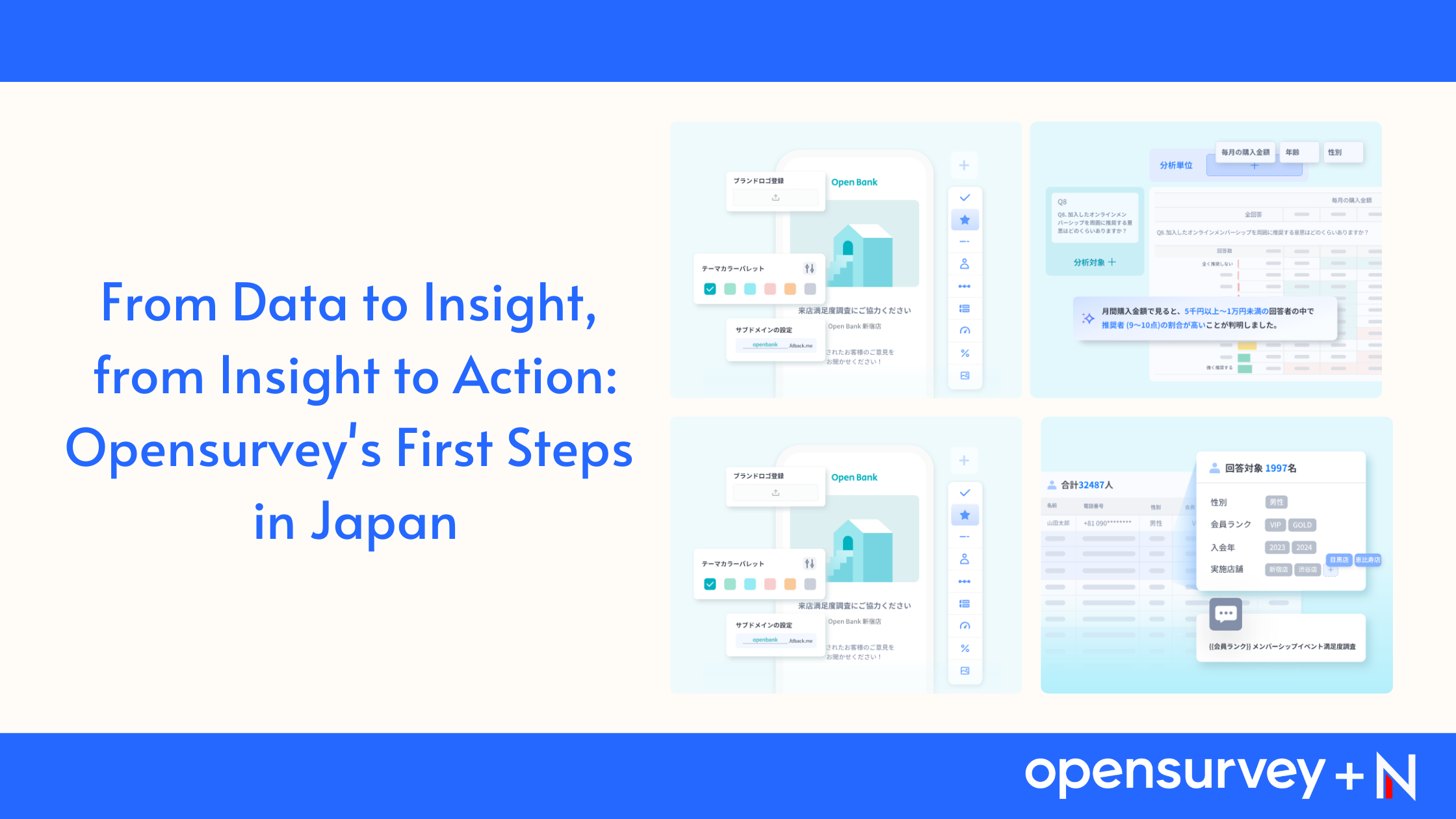
From Data to Insight, from Insight to Action: Opensurvey’s First Steps in Japan
Nihonium has had the pleasure of supporting Opensurvey with their Japan market entry efforts. Opensurvey recently closed their first Japanese customer. With the achievement of this milestone, generously offered to share their Japan market entry experience.
Company Introduction
About Opensurvey
Opensurvey is a market research technology company headquartered in Seoul, founded in 2011. Opensurvey helps organizations grow through data by enabling them to understand and improve customer experiences across every touchpoint. Over 2,800 leading companies trust Opensurvey to collect and analyze customer data, turning insights into better decisions, products, and services.
About Dataspace
Dataspace is Opensurvey’s AI-powered platform that combines robust analytics with intuitive usability, helping organizations internalize their research capabilities. From advanced targeting and data collection to real-time visualization, cross-system integration, secure collaboration, and expert-assisted services, Dataspace supports the full research lifecycle in one seamless workspace. By integrating AI models with expert-designed logic, Dataspace accelerates analysis and delivers richer insights with less effort. Whether it’s market research or the analysis of customer, user, or employee experience, Dataspace does it all.
Opensurvey’s Japan Entry
Why did Opensurvey decide to enter the Japanese market?
Data is a universal business language, and companies make decisions based on data. Opensurvey has been providing data insights and research services for over 12 years, primarily in Korea, helping companies grow with data-based insights. Based on this experience and expertise, we launched Dataspace, a customer experience analysis SaaS platform.
Dataspace goes beyond simply providing research services. Dataspace helps companies streamline and systematize their entire research process of collecting, analyzing, and capitalizing on customer and market data. This enables companies to shift their focus and resources from the data collection process to planning and executing data-driven initiatives.
The need for a platform like Dataspace is not only limited to South Korea but also to markets like Japan. There are three reasons why we prioritized Japan for our global expansion.
First, although Japan’s GDP is 2.5x larger than Korea’s, Japan’s SaaS and research market is 4.5x larger. Japan is the closest major global economy to Korea. The size of the SaaS market and the proximity were the first considerations. The proximity has helped accelerate the Japan market entry initiatives.
Second, the Japanese market is similar to Korea in the sense that the market has a wide spectrum of consumer groups and complex consumer segmentation. In these types of markets, data holds even higher value. Defining and analyzing consumers by detailed groups to make data-driven decisions plays a crucial role in business survival and growth.
Finally, with a strong push for digital transformation (DX), Japanese companies are growing more interested in data collection and utilization. Demand for UX research to better understand and analyze customers, potential customers, and users is growing. These market changes and trends are opportunistic for Opensurvey’s Dataspace in the Japanese market.
What does the current Japan team look like?
Opensurvey currently doesn’t have an entity in Japan. We want to validate the Japanese market before proceeding with creating a local entity. That being said, we do have a teammate dedicated to the Japanese market. Business development and sales, which are key to business expansion, are led by the Japan Business Manager. We also work with a local partner who acts as a local sales resource for Opensurvey.
The Japan Business Manager coordinates and works with each team, including the marketing, product, customer success, and operations teams. This ensures swift alignment between the Japanese market and our main Opensurvey office in Korea. We now understand even more that customer support in the local language is an important aspect in building trust, so we have started actively looking for a customer support teammate to join us in Japan.
What go-to-market activities is Opensurvey executing for the Japanese market? What further go-to-market plans in Japan does Opensurvey have?
Currently, we are focusing on offline activities such as exhibitions, trade shows, and networking events to generate leads and conduct follow-up meetings both online and offline. While the brand has already been established in Korea, it is still in its early stages in Japan. We aim to adapt to the Japanese market by meeting customers directly and introducing our products.
The goal is to establish a foundation of 1,000 qualified leads within the first year through offline activities. From then on, we plan to build a content marketing/production process through online channels to convert cold leads into warm leads. Additionally, from late 2025 to early 2026, the company is planning to increase inbound traffic through SEO.
Opensurvey recently closed its first deal in Japan. How was the process? Where did you acquire the lead?
Opensurvey has both Korean and global companies as customers. The Japanese company that we closed was introduced to us by a Korean representative of a global company. Since the referral was from a happy, active Dataspace user/subscriber, we had a solid foundation and were able to build out the trust-based relationship further.
What did the sales process look like?
We started with an online meeting to build the relationship. We referenced the key person’s job title and responsibilities to formulate hypotheses about their pain points and needs. Based on that, we laid out the key benefits that Dataspace would provide and were able to construct a narrative that resonated with the company.
After making a good impression on the key person about Dataspace, we suggested that we introduce the product to the entire team. This meeting was held offline in Tokyo, and most of the relevant team members attended this in-person meeting. For us, this meeting felt like a big milestone in building the relationship, as we had the opportunity to meet person-to-person. It was also great to see that other relevant team members attended online, as remote work is still offered in Tokyo, depending on the company. We were able to get in front of all the relevant team members and stakeholders through this hybrid meeting.
In several subsequent online and offline meetings, we pitched how Dataspace can create value and achieve efficiency for the organization. We also proposed that the person in charge of the purchasing and procurement process attend the final proposal meeting. It was important to not only have this meeting, but also to include the procurement team to iron out any outstanding procurement-related items and to get full alignment. After about seven months of discussions, the contract was finalized!
How long did it take to close the deal?
It took approximately seven months. Considering that this was the first successful contract signed in the Japanese market, where we had no prior track record, we believe this was a fairly reasonable timeline.
How did Nihonium support Opensurvey’s entry into the Japanese market?
Nihonium’s support with the product, homepage, and marketing content localization greatly contributed to laying the foundation for a full-scale entry into the Japanese market.
Dataspace is a product that streamlines the research process. This process has previously been hindered and associated with high costs and a lack of specialized personnel, so we put a lot of effort into developing its UX (user experience). Given the importance of meticulous research in the Japanese market, we judged that Dataspace’s usability would be a key strength, making product and homepage localization crucial for market entry.
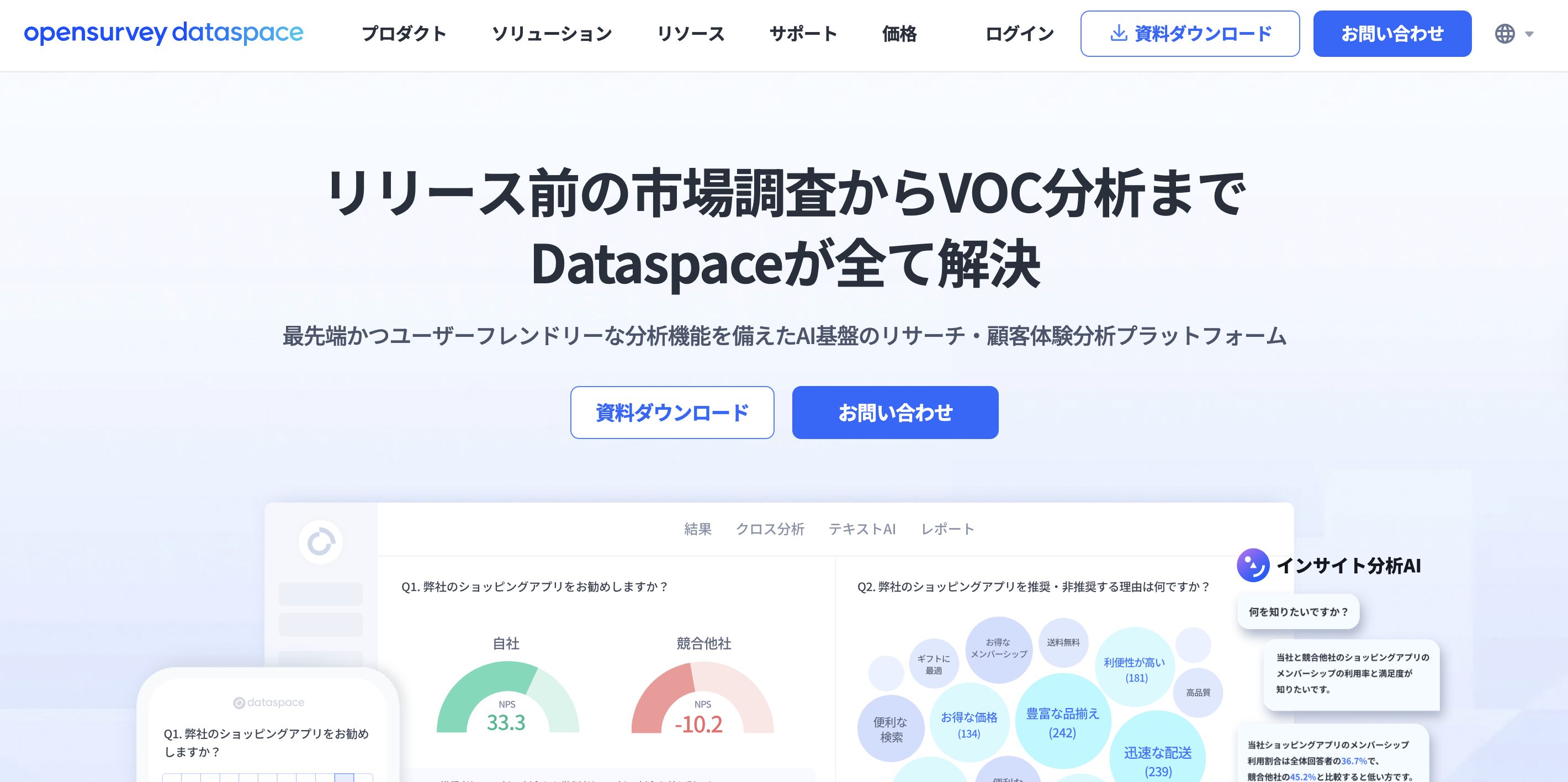
Nihonium’s localization efforts went beyond simple language translation, carefully considering the nuances and context the product aims to convey, as well as industry-standard keywords and expression methods in Japan. This resulted in a high-quality product and homepage in Japanese for Japanese end-users.
During meetings with Japanese clients, we often demonstrate Dataspace directly, and many clients provide positive feedback on the fact that the product is already localized in high-quality Japanese. This localization made a strong first impression for the Dataspace product and was the first step in building trust with the Japanese companies.
What are Opensurvey’s Japan entry goals?
The first short-term goal is to secure five Japanese customers. As we build a customer base, we plan to identify and build a Japan-specific ICP and refine our sales narrative. The second, mid-term goal is to establish a marketing content process. Once we understand the ICP and have a larger database of leads (our goal of 1,000 leads in the first year), we’ll be able to create tailored content. This will lay the foundation for inbound lead generation in the Japanese market. We believe that combining proactive outbound sales with inbound marketing processes will enable us to secure substantial growth in the Japanese market.
Additionally, we aim to further empower our Japanese customers through strong customer success. This will naturally result in Opensurvey providing higher-level products and services. While product development priorities are not yet globally oriented, our long-term goal is for the Japanese business to grow to the point where we can consider and incorporate Japanese and global product development in our roadmap. We are hoping to achieve this global mindset from a product perspective in the second half of 2026.
 English
  Japanese