
Japanese businesses are moving to multi-cloud strategies to improve flexibility, avoid vendor lock-in, and ensure compliance with strict data protection laws. By 2032, the country’s cloud storage market is set to grow from $9.5 billion to $30.5 billion, while the multi-cloud SaaS market is projected to hit $115 billion by 2033.
Key drivers include:
- Regulatory compliance: Partnerships like Oracle and NTT DATA (2024) address Japan’s data protection laws.
- AI and innovation: Collaborations, such as Hitachi and Google Cloud, focus on generative AI and modernizing systems.
- Business resilience: Hybrid cloud adoption is growing, with the market expected to reach $18.75 billion by 2033.
Challenges:
- Modernizing legacy systems, as seen in Japan Airlines‘ migration to AWS in 2025.
- Shortage of skilled multi-cloud professionals.
- Complex data management across providers.
Success Stories:
- Mizuho Bank: Reduced server build time by 78% and improved customer service through phased cloud integration with Red Hat and Google Cloud.
- Toyota: AI initiatives cut machine-learning model creation time by 20%.
Despite hurdles, Japan’s multi-cloud market is expanding, supported by government policies and digital transformation efforts, making it a key area for growth.
Case Study: Mizuho Bank‘s Multi-Cloud Transition
Mizuho Financial Group‘s move to a multi-cloud environment offers a glimpse into how a major financial institution modernizes its IT infrastructure. As one of Japan’s leading banking groups, Mizuho faced the daunting task of overhauling its legacy systems to remain competitive in the rapidly evolving financial services industry.
Background and Goals
Mizuho Financial Group embarked on its multi-cloud journey to tackle pressing operational challenges. The bank managed a sprawling infrastructure with countless physical and virtual servers, creating inefficiencies and slowing down operations. For instance, provisioning new virtual servers required around six weeks of manual effort, significantly hindering the bank’s ability to respond quickly to business demands.
The bank’s primary objectives for this transformation were clear: simplify operations, speed up deployments, and improve customer service. With Japan’s financial landscape shifting rapidly, Mizuho recognized the need to modernize while ensuring top-notch security and reliability. This urgency drove the bank to adopt a phased approach, combining internal automation with carefully chosen cloud partnerships.
"To deliver on the needs of our customers in this new era, we’re working with Google to enhance our operational capabilities, innovate across our online and mobile channels, and transform our corporate culture. Through this partnership, we will become a stronger and more resilient financial group which our customers can trust." – Masahiro Kihara, President & Group CEO, Mizuho Financial Group, Inc.
Implementation Process and Phases
Mizuho’s multi-cloud transformation was executed in two distinct phases, each designed to ensure stability while gradually modernizing its systems.
In the first phase, the focus was on server virtualization and automation within Mizuho’s private cloud, known as Mizuho Cloud. By adopting the Red Hat Ansible Automation Platform, the bank streamlined its server management and automated hardware provisioning. This step not only reduced manual workloads but also laid the groundwork for more efficient operations.
"While open source software is a reasonable option in terms of cost and innovation, there is value in the fact that Red Hat Ansible Automation Platform is the de facto standard Ansible product, backed by Red Hat’s enterprise support." – Mizuho Financial Group
The second phase expanded beyond the private cloud, integrating Google Cloud services. A key achievement during this phase was the development of a new digital marketing platform built on Google Cloud and integrated with Google Analytics. This allowed Mizuho to harness advanced data analytics and AI, enhancing its ability to understand and serve customers more effectively.
Results and Lessons Learned
The results of Mizuho’s transformation were striking. The bank reduced the time required to build virtual servers by 78%, slashing it from 77 work hours to just 17 hours for every ten servers. Similarly, hardware setup time dropped dramatically – from six weeks to just three days.
These operational efficiencies translated into real business advantages. Faster deployment times and improved system reliability enabled the bank to respond more quickly to customer needs. With over five million customer interactions annually, Mizuho’s enhanced IT capabilities have had a meaningful impact on service quality.
Mizuho’s experience underscores how automation and strategic cloud adoption can address operational challenges, even in highly regulated industries. Key takeaways include the value of enterprise-grade support, the effectiveness of a phased approach to minimize disruptions, and the critical role automation plays in boosting efficiency. Furthermore, partnerships with providers like Red Hat and Google Cloud proved essential in navigating the complexities of multi-cloud adoption, ensuring both compliance and innovation in a tightly regulated sector.
Case Study: Oracle Database@Google Cloud in Japan
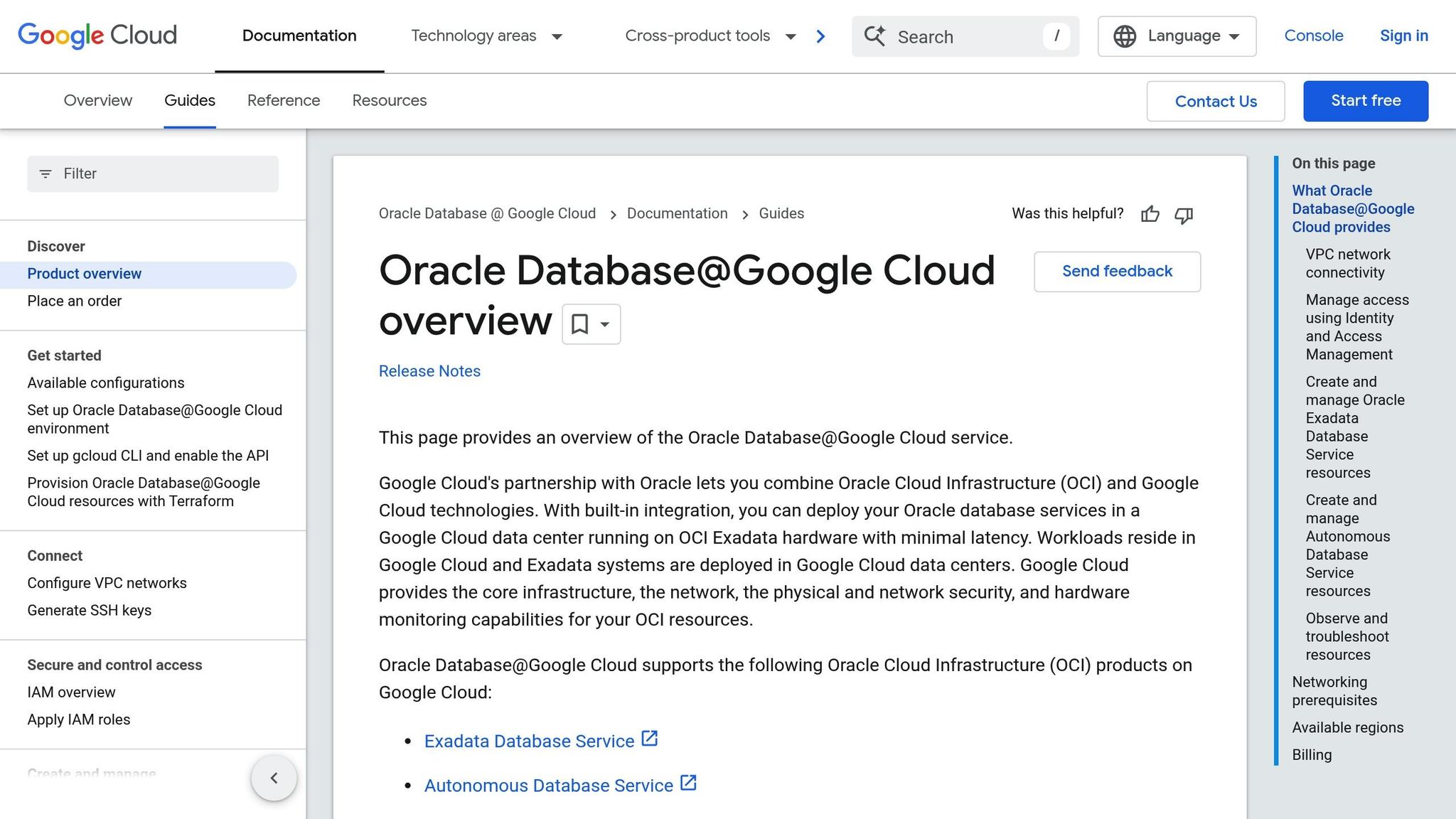
Oracle Database@Google Cloud offers a multi-cloud solution designed to connect legacy Oracle systems with modern cloud platforms. This managed service enables organizations to operate their existing Oracle databases on Google Cloud, reaping the advantages of cloud technology without the need for a complete overhaul of their systems. It’s marketed as a tool to streamline integration with Google Cloud features like analytics, artificial intelligence, and machine learning. The service also includes automated maintenance and ensures high availability, making it suitable for industries requiring reliable and continuous Oracle operations. However, public case studies from Japan showcasing its implementation remain limited.
Service Overview
Oracle Database@Google Cloud is built to help organizations transition their Oracle databases into a cloud-based environment while maintaining the integrity of existing systems. By offering compatibility with Google Cloud’s advanced tools – such as AI, machine learning, and analytics – it removes the need for organizations to start from scratch when modernizing their infrastructure. Key features include automated maintenance and high availability, which aim to reduce operational complexity. This service is particularly positioned to help businesses in Japan bridge the gap between traditional Oracle systems and cutting-edge cloud capabilities.
Use Cases and Industry Applications
This solution is particularly relevant for industries that face challenges such as strict regulatory compliance and the need to modernize legacy systems. Sectors like finance, manufacturing, retail, and healthcare stand to benefit from the hybrid model, which allows them to retain critical Oracle systems while adopting innovative cloud solutions. Despite its potential, verified examples of its application in Japan remain scarce, leaving room for further exploration of its impact.
Business Results and Impact
Oracle Database@Google Cloud is marketed as a way to simplify the management of traditional databases alongside cloud services, potentially enhancing operational efficiency and system integration. For instance, Mizuho Bank has demonstrated success with a multi-cloud strategy, showcasing operational improvements. While Oracle Database@Google Cloud offers a complementary approach tailored to regulated industries, quantifiable results from its use in Japan have yet to emerge. This leaves its full impact on Japanese enterprises open to further study and validation.
Business Considerations for Multi-Cloud in Japan
Business Value of Multi-Cloud
For Japanese businesses, adopting a multi-cloud strategy delivers more than just flexibility – it addresses critical needs like data sovereignty and cost management. Companies are aiming for tighter control over their data while cutting down infrastructure costs.
In the Asia Pacific, nearly all enterprises work with at least two cloud providers, and 35% use four or more. This highlights a shift from relying on a single vendor to building optimized, purpose-specific cloud setups.
"The ‘one-stop-shop’ mentality has died when it comes to the cloud. Instead, multicloud is the reality of enterprise technology environments as these organizations seek to get the right mix of solutions and capabilities they need to operate effectively." – Melanie Posey, research director, Cloud & Managed Services Transformation at 451 Research
Real-world examples show the impact of multi-cloud strategies. Toyota’s AI-platform initiative, for instance, empowers plant staff to create machine-learning models independently, slashing model-creation time by 20% and increasing annual output from 8,000 to 10,000 models. Similarly, Mizuho has committed ¥100 billion to develop a multi-cloud marketing engine capable of tailoring offers to individual customers.
The financial potential is enormous. Japan’s cloud computing market hit $24.5 billion in 2023 and is expected to grow to $62.4 billion by 2031, with an annual growth rate of 12.4%. Government policies like the "Cloud-by-Default" policy and the "Society 5.0" framework are driving adoption, with 90% of government-related technologies projected to transition to the cloud by 2025.
But the benefits go beyond cost savings. Multi-cloud setups enhance business continuity, a critical factor given Japan’s vulnerability to natural disasters. They also accelerate innovation cycles by harnessing the unique strengths of various cloud providers.
"Customers are on-boarding new cloud providers to accelerate their digital transformation goals. They want to get their existing mission critical workloads on the cloud faster, without the cost or risk of having to re-write, to then tap into the innovation areas driven by machine learning and AI." – Chris Chelliah, senior vice president, technology and customer strategy, Oracle Japan and Asia Pacific
These advantages highlight the need to explore the market dynamics and challenges shaping Japan’s multi-cloud evolution.
Market Opportunities and Gaps
While multi-cloud adoption is gaining traction, traditional business practices in Japan, such as keiretsu-based vendor relationships, often slow progress. These long-standing partnerships can create resistance to diversifying cloud vendors.
Adding to the complexity is a looming IT talent shortage. By 2030, Japan could face a deficit of 220,000 to 450,000 IT professionals, with the most severe shortages in the Tokyo area. This scarcity is driving up wages for cloud-native talent, which in turn affects adoption timelines.
Despite these hurdles, several factors are fueling multi-cloud growth:
- Generative AI workloads are driving demand for sovereign compute capabilities, contributing +4.2% growth.
- The government’s Digital Agency Government Cloud rollout is adding +3.8% growth, with initial adoption focused on central government agencies.
- Digital transformation in manufacturing and financial services is contributing +3.5% growth, particularly in major industrial regions.
- Mainframe-to-cloud migration initiatives are creating an additional +2.4% growth, benefiting financial institutions and large enterprises.
However, challenges remain. Regulatory requirements, such as the Act on the Protection of Personal Information (APPI), necessitate stringent governance solutions, complicating multi-cloud architectures. Infrastructure issues, like Tokyo power-grid congestion, are delaying permits for hyperscale data centers, reducing growth by -1.2% in the Tokyo area and impacting nearby regions.
The key to success lies in addressing these gaps. Companies that can navigate regulations while offering tailored, compliant multi-cloud solutions stand to gain a significant edge. For example, the Japan hybrid cloud market, valued at $4.32 billion in 2024, is forecasted to grow to $18.75 billion by 2033, with a growth rate of 16.60% annually.
Japanese enterprises emphasize consensus-driven decision-making and risk avoidance. Businesses that provide proven compliance frameworks, educate stakeholders, and deliver culturally aligned support will be well-positioned to succeed. These considerations mirror the real-world achievements of companies like Mizuho and Toyota, showcasing the potential of multi-cloud strategies in Japan’s evolving market.
sbb-itb-a752276
Localization and Success Factors for Multi-Cloud Deployments
Localization for Compliance and User Adoption
Japan’s multi-cloud landscape presents unique challenges, as illustrated by Mizuho’s journey. Success here hinges on understanding local regulations, business practices, and cultural expectations.
With 71% of nations enforcing data protection laws, Japanese companies must navigate stringent frameworks like the Act on the Protection of Personal Information (APPI) while leveraging the advantages of global cloud infrastructure. The growing adoption of cloud automation – already at 65% among medium to large enterprises – further emphasizes the need for Japanese vendors to offer contracts and support in Japanese from the outset, ensuring compatibility with local software platforms.
Cultural nuances also play a significant role in shaping adoption timelines. Japanese businesses often prioritize detailed risk assessments and long-term commitments. This means localized documentation, dedicated support teams, and security tools tailored to Japan’s IT practices are essential. Government-led digital transformation efforts, aimed at addressing labor shortages and an aging population, highlight the importance of aligning multi-cloud strategies with national priorities while maintaining high standards of safety and quality. This localized approach creates opportunities for strategic alliances that can drive success in Japan’s multi-cloud ecosystem.
Role of Specialized Partners
Navigating Japan’s complex compliance landscape often requires partnerships with local experts. These partnerships provide access to established customer relationships and critical compliance insights needed for success.
The value of such collaborations is evident in real-world examples. In January 2019, Sumo Logic partnered with AWS Japan, which led to a connection with Classmethod, an AWS APN consulting partner. This partnership allowed Japanese customers to fully utilize the Sumo Logic platform through localized deployment guidance, support, and AWS-based storage. Sumo Logic further supports Classmethod’s AWS infrastructure, fostering a mutually beneficial ecosystem that expands their reach in Japan.
"I’ve been here in Tokyo for over 30 years so I feel (with confidence) that it was our moment to shine in Japan. From a sales perspective, we’re very successful with a land and expand approach where we start with only a small subset of the business, and then gradually, we grow to other areas, operations, security and business as we continue to deliver great customer experiences that demonstrate long term value and impact. That level of trust building and attentiveness we provide to our global customer base is very typical of how Japanese enterprises like to conduct business." – Robert Stevenson, Sumo Logic
Specialized localization partners like Nihonium play a critical role in helping global SaaS companies navigate Japan’s multi-cloud market. Their services – ranging from product localization and SEO-driven marketing to fractional sales support – ensure offerings are tailored to meet Japan’s unique demands.
Successful partnerships go beyond standard vendor agreements. Joint ventures, co-branded marketing campaigns, and co-development projects help build the trust that Japanese enterprises value. These collaborative efforts can streamline procurement processes and drive growth post-launch by leveraging the credibility and market knowledge of local partners.
Local partners also provide essential on-the-ground support for marketing and deployment. They understand that Japanese companies value brand loyalty, exceptional quality, and ethical practices, enabling them to position multi-cloud solutions in ways that align with local business priorities.
Japan’s cloud market is on track to grow from $21.1 billion in 2024 to over $72 billion by 2030. Meanwhile, spending on generative AI is expected to jump from ¥101.6 billion (around $0.9 billion) in 2024 to an estimated $25.8 billion by 2033.
To thrive in this rapidly expanding market, companies must carefully select their partners, invest in localized support, and demonstrate a deep understanding of Japanese business culture. Those who build strong partnership networks and commit to long-term success will be well-positioned to seize opportunities in Japan’s evolving multi-cloud environment.
Conclusion and Key Takeaways
Japan’s multi-cloud environment presents a wealth of opportunities for businesses ready to embrace the right strategies and partnerships. The case studies highlighted here show that achieving success in multi-cloud adoption in Japan involves more than just technical execution – it requires a thorough understanding of cultural nuances, regulatory frameworks, and strategic localization.
By the end of 2025, over 75% of organizations are expected to adopt a multi-cloud or hybrid cloud model, with companies already reporting up to 45% savings in costs and a 40% boost in service availability. Microsoft’s planned $2.9 billion investment over the next two years to enhance hyperscale cloud computing and AI infrastructure in Japan further emphasizes the market’s vast potential.
Real-world examples illustrate these benefits clearly. Recruit Co., Ltd. utilized Microsoft Azure OpenAI Service to develop conversational AI for Jalan.net, attracting tens of thousands of monthly users while keeping negative user reactions below 1%. Similarly, TXP Medical‘s NSER mobile app, which serves nearly 22,000 users monthly, cut average call times with hospitals from 3 minutes and 30 seconds to just 2 minutes and 44 seconds.
"We started using Copilot with the hypothesis that it would elevate our people’s potential and bring additional value to our clients. I am delighted our high expectations proved to be accurate based on survey data and insights as we work to broaden access to this and other generative AI technologies", – Brian Klochkoff, Executive Vice President, Innovation & Emerging Technologies at dentsu
These examples underscore the importance of AI integration as a critical driver of success in multi-cloud strategies. Japan, ranking second on the Asia-Pacific AI Readiness Index, is well-positioned to capitalize on this trend. Microsoft’s commitment to providing AI digital skills training to over 3 million people in Japan within three years reflects this momentum. Companies like DENSO Corporation are already leveraging tools like GitHub Copilot to streamline development, reduce costs, and accelerate innovation.
For businesses exploring multi-cloud strategies in Japan, success hinges on several key actions. First, audit your cloud architecture and work with local experts to navigate Japan’s regulatory landscape, including compliance with the Economic Security Promotion Act’s digital sovereignty requirements. Providers like Nihonium (https://nihonium.io) specialize in tailoring cloud strategies to align with Japan’s unique market demands through robust localization services.
Nomura Research Institute’s upcoming launch of NRI Digital Trust in February 2025 exemplifies how enterprises can address data sovereignty concerns while staying competitive. Their AI Development and Execution Platform, powered by Oracle Alloy, operates from data centers in Tokyo and Osaka, ensuring robust disaster recovery capabilities and adherence to local compliance standards. These innovations not only mitigate risks but also drive cost efficiencies.
The financial impact is hard to ignore. A pharmaceutical company reported a 28% reduction in cloud expenses and a 52% decrease in data breach risks after adopting a multi-cloud model using AWS for scalable computing and Oracle for backend data management. Similarly, a manufacturing firm slashed application deployment times by 60% with a dual-cloud approach.
Thriving in Japan’s multi-cloud market requires more than just technical know-how – it demands long-term partnerships, meticulous risk management, and alignment with local business practices. The case studies make it clear: combining cutting-edge technology with localized expertise is the winning formula. Companies that prioritize Japanese-language support, local partnerships, and compliance-first strategies will be best placed to succeed. Multi-cloud adoption in Japan isn’t just a technical shift – it’s a transformative journey that blends innovation with a deep respect for Japan’s distinctive business culture and regulatory environment.
FAQs
What are the main benefits of a multi-cloud strategy for Japanese businesses, and how can it help address local regulatory and operational challenges?
A multi-cloud strategy offers Japanese businesses a way to achieve more flexibility, better cost management, and improved risk control by letting them select cloud providers that best meet their specific needs. This method helps companies strike a balance between performance, cost, and scalability while steering clear of overdependence on a single vendor.
On top of that, multi-cloud solutions are particularly helpful in navigating Japan’s stringent regulatory landscape. They support data sovereignty by ensuring sensitive information stays within Japan’s legal boundaries. This not only helps businesses comply with local laws but also allows them to maintain operational efficiency and embrace technological advancements.
How does Mizuho Bank’s step-by-step multi-cloud adoption strategy help financial institutions modernize their IT systems while staying compliant and efficient?
Mizuho Bank has embraced a multi-cloud adoption strategy that follows a step-by-step process, ensuring a seamless shift to modern IT systems. By taking this gradual approach, the bank effectively reduces risks, stays aligned with strict regulatory standards, and keeps its operations running smoothly throughout the transition.
This strategy also allows Mizuho to incorporate cutting-edge technologies such as data analytics and virtualization. The result? Greater flexibility and lower costs. It’s a thoughtful approach that demonstrates how financial institutions can modernize their systems securely while navigating the increasing demand for hybrid and multi-cloud solutions.
How do localization partners support the adoption of multi-cloud solutions in Japan, and why are they essential for navigating the country’s unique business environment?
Localization partners play a crucial role in the successful adoption of multi-cloud solutions in Japan. They help ensure that products are adapted to the local language, meet cultural expectations, and comply with regulatory requirements. This tailored approach creates a smooth experience for both users and businesses, helping foreign companies build trust and establish a foothold in the Japanese market.
These partners also bring valuable expertise in navigating Japan’s intricate regulatory framework, ensuring that businesses adhere to local laws and standards. By addressing both cultural subtleties and legal obligations, they empower global companies to localize their cloud infrastructure effectively and confidently compete in Japan’s dynamic business landscape.
 English
  Japanese