

Breaking into Japan’s SaaS market isn’t just about having a great product – it’s about understanding a unique business structure called keiretsu. Keiretsu are tightly-knit corporate networks where companies prioritize internal relationships for purchasing decisions. For SaaS vendors, this means navigating complex group dynamics, gaining trust, and tailoring strategies to fit Japan’s business norms.
Key Takeaways:
- Keiretsu Overview: These networks are either horizontal (spanning industries, e.g., Mitsubishi) or vertical (supply chains, e.g., Toyota).
- Challenges: Limited access to buyers, long sales cycles, and high trust thresholds make entry difficult.
- Solutions: Partner with local firms, align with keiretsu priorities, and localize your product for Japanese standards.
Why it Matters: Winning over one keiretsu company can unlock opportunities across its entire network, but it requires patience, precision, and the right partnerships. Success in Japan’s SaaS market depends on understanding these dynamics and building long-term relationships.
Problems SaaS Vendors Face When Entering Keiretsu Networks
Limited Access to Enterprise Buyers
Keiretsu networks operate on a tightly woven system of cross-shareholding and reciprocal business relationships. This structure strongly encourages member companies to prioritize purchases from sister companies, affiliated system integrators, or long-established domestic vendors instead of looking to external suppliers. Centralized procurement for core systems typically happens at the keiretsu’s main trading company or primary system integrator, which then distributes solutions across the group. Because of this, foreign SaaS vendors often find it nearly impossible to connect directly with IT executives or business-unit leaders without first going through these entrenched players.
This closed network makes it incredibly challenging for new vendors to break into the market. Many Japanese enterprises have a long history of developing software internally or working with affiliated system integrators like Fujitsu, NTT Data, or Nomura Research Institute to create solutions tailored to their specific needs. This further discourages the adoption of external SaaS offerings. As some market-entry advisors note, Japanese companies often "will only do business within the same keiretsu", highlighting the strong preference for internal procurement. These barriers set the stage for the lengthy and complex sales processes that foreign vendors typically face.
Long and Complicated Sales Processes
Enterprise technology purchases in Japan are shaped by deeply ingrained practices like nemawashi (informal consensus-building) and the ringi process (formal approval). Both involve multiple stakeholders and hierarchical reviews, which can significantly extend SaaS sales cycles. Keiretsu affiliations further complicate matters, as decision-making power may lie with group headquarters, a major subsidiary, or a dominant system integrator.
For foreign vendors, success hinges on carefully navigating this landscape. Identifying where the real decision-making authority resides, mapping keiretsu affiliations, and understanding the structure of buying committees are all essential steps. Vendors must also align their efforts with Japan’s fiscal year and budget cycles to avoid stalled negotiations. Ignoring these dynamics can lead to wasted time targeting subsidiaries with little influence. On the other hand, securing a partnership with a key system integrator or a flagship account can open doors to broader referrals and group-wide adoption.
Strict Trust and Risk Standards
Access and process challenges are only part of the equation. Keiretsu networks also impose rigorous trust and risk standards. These companies place a premium on long-term stability and group reputation, which means foreign SaaS vendors face more intense scrutiny than domestic or group-affiliated providers. To gain consideration, new vendors must demonstrate financial stability, provide local support, comply with data residency requirements, and meet Japanese standards. Additionally, keiretsu procurement often relies on negotiated, long-term pricing models with in-group suppliers – something foreign vendors may struggle to match initially.
Without a local presence or a trusted introduction, foreign SaaS providers often encounter skepticism. Concerns typically center around their commitment to the Japanese market, their ability to provide ongoing support in Japanese, and their expertise in meeting compliance standards. Companies like Nihonium help bridge this gap by offering localization services, building fractional sales teams, and crafting go-to-market strategies tailored to keiretsu expectations. These efforts can help foreign vendors establish the credibility needed to succeed in this unique environment.
How SaaS Companies Can Work with Keiretsu Networks
Use Local Partners to Build Connections
To tap into keiretsu networks, work with established Japanese resellers, system integrators, and consulting firms like Fujitsu, NTT Data, or Nomura Research Institute. These organizations play a crucial role in shaping architecture decisions and standardizing vendors across keiretsu groups. Their credibility and established approval channels can open doors that would otherwise remain closed to foreign vendors.
When choosing partners, focus on those with deep keiretsu access. Assess the number of group companies they serve and the seniority of their connections. Align their expertise with your product’s target market. For instance, if you’re selling DevOps tools, seek out system integrators with strong cloud and infrastructure practices. If your specialty is finance software, partner with consultants who advise keiretsu banks and trading companies.
Structure your agreements to reflect keiretsu dynamics. Offer clear margin protections through deal registration for large, slow-moving opportunities. Consider tiered incentives that reward partners for securing group-wide framework agreements. Once one keiretsu company adopts your solution, the network’s interconnected structure can lead to adoption across multiple affiliated companies through preferred in-group sourcing.
Adjust Your Messaging for Keiretsu Priorities
After your local partners open the door, adjust your messaging to resonate with keiretsu priorities. Trust and risk mitigation are key, so shift the focus from innovation to reliability. Highlight uptime service-level agreements (SLAs), minimal critical incidents, conservative change management, and a long-term roadmap. Include certifications like ISO 27001 and SOC 2, data residency options, and features like audit trails and access controls to meet governance and compliance expectations.
Position your SaaS offering as a group-wide solution. Demonstrate how it can standardize processes across affiliates, enable unified reporting, create cost efficiencies through volume pricing, and improve governance at the group level. Use recognizable global and Japanese customer logos, testimonials from regulated industries, and endorsements from trusted local partners to address reputational concerns.
Adapt your sales process to Japan’s consensus-driven decision-making. Provide clear, concise proposals and business cases that can circulate during nemawashi (informal alignment) and ringi (formal approval). Offer proof-of-concept programs with KPIs tailored to different stakeholders – such as reduced downtime for IT, easier audits for compliance, or predictable costs for finance. Map out decision-makers at both the functional and group levels, and plan timelines around Japan’s budgeting cycles. Start engaging 6–12 months before your desired launch date.
Localize Your Product for Japanese Business Standards
Beyond partnerships and tailored messaging, your product itself must align with Japanese business expectations. This includes a fully localized Japanese user interface with correct terminology, character handling, and formatting (e.g., MM/DD/YYYY dates, local addresses, fiscal years). Features like single sign-on with widely used Japanese identity providers and role-based access control for complex organizational hierarchies are often mandatory.
Ensure your security and compliance documentation is available in Japanese, and address specific local needs:
- Provide detailed security questionnaires in Japanese.
- Schedule maintenance windows that align with Japan’s time zones.
- Offer Japanese-language support (via phone, email, or chat) during local business hours.
- Deliver structured incident reports in Japanese for any significant outages.
- Hold quarterly service review meetings with key customers.
On the commercial side, localize contracts and documentation to meet Japanese legal standards. Invoicing must adhere to Japanese tax rules and payment practices. Companies like Nihonium can simplify this process, offering end-to-end localization services. This includes Japanese UI development, documentation, marketing materials, and sales enablement by native experts. They even provide fractional sales teams with keiretsu expertise to handle the sales process while you build your in-market capabilities.
sbb-itb-a752276
Weighing the Pros and Cons of Targeting Keiretsu
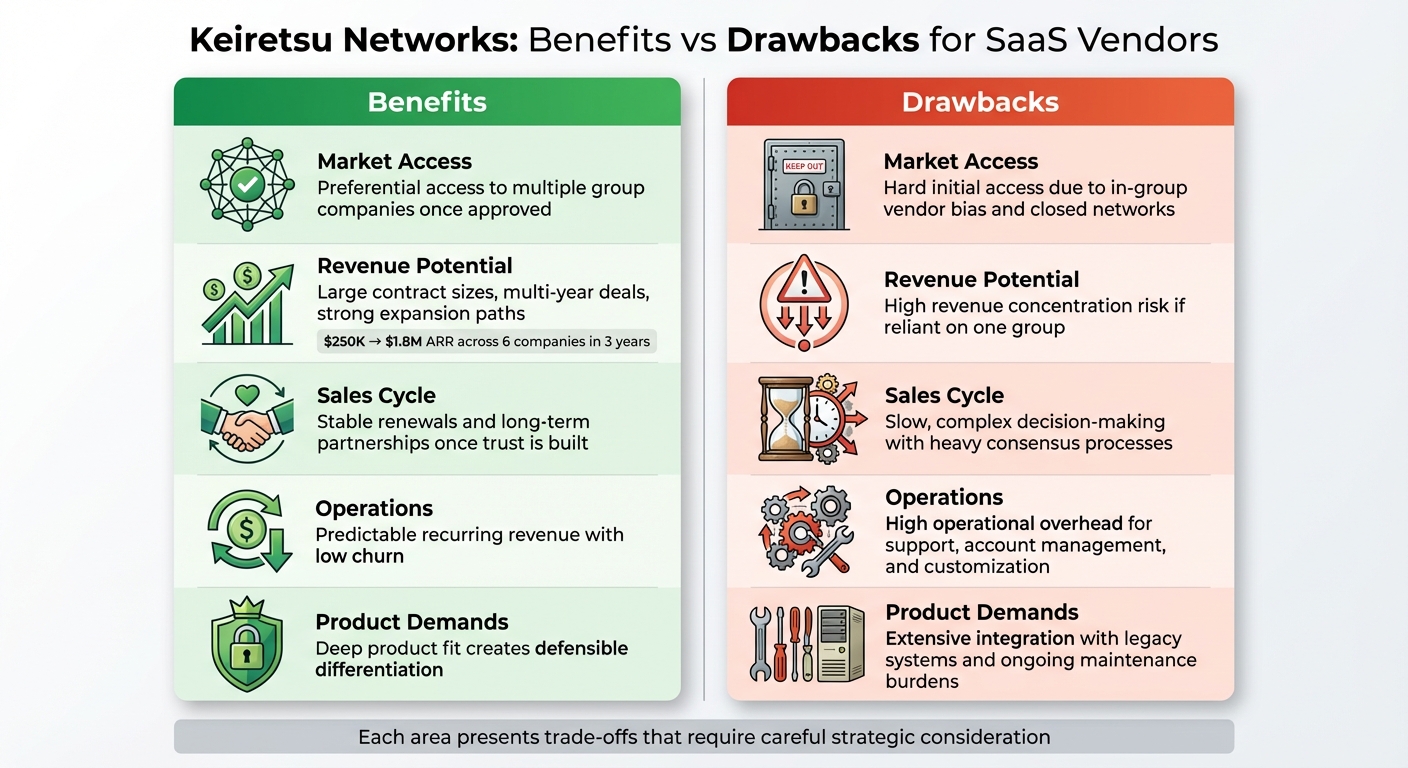
Benefits vs Drawbacks of Targeting Keiretsu Networks for SaaS Companies
Benefits of Selling to Keiretsu Companies
Landing a keiretsu account can open doors to an entire network of interconnected companies. When you secure a deal with a central player – like a major trading company or bank – you gain access to a web of affiliated manufacturers, suppliers, distributors, and service providers. These entities already have strong, trust-based relationships, which can significantly lower your customer acquisition costs and streamline introductions across the network.
Being chosen by a respected keiretsu member also acts as a stamp of approval. It demonstrates that your SaaS platform meets Japan’s rigorous standards for reliability, security, and long-term support. This recognition can make it easier to break into other Japanese enterprises outside the keiretsu network as well. Additionally, the cross-shareholding structure of keiretsu groups fosters long-term partnerships, often leading to multi-year contracts, steady recurring revenue, and predictable renewals rather than frequent churn.
The revenue potential is another major draw. While keiretsu deals are fewer in number, they tend to be larger and offer room for growth. For instance, an initial $250,000 ARR deal can expand to $1.8 million ARR across six group companies within three years. These relationships often start small – perhaps with one division – and gradually grow to include additional sites and other group entities. This creates opportunities for seat expansion, add-ons, and higher-tier plans over time.
However, these advantages come with some significant challenges.
Drawbacks and Limitations for SaaS Vendors
One of the biggest risks is revenue concentration. Keiretsu deals often represent a large portion of your regional ARR, making your business vulnerable to shifts in group strategy, mergers, or internal politics. Losing a key keiretsu account could mean losing multiple related contracts at once.
The decision-making process within keiretsu networks is another hurdle. Their hierarchical and consensus-driven approach can slow down sales cycles, making your pipeline less predictable. Additionally, deep product integration often leads to costly customizations, which can be difficult to repurpose for other clients, impacting your margins and potentially adding technical debt.
Keiretsu companies also have a strong preference for working with trusted, long-standing partners. Displacing an incumbent vendor typically requires extraordinary proof of value and a lot of patience. Furthermore, their preference for in-group vendors can limit your flexibility in selecting local resellers, system integrators, or cloud providers, which may constrain your overall strategy for the Japanese market.
Comparison Table
Here’s a quick look at the key benefits and drawbacks:
| Area | Benefits | Drawbacks |
|---|---|---|
| Market Access | Preferential access to multiple group companies once approved | Hard initial access due to in-group vendor bias and closed networks |
| Revenue Potential | Large contract sizes; multi-year deals; strong expansion paths | High revenue concentration risk if reliant on one group |
| Sales Cycle | Stable renewals; long-term partnerships once trust is built | Slow, complex decision-making with heavy consensus processes |
| Operations | Predictable, recurring revenue with low churn | High operational overhead for support, account management, and customization |
| Product Demands | Deep product fit creates defensible differentiation | Extensive integration with legacy systems and ongoing maintenance burdens |
Conclusion: What SaaS Companies Should Know About Keiretsu
In Japan, keiretsu networks often shape enterprise purchasing decisions, making it challenging for lesser-known foreign SaaS firms to break into the market . However, securing a flagship account can open doors to subsidiaries within the network, thanks to the interconnected nature of these relationships .
To tackle the challenges of entering this market, focus your efforts on 10–20 key accounts where the headquarters can influence group-wide adoption. This approach aligns with Japan’s consensus-driven decision-making process. Support these initiatives with Japanese-language materials, such as security documentation and local case studies, to build trust and credibility . An account-based selling strategy that respects the cultural norms of nemawashi (informal pre-alignment) and ringi (formal approval) is crucial. Additionally, syncing your campaigns with Japan’s fiscal year cycles can help streamline decision-making timelines.
Understanding how keiretsu structures operate is essential for identifying the right customer profile. Prioritize headquarters that can drive standardization across the group, rather than wasting time on subsidiaries with limited influence. This clarity ensures you’re targeting the accounts that can unlock broader opportunities within the keiretsu .
Leveraging local expertise can significantly enhance your market entry strategy. Partnering with local firms can help you navigate the complexities of localization and decision-making processes. For instance, Nihonium offers fractional sales support tailored to the nuances of nemawashi and ringi, manages product localization, and oversees the entire sales cycle to accelerate adoption within keiretsu networks.
It’s worth noting that Japan’s SaaS market is growing at an annual rate of 11%, with SaaS currently making up about 5% of total IT spending – far behind the 20% seen in the U.S.. This gap signifies a market ripe with opportunity, but success requires patience, cultural sensitivity, and a commitment to building long-term relationships. Start small by targeting 1–2 key accounts, refine your approach for group-wide expansion, and let the keiretsu ecosystem work to your advantage.
FAQs
What strategies can SaaS companies use to navigate limited access to keiretsu networks in Japan?
To overcome the challenges of limited access to keiretsu networks, SaaS companies should prioritize forming strong local partnerships and working with professionals who understand the nuances of the Japanese market. These efforts are essential for building trust and credibility, both of which are vital in these closely connected business circles.
On top of that, adjusting your sales and marketing strategies to fit cultural norms in Japan can greatly improve your visibility and help establish lasting relationships. A tailored approach shows dedication to the market and boosts your chances of connecting with influential networks.
What strategies can SaaS companies use to work effectively within keiretsu networks in Japan?
For SaaS companies aiming to thrive within keiretsu networks, the key lies in fostering trust and building strong, enduring relationships with influential stakeholders. These networks are deeply rooted in collaboration and mutual support, so understanding their priorities and the way member companies interact is crucial.
Here are some strategies to consider:
- Localization: Adapt your product, messaging, and overall customer experience to fit Japanese business practices and cultural norms. This alignment is essential for building credibility and trust.
- Collaborate with Established Members: Partnering with companies already affiliated with a keiretsu can open doors to valuable resources and enhance your reputation within the network.
- Show Long-Term Commitment: Demonstrate your dedication to the Japanese market by maintaining consistent engagement and providing exceptional support.
For companies looking for tailored advice, Nihonium offers services that focus on localization and market entry, helping global SaaS vendors find success in Japan.
Why is localization essential for SaaS companies entering the Japanese market?
Localization plays a crucial role for SaaS companies aiming to thrive in Japan. It’s not just about translating your product or content; it’s about making everything – from your messaging to your user experience – feel like it was designed specifically for the Japanese market.
Japan has distinct cultural, linguistic, and business practices that demand more than a one-size-fits-all approach. By aligning your product with local expectations, you can build trust, encourage higher adoption rates, and carve out a space in a highly competitive market. Localization goes beyond language – it’s about understanding and adapting to the preferences, behaviors, and needs of Japanese users to deliver an experience that truly connects.
 English
  Japanese