

The Ringi system in Japan is a bottom-up decision-making process where middle managers play a key role. Unlike top-down approaches seen in many Western organizations, this method emphasizes consensus and collaboration. Middle managers draft detailed proposals, called Ringi-sho, which are reviewed and approved by multiple stakeholders across departments. This process reflects Japanese values like harmony (wa) and collective responsibility.
Here’s what you need to know:
- Process Stages: Proposal, circulation, approval, and record.
-
Key Role of Middle Managers:
- Draft proposals based on frontline insights.
- Coordinate communication across departments.
- Facilitate informal discussions (nemawashi) to build consensus.
- Challenges: The process can take weeks due to multiple reviews, with delays often caused by bottlenecks in the approval chain.
- Modern Updates: Digital tools, like electronic Ringi platforms, help speed up the process by allowing simultaneous reviews and mobile approvals.
For businesses entering the Japanese market, understanding the Ringi system and collaborating with middle managers is crucial for navigating this structured decision-making process.
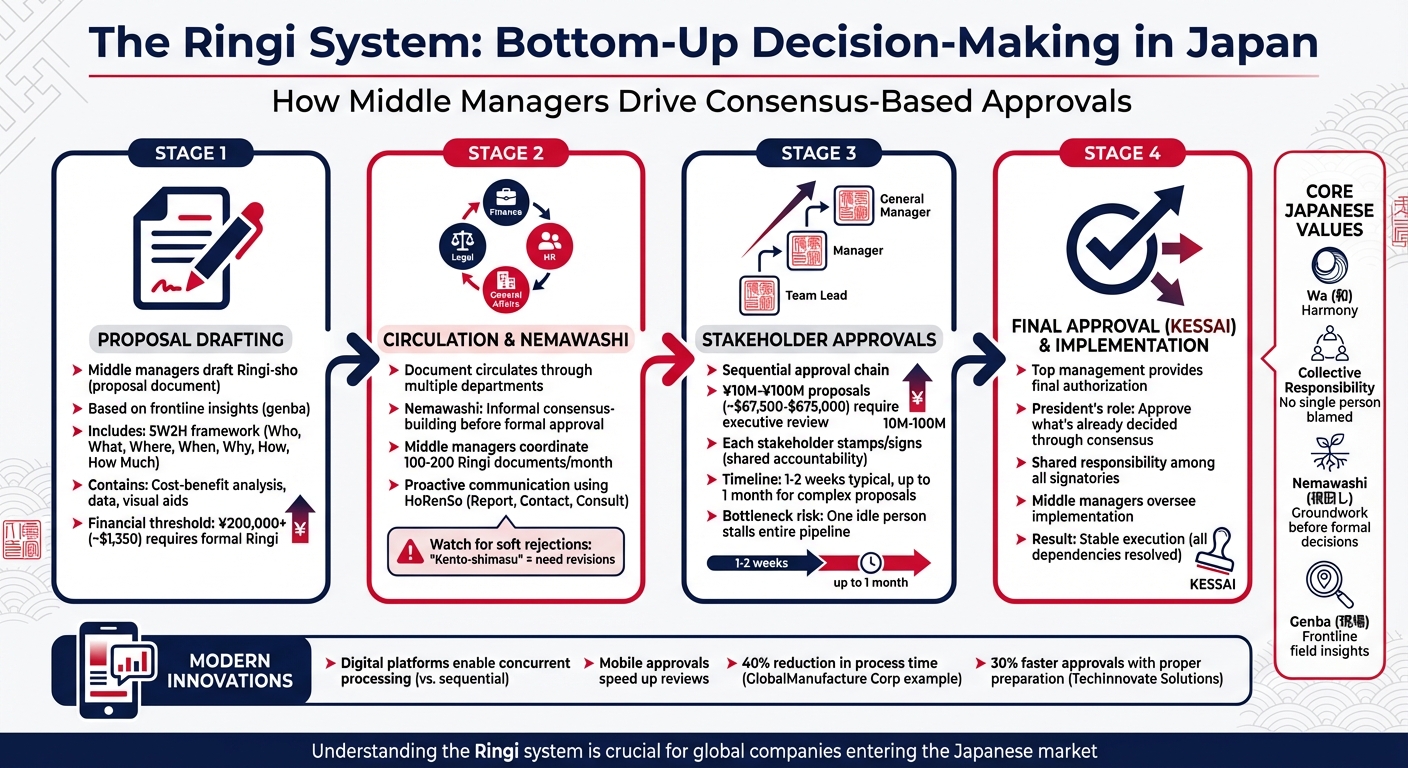
The Ringi System: 4-Stage Decision-Making Process in Japanese Organizations
How Middle Managers Facilitate the Ringi Process
Middle managers play a crucial role in the Ringi system, acting as the bridge between frontline employees and senior executives. Unlike in many Western organizations, where decisions often flow from the top down, Japanese companies rely on middle managers to transform frontline insights into formal proposals. As Saori Tamaki from Inventure Japan explains:
"Since it is basically the employees on the frontline who write the Ringi-sho, the Ringi strongly reflects the voice of the people on the frontline".
This bottom-up approach depends on middle managers to channel these insights upward while maintaining harmony within the organization. Their dual role as both proposal creators and interdepartmental coordinators is central to the system’s success.
Middle Managers as Proposal Creators
Middle managers are responsible for drafting the Ringi-sho (proposal document), which integrates frontline expertise with the company’s strategic objectives. Senior executives in Japanese companies often lack detailed knowledge of specific operational areas, which is why they depend on middle managers to provide genba (field) insights. These insights shape decisions at the top level. A typical Ringi-sho includes detailed cost–benefit analyses, data, and visual aids, enabling executives to process the information efficiently.
There are real-world examples showing how effective proposal creation can streamline the process. In 2024, TechInnovate Solutions, a U.S.-based software company, successfully entered the Japanese market in phases by appointing a Japanese manager to lead their Ringi process. This manager developed a bilingual Ringi-sho with clear visual aids , highlighting the importance of localization and held informal discussions across departments. The result? The proposal was approved 30% faster than the company’s average, with complete agreement from all departments involved.
Coordinating Communication Across Departments
Middle managers also ensure smooth communication and alignment between departments during the Ringi process. They circulate the Ringi-sho through various departments – such as Finance, Legal, HR, and General Affairs. This coordination involves practices like nemawashi (informal consensus-building) and HoRenSo (Report, Contact, Consult). Before submitting a formal proposal, middle managers engage in behind-the-scenes discussions to address potential concerns and refine the proposal, ensuring organizational harmony.
The workload for this coordination can be immense. In large Japanese companies, some managers oversee between 100 and 200 Ringi documents each month. To manage this challenge, GlobalManufacture Corp, a European manufacturing firm, introduced a digital platform for Ringi-sho circulation in 2024. By combining this technology with regular "listening sessions" during the nemawashi phase, they reduced the Ringi process time by 40% while maintaining effective collaboration across departments. This example shows how integrating digital tools with traditional practices can enhance the Ringi process.
sbb-itb-a752276
The Ringi Process Stages and Middle Manager Responsibilities
Middle managers play a central role in the Ringi process, guiding proposals from inception to execution. Acting as the bridge between operational needs and top-level decision-making, they ensure that proposals are well-structured, move efficiently through the hierarchy, and align with the organization’s goals. While the process typically takes one to two weeks, more complex proposals can stretch to a month.
Drafting and Submitting the Ringi-Sho
The Ringi process begins with middle managers, who are closest to the operational challenges and frontline requirements. They draft the Ringi-sho, a formal proposal document that outlines key details like the proposal’s title, objective, execution timeline, supplier or client information, payment terms, and any supporting materials. Administrative details such as the Ringi number, department, dates, and seals/digital signatures are also included.
To ensure clarity and effectiveness, middle managers rely on the 5W2H framework – Who, What, Where, When, Why, How, and How Much. They strengthen the Ringi-sho with data-driven insights like sales forecasts, cost-benefit analyses, and visual aids, making it easier for senior management to assess the proposal’s value. Additionally, they prioritize simple, jargon-free language so that stakeholders across departments, such as Finance or HR, can understand the document.
The financial scope of the proposal often dictates its approval path. For example, items exceeding ¥200,000 (around $1,350) typically require a formal Ringi process, while proposals in the range of ¥10 million to ¥100 million (approximately $67,500 to $675,000) demand executive-level review.
Circulation and Stakeholder Approvals
Once the Ringi-sho is prepared, it begins its journey through various departments and management levels. Middle managers take on the role of "shepherds", ensuring the document progresses smoothly from Team Lead to Manager to General Manager. They also interpret feedback, including subtle cues like "Kento-shimasu" (I will consider it), which often signals a soft rejection and a need for additional data or adjustments.
To keep the process moving, middle managers adopt a proactive approach. Instead of asking for status updates directly, they offer assistance, such as: "If any additional technical clarifications or test logs are required for the approval process, I am ready to provide them immediately". This strategy is crucial, given that managers in large Japanese organizations may review and approve between 100 to 200 Ringi documents each month. By staying flexible and responsive, middle managers ensure the proposal remains on track.
Once all feedback is incorporated and approvals are gathered, the proposal advances to the final decision stage.
Final Approval and Implementation
With all lower-level approvals secured, the Ringi-sho moves to top management for final authorization, known as Kessai. As Career Management English explains:
"The role of the president of the company is solely to approve what has already been decided upon through the whole decision-making process."
Thanks to thorough nemawashi (informal groundwork), this final step is typically a formality. Once approved, the responsibility for execution is shared among all stakeholders who signed off on the proposal. Middle managers take the lead in overseeing implementation and conducting post-project reviews. This shared accountability ensures that no single individual bears the blame for potential failures. As N.K., a former embedded engineer at a major Japanese automotive company, notes:
"Once the Ringi is approved, the implementation phase is incredibly stable because every dependency has already been resolved."
Challenges and Modern Changes to the Ringi System
Delays in Decision-Making
While middle managers play a vital role in the Ringi system, this traditional decision-making process is not without its challenges. One of the most pressing issues is the slow pace of reaching a final decision. In many cases, the consensus-driven approach can take up to a month. Middle managers often find themselves juggling the need for thorough review with the pressure of meeting tight business deadlines.
N.K., a former OBD engineer at a Japanese automaker, sheds light on this issue:
"The Ringi process is essentially a Sequential Processing Pipeline… if one person in the chain is ‘Idle,’ the entire pipeline stalls."
This bottleneck can be further complicated by late-stage rollbacks. Even after weeks of circulation, a high-ranking executive may identify a potential risk or oversight, sending the proposal back to square one. For companies accustomed to faster decision-making cycles, this can be a major source of frustration. Adding to the complexity is the shared accountability model. Since every stakeholder who stamps their seal shares ownership of the decision, it often becomes unclear who is ultimately responsible for the final call.
Dr. Sri Lalitha, Assistant Professor at Gitam University, notes:
"Even though the ‘Ringi’ process is viewed as time consuming… it still ranks high in appreciation for its nature of participatory management."
These challenges highlight the growing need for modern solutions that can streamline the process while maintaining its collaborative essence, especially as Japanese companies compete in global markets.
Digital Tools and Process Improvements
To address these inefficiencies, many Japanese companies are embracing digital tools to modernize the Ringi system while preserving its core values. Paper documents are increasingly being replaced by electronic Ringi-sho platforms, which eliminate delays caused by physical circulation. These platforms enable concurrent processing, allowing multiple departments to review a proposal simultaneously rather than waiting for their turn in a linear chain.
Mobile integration has also been a game changer. Managers can now approve documents directly from their smartphones, significantly speeding up the process. This is particularly beneficial given the heavy workload of middle managers, who often review between 100 and 200 Ringi documents each month.
Interestingly, these digital systems are designed to retain the traditional appearance of the approval process, including visual representations of seal sequences. This thoughtful localization for the Japanese market encourages adoption by senior management, who often prefer familiar formats. By balancing tradition with innovation, these tools not only uphold the Ringi system’s collaborative nature but also enhance its efficiency, enabling Japanese organizations to better align with global business practices and partnerships.
How Global SaaS Companies Can Navigate the Ringi System
To successfully navigate the Ringi system – a key decision-making process in Japanese organizations – global SaaS companies need to adapt their strategies to fit these structured protocols. This involves crafting detailed proposals, building relationships with middle managers, and leveraging expert localization services.
Creating Proposals for Japanese Subsidiaries
When preparing proposals for Japanese subsidiaries, attention to detail is non-negotiable. Unlike Western-style proposals, the Ringi-sho requires extensive documentation, including ROI projections, localized case studies, implementation timelines, and detailed risk analyses. Japanese organizations value solid evidence over vague assurances, making case studies the most sought-after sales material in this market.
Timing is also crucial. Align proposals with Japan’s April–March fiscal year to match key budget allocation cycles. Additionally, proposals should break down costs, onboarding processes, training, and ongoing support to address potential risks comprehensively. A small but impactful adjustment? Replace "Book a Demo" with "Download Documents" on your website. Middle managers often need these materials to include in their internal Ringi proposals.
Once the proposal is ready, the next step is to focus on relationship-building with key stakeholders.
Building Relationships with Key Middle Managers
In Japan, success often hinges on mastering Nemawashi, an informal process of consensus-building that occurs before formal proposals are circulated. This involves engaging stakeholders individually to identify concerns early on. As N.K., a former engineer at a Japanese automotive OEM, puts it:
"If the final meeting is ‘Synchronous Communication,’ Nemawashi is your ‘Asynchronous Request.’… By the time the meeting starts, you have already cleared all ‘Runtime Errors’".
Sharing draft proposals with middle managers for private feedback can smooth the path for formal approval. Adopting the HoRenSo communication style – Hokoku (Report), Renraku (Contact), and Soudan (Consult) – ensures alignment throughout the process. Be alert to soft rejections; phrases like "Kento-shimasu" (I will consider it) often signal a polite decline without direct feedback.
TechInnovate Solutions provides a great example of this approach in action. By assigning a Japanese manager to lead their Ringi process and creating a bilingual Ringi-sho with detailed visual aids, they achieved 30% faster approvals and 100% buy-in from all departments.
Deepening trust with middle managers paves the way for effective localization, which is critical for a seamless market entry.
Using Localization Services for Market Entry
Localization is more than just translation – it’s about adapting everything from visual design and terminology to business logic in a way that aligns with Japanese corporate norms. This level of adaptation communicates respect for local practices and builds credibility with middle managers who are evaluating your proposal.
Creating "Ringi-ready" documentation involves crafting ROI analyses, localized case studies, and implementation plans tailored to Japanese expectations. Companies like Nihonium specialize in helping global SaaS firms navigate these complexities. Their services include creating sales collateral suited for the Ringi process, mapping stakeholder matrices, and guiding businesses through the Nemawashi phase.
Conclusion
Middle managers play a crucial role in the Ringi process. They are the ones who bring ideas from the frontline, manage cross-departmental reviews, and guide proposals through the approval chain. Their on-the-ground expertise is vital since top management in Japan often lacks deep departmental knowledge due to frequent internal rotations.
Beyond proposal creation, middle managers ensure post-approval stability. Once a proposal gets the green light, implementation tends to run smoothly because all stakeholders have already agreed during the process. This shared accountability leads to consistent execution. Middle managers act as more than just gatekeepers – they’re internal advocates who can either speed up or slow down market entry.
The Ringi process is also adapting to modern needs. Digital tools have trimmed timelines by up to 40% in some cases, and many organizations are blending traditional consensus-driven methods with faster, more agile approaches.
For companies aiming to enter the Japanese market, success hinges on viewing middle managers as strategic allies. Craft proposals backed by solid data, align them with Japan’s April–March fiscal year, and respect the step-by-step approval process. Some companies have even reduced approval times by 30% by assigning experienced Japanese managers to oversee their Ringi efforts. These strategies highlight the system’s dependability and the indispensable role of middle managers.
While the Ringi process can be time-consuming, it ensures strong consensus and smooth execution – qualities essential for long-term success in Japan. For global SaaS companies navigating these complexities, working with experts like Nihonium, specialists in Japan localization and go-to-market strategies, offers the tailored support needed to thrive in this unique business landscape.
FAQs
What makes a Ringi-sho get approved faster?
When a Ringi-sho is well-prepared, clearly written, and shared effectively with the appropriate managers, it tends to get approved faster. Building consensus by fostering clear communication and teamwork also plays a key role in moving the process along smoothly.
How can you tell a “soft no” during Ringi reviews?
When it comes to Ringi reviews, a “soft no” is often delivered in an indirect way. You might hear phrases like "I’ll think about it" or "We’ll positively consider it." While these may sound promising, they usually indicate that the proposal is either a low priority or headed toward rejection – just without a direct refusal.
How should U.S. SaaS teams adapt to Ringi timelines?
For U.S. SaaS teams working with Japanese partners, it’s essential to grasp the nuances of the Ringi system. This approach emphasizes consensus-building, thorough reviews, and patience – a sharp contrast to the faster-paced decision-making styles common in the West.
Here’s how it works: proposals are circulated among various stakeholders for feedback and approval, which can naturally extend timelines. To navigate this effectively, focus on a few key strategies:
- Build strong relationships: Invest time in establishing trust and rapport. Relationships often carry significant weight in Japan’s professional culture.
- Respect hierarchy and formal protocols: Acknowledge the importance of rank and follow established processes to show your understanding of local business etiquette.
- Allow time for nemawashi: This informal groundwork helps stakeholders align behind the scenes, paving the way for smoother formal approvals.
By aligning your project timelines and milestones with these practices, you’ll set the stage for more effective and harmonious collaboration.
 Japanese
  English