

H1 2024 Japan Startup Funding Trends
Introduction
One key factor of any startup ecosystem is the level of funding available. Though there are other factors, funding is a major component. Speeda releases a report every six months. The most recent report is on startup funding in H1 2024 (you can take a look at the full year’s funding trends here). Much, if not all, of the data is from Speeda’s report with additional commentary.
Overall Funding
Overall funding is lower than in the same period last year.
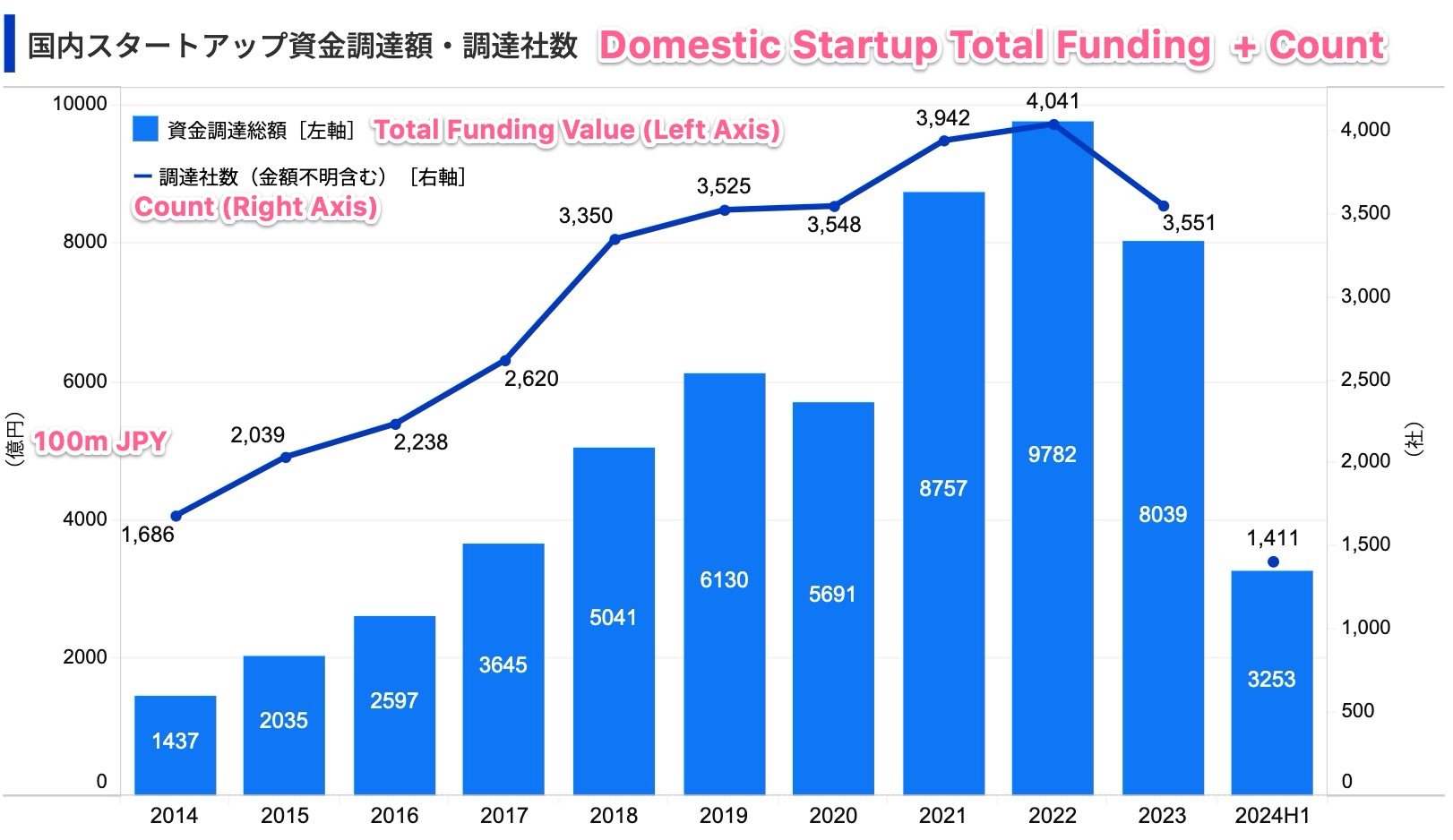 Speeda does flag that the larger rounds tend to come in the second half of the year, so these metrics can easily be affected by a handful of larger deals. Newmo, SakanaAI, and SmartHR are prime candidates to announce larger rounds in H2 2024.
Looking at the half-yearly numbers, H1 2024 seems to be lagging.

That being said, the total amount of funding decreasing should not be something to worry over. The overall trend for the startup ecosystem in Japan is positive.
Notable Trends
There were a few trends to flag in the report. In H1 2024, there was a concentration of investments in earlier rounds with the median investment increasing. There were also larger funds being raised, which will then be invested in local startups. Foreign investors seem to be eyeing the Japanese startup scene, as well.
Investments in Earlier Rounds
In H1 2024, there was a notable increase in earlier-stage companies. There was a 13.9% increase in companies that raised less than 1b JPY.
 As the chart shows, there are limited companies raising over 1b JPY. The increase in earlier-stage investments is an early indicator of future rounds. This increase in early-stage companies may impact the fundraising dynamics in a few years, as these earlier-stage investments will mature and become the companies that raise these larger rounds.
Median Investments Up
The average investment is down, but the median investment is up. The average investment can be swayed with a few larger deals, so there may be more insights derived from the median investments. 
The median investment trending up is a positive sign. Companies will have more firepower to accelerate their growth. Companies will have more funds to invest in research and development, GTM, and hiring. Companies will also have a longer runway and will be able to focus on growth rather than near-term fundraising. The overall trend in terms of this increase is greatly positive.
Larger Funds Being Raised
Though the number of funds raised has decreased, each of the funds is getting larger. The number of funds raised in H1 2024 is down by 10 compared to H1 2023, but the aggregate fund amount is 20b JPY higher. Notably, the number of funds over 10b JPY has increased. In H12024, 10 funds over 10b JPY, which is 3 more than H1 2023.
 Larger funds being raised is a positive sign. VCs want to invest more in local companies. With more funding available, more startups may be started. The increased funding can play into a positive feedback loop of a startup ecosystem.
Interest from Foreign Investors
The level of interest from foreign investors is noteworthy. Of the 10 funds that are over 10b JPY raised in h1 2024, one is a foreign investor. Vertex Ventures Japan is Temasek’s venture capital arm. Temasek is an investment firm owned by the Government of Singapore.
 Overall the interest level from foreign investors is positive and gives local startups more funding options (which is generally good for the ecosystem).
Number of Companies to Invest in Will be Key
The top five sectors by total funding were AutoTech, space, real estate, manufacturing, and SaaS. SaaS is still in a healthy spot in the Japanese market. AI ranked relatively low in the total amount raised. Since the AI companies are still early-stage companies, the amount of funding is relatively small. This is likely to explode over the coming years.
Based on the report, the funding side seems to be strong. The other side of the equation is companies receiving the funding. Japan will need to create more companies for these VCs to invest in. Based on 2022 data (the most recent data I could find), the corporate entry rate (number of companies being started) is down to 3.9% compared to 5.1% in 2020. We’ll have to closely monitor the number of companies being started to get a better understanding of the full ecosystem.
Conclusion
Overall the startup ecosystem is strong and moving in the right direction. As the earlier-stage companies mature, the ecosystem will be even more robust. That being said, there’s a gap between the technology available globally and in Japan. The overall demand for innovation is still very much present. If you’re considering entering the Japanese market and would like to learn more, book a call here.
 English
  Japanese