

Understanding communication styles is key when working with Japanese businesses. While Americans often prefer direct, clear answers, Japanese professionals frequently use indirect language to maintain harmony and avoid conflict. This cultural difference can lead to misunderstandings, especially in business settings like sales, negotiations, and feedback.
Key Takeaways:
- Direct Communication: Used selectively for clarity in technical details, compliance, or urgent matters. Even then, it’s softened with politeness and context.
- Indirect Communication: Common for refusals, disagreements, or sensitive topics. Phrases like "It may be difficult" often mean "no" without explicitly saying so.
- Nonverbal Cues: Silence, pauses, or slight changes in tone or body language can signal hesitation or disagreement.
- Building Trust: Focus on long-term relationships, subtle communication, and respect for hierarchy.
Quick Tip:
When working with Japanese counterparts, avoid pushing for quick, explicit answers. Instead, pay attention to subtle cues and use polite, context-driven language to build rapport and foster collaboration.
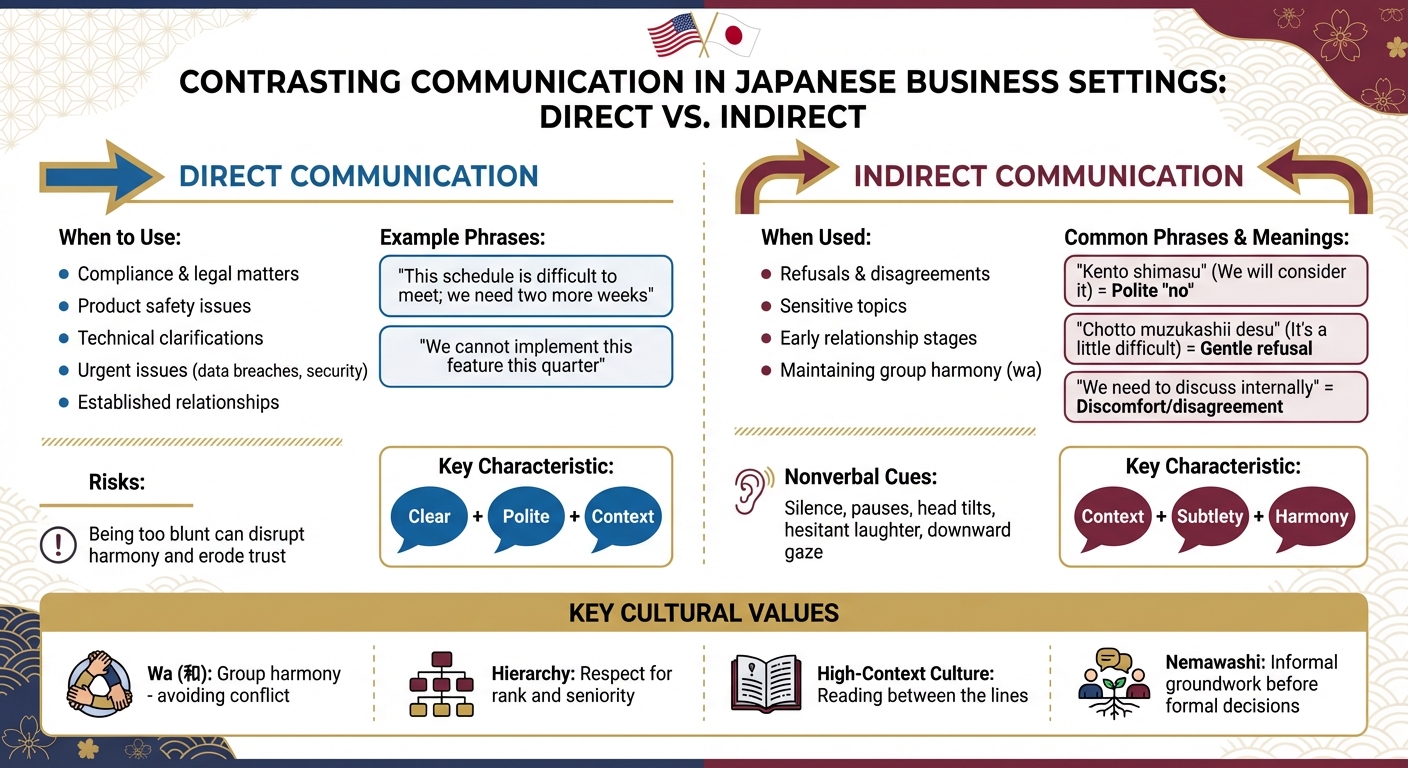
Direct vs Indirect Communication Styles in Japanese Business Culture
Direct Communication in Japanese Business Settings
In Japan, communication often leans on subtlety and indirect cues, but there are moments when a straightforward approach is necessary. Knowing when to shift to a more direct style – while staying mindful of cultural norms – is key to navigating professional interactions effectively.
What Direct Communication Looks Like in Japan
Direct communication in Japan is typically clear and specific but still grounded in politeness and respect for hierarchy. For example, instead of hinting at a delay, one might say, "This schedule is difficult to meet; we need two more weeks." Similarly, rather than a vague "We will consider it", a direct response might be, "We cannot implement this feature this quarter." Even with such clarity, these messages often begin with polite context-setting and background details before addressing the core issue. This approach ensures the message is understood without undermining respect or harmony. Mastering this balance can help you decide when this style is most effective.
When to Use Direct Communication
Direct communication is essential in situations where precision is critical, such as compliance, legal matters, product safety, or technical clarifications. These scenarios leave little room for ambiguity and require clear language to avoid misunderstandings. Similarly, urgent issues like data breaches or security concerns demand straightforward communication. Over time, as trust develops in a business relationship, more direct exchanges may feel natural. Early interactions, however, often benefit from a more indirect, consensus-driven approach. When relationships mature, it becomes easier to express constraints or priorities clearly, but even then, directness should be handled with care.
Risks of Being Too Direct
Overly blunt communication, especially in the style often seen in the U.S., can come across as rude or confrontational in Japan. This can disrupt group harmony and cause embarrassment, particularly if it involves publicly contradicting someone or demanding an immediate yes-or-no answer. Such actions can erode trust. Additionally, pushing for explicit answers without recognizing subtle cues might lead to misinterpreting polite, noncommittal responses as firm commitments. Signs like long pauses, nervous laughter, or abrupt changes in topic can indicate discomfort or resistance. In these moments, softening your tone and rephrasing questions to encourage discussion can help preserve respect and foster better communication.
Indirect Communication in Japanese Business Contexts
In Japan, communication often leans on context, relationships, and nonverbal signals rather than straightforward statements. As a high-context culture, Japan expects listeners to interpret subtleties and read between the lines. This contrasts sharply with the U.S., where a low-context approach favors clear, direct communication. These differences highlight the unique characteristics of Japan’s indirect communication style.
Common Features of Indirect Communication
Japanese communication often incorporates ambiguity, softened language, and a shared understanding. Many phrases carry meanings beyond their literal interpretation. For instance, "Kento shimasu" ("We will consider it") is typically a polite way of saying "no" rather than a genuine commitment to evaluate. Similarly, "Chotto muzukashii desu" ("It’s a little difficult") is more likely a gentle refusal than an expression of actual difficulty. When someone says, "We need to discuss internally," it often signals discomfort or lack of agreement, subtly suggesting "not now".
Nonverbal cues also play a significant role. Silence, slight head tilts, or hesitant laughter can indicate disagreement or unease. A soft tone, downward gaze, or even a small intake of breath might reveal concerns that go unspoken. The broader context – such as the participants’ roles and timing – further shapes the meaning behind these polite expressions.
These communication traits are deeply rooted in Japan’s cultural values, which will be explored further below.
Why Japanese Business Culture Favors Indirectness
The preference for indirectness is tied to key cultural ideals, particularly wa (group harmony), which prioritizes maintaining peace and avoiding conflict within teams or relationships. Open confrontation or blunt criticism can cause embarrassment or harm social standing, so people often rely on softer language to preserve mutual respect. Japan’s hierarchical norms also influence this approach. For instance, openly challenging a superior is considered disrespectful, so subordinates may hint at issues rather than directly stating disagreements. In this high-context environment, picking up on subtle cues is seen as a considerate and socially aware way to communicate.
Benefits of Indirect Communication
Indirect communication plays a crucial role in preserving relationships. For example, politely declining a request with a phrase like, "It may be difficult this quarter", avoids embarrassment and keeps the door open for future opportunities. This approach also fosters consensus by allowing stakeholders to share concerns discreetly, helping address potential problems without public conflict. By using conditional language – such as "if we can solve this point" – discussions remain flexible, encouraging adjustments rather than forcing a simple yes-or-no answer. Handling disagreements with care not only builds trust but also demonstrates an understanding of cultural expectations.
How to Communicate in Common Business Scenarios
Adjusting your communication style to fit specific business scenarios in Japan is essential. By understanding the nuances of direct and indirect communication, you can navigate important interactions more effectively.
Initial Sales Outreach and Discovery Calls
In Japan, communication is often high-context, meaning that subtlety and politeness are key. When reaching out for the first time, especially via email, use formal and modest language. Avoid aggressive calls-to-action. Instead, introduce yourself briefly, mentioning your company and your connection to the recipient. For example, say, "I would be grateful for the opportunity to briefly introduce…" rather than directly requesting a 30-minute product demo.
During discovery calls, start by thanking the prospect and clearly stating the purpose of the meeting. Focus on building rapport rather than immediately qualifying the lead. Use open-ended questions like, "Could you share how you currently handle…?" rather than directly asking, "What’s broken in your process?" To validate any challenges they mention, paraphrase their responses and ask, "Is my understanding correct?" This approach aligns with Japan’s preference for consensus and subtle confirmation. Be comfortable with longer pauses in the conversation – they often indicate thoughtful consideration rather than disagreement. Active listening is crucial, so maintain modest eye contact, take notes, and use simple verbal acknowledgments like "hai" or "naruhodo."
Negotiations and Pricing Discussions
When discussing contracts or pricing, Japanese teams often avoid outright rejection. Instead, they use indirect phrases like "It may be a little difficult" or "We will consider it" to signal hesitation. Statements such as "We need to discuss internally" often point to underlying concerns about price, risk, or fit. Other signs of reluctance may include delayed responses, repeated requests to revisit the proposal, or a shift toward more formal language.
If you notice these signals, avoid asking directly, "Is that a no?" Instead, acknowledge their perspective and invite clarification in a low-pressure way. For instance, you could say, "I understand this might be challenging in the current situation; could you share which aspects are most difficult so we can explore alternatives?" Offering flexible options – such as phased rollouts, pilot programs, or adjusted timelines – can help maintain the relationship. When presenting pricing and ROI data, lead with context and value before diving into the numbers. This follows the Japanese preference for inductive reasoning, which builds up to the main point gradually.
Feedback and Internal Collaboration
In Japan, negative feedback is delivered indirectly to preserve harmony and avoid confrontation. For example, instead of saying, "This is wrong", you might phrase it as, "There may be a small point to improve here." Similarly, customer feedback is often framed as a question or gentle suggestion rather than a direct complaint. Keep in mind that a lack of strong negative comments doesn’t necessarily mean full satisfaction, so actively invite specific concerns and carefully interpret mild language.
When giving feedback to Japanese colleagues, use a context-first approach that emphasizes shared goals. Begin by expressing appreciation or highlighting positive aspects before introducing areas for improvement. For instance, you might say, "To make this project even smoother next time, one thing we could adjust is…" Avoid blunt statements like "You missed the deadline." Instead, describe the situation and its impact, such as, "The report arrived after the agreed time, which made it challenging to prepare the client deck", and propose a collaborative solution. Always deliver sensitive feedback privately, and follow up with a brief written summary, especially if English isn’t the recipient’s first language.
For effective collaboration, global and Japanese teams must understand each other’s communication norms and agree on clear working methods. Since Japanese colleagues may hesitate to voice disagreements in large meetings, consider creating smaller working groups or anonymous feedback channels to surface concerns. Clarify expectations on timelines and decisions in writing, as verbal agreements like "That may be possible" don’t always indicate full commitment. Partnering with experts like Nihonium, who specialize in Japan localization and go-to-market strategies for global SaaS companies, can help bridge cultural and communication gaps by interpreting both linguistic subtleties and local expectations in business operations.
sbb-itb-a752276
How to Adapt Your Communication Style in Japan
When working in Japan, adapting your communication style means shifting from a straightforward, U.S.-style approach to a more nuanced, relationship-driven way of interacting. For SaaS professionals from the U.S., this involves adjusting to longer sales cycles, adding more context to proposals, and prioritizing harmony alongside accuracy. Expect to spend more time setting the stage before presenting conclusions, allow for reflection periods, and recognize that indirect disagreement often carries meaningful feedback.
How to Read Indirect Cues
Japanese business communication often relies on subtlety, with silence, pauses, and nonverbal cues conveying much more than words alone. For instance, extended silence after a proposal could mean the participants are processing information, feeling uneasy, or disagreeing without openly saying so. Watch for softened eye contact, a slight lean forward, or delayed responses, which may signal hesitation. Keep in mind that a nod usually means they’re listening – it doesn’t necessarily indicate agreement.
Soft refusals are common and often phrased delicately. Examples include "chotto muzukashii desu" (that may be a bit difficult), "kenshō ga hitsuyō desu" (we need to examine internally), or "kondo kangaete mimashō" (let us think about it next time). Similarly, vague responses like "we’ll consider it" or repeated mentions of internal approvals without clear next steps often suggest a lack of commitment or a polite rejection. Recognizing these patterns is crucial – train your team to interpret soft refusals as real feedback and adjust your approach rather than pushing for a quick decision.
For online presentations or quarterly reviews, embrace longer pauses and resist the urge to fill every silence. Create a low-pressure environment by asking open-ended questions like, "Does anything here raise concerns or questions, even small ones?" After meetings, send a follow-up email to confirm understanding, as true reactions often surface after internal discussions.
Mastering these cues can help you refine your direct communication strategy.
How to Soften Direct Communication
When it comes to direct communication, softening your tone involves three main techniques: politeness, framing, and sequencing. Start by using polite language and honorifics, whether you’re speaking Japanese or formal English. Avoid blunt commands; for instance, say "We recommend…" instead of "You must…". Next, frame negative points indirectly by emphasizing shared goals. For example, instead of saying "We can’t do that", try, "To maintain reliability for your users, this option would be challenging, but here are two alternatives."
Structure your message thoughtfully. Begin with appreciation and context (e.g., "Thank you for sharing…"), then outline the issue, and finally present options. Use hedging phrases like "It may be challenging…" and frame proposals collaboratively with language like "We propose…" rather than imposing statements. When writing emails, start with a warm, relationship-focused remark – such as "I hope your Q4 is going smoothly" – before expressing thanks and diving into the main topic.
Building Relationships and Trust
Strong communication in Japan is about more than just words – it’s deeply tied to trust and long-term relationships. Japanese business culture values reliability, harmony, and sustained commitment over quick wins or the lowest price. Building trust requires consistent, low-pressure engagement, such as periodic check-ins, sharing relevant insights, or even making visits without a sales agenda.
For SaaS companies, this means going beyond transactional interactions like proposals or renewals. Consider relationship-building initiatives like on-site visits, executive introductions, user groups, or personalized quarterly reviews that focus on mutual success rather than upselling. Over time, as trust grows, Japanese counterparts may feel more comfortable expressing concerns and providing direct feedback, which can lead to smoother negotiations and clearer planning.
In meetings, allocate time for small talk before diving into business discussions. Respect hierarchy by learning titles, seating senior figures appropriately, and deferring key decisions to the most senior attendee. Embrace the concept of nemawashi – informal groundwork before formal decisions – by sharing materials like decks or localized documents in advance to allow internal discussions.
For SaaS teams without a local presence, partnering with a specialist like Nihonium, which focuses on Japan localization and go-to-market strategies, can be a game-changer. They can offer tailored guidance, shadow calls, and refine scripts to align with Japanese business norms, making the transition smoother and more effective.
Conclusion
Navigating Japan’s business environment requires understanding the unique balance between direct and indirect communication. While Japanese professionals use directness for conveying facts, timelines, and operational details, they often frame these with context and politeness. On the other hand, indirect communication is the norm for handling disagreements, risks, or refusals. Phrases like "it’s difficult", extended pauses, or vague responses often signal hesitation or rejection. For U.S.-based SaaS teams accustomed to straightforward, results-driven communication, adapting to this approach demands patience and active listening. However, this isn’t just about etiquette – it’s a strategic edge in building trust and fostering long-term partnerships.
Being overly direct can backfire. Questions that feel too blunt, aggressive closing tactics, or open criticism can lead to stalled deals without explicit rejection. Instead, your Japanese counterparts might stop responding or delay indefinitely, avoiding confrontation. By embracing indirect communication, you can spot concerns early, adjust your strategy, and strengthen the trust needed for long-term success in Japan’s consensus-focused market.
Clarity is still key – but it should come with context and an emphasis on relationship-building. Start with appreciation and background before presenting your recommendation. Whether you’re discussing pricing or conducting sales outreach, allow room for internal deliberation and treat soft refusals as opportunities for adjustment rather than setbacks. Over time, as trust deepens, Japanese partners may grow more comfortable with slightly more direct exchanges. Begin by slowing down your messaging, adding context before making requests, and interpreting pauses or noncommittal responses as valuable insights rather than barriers. This thoughtful approach can pave the way for meaningful and productive partnerships.
FAQs
How can I recognize indirect refusals in Japanese business communication?
In Japanese business settings, refusals are often expressed through subtle or indirect language. For instance, phrases such as "We’ll consider it," "Let me think about it," or "It’s under review" might politely imply a decline rather than an actual commitment. Similarly, silence or ambiguous responses can hint at hesitation or even rejection.
Recognizing these nuanced cues within their context is key to responding thoughtfully and ensuring effective communication.
What challenges can arise from using direct communication in Japan?
In Japan, direct communication can occasionally result in misunderstandings or be seen as impolite. This is because Japanese culture places a high value on indirect expressions and subtlety, aiming to maintain harmony and mutual respect in conversations. Being too straightforward might unintentionally come off as confrontational or even offend.
In professional environments, this communication style can affect the ability to build strong relationships and establish trust. To navigate this effectively, it’s essential to adjust your approach – pay attention to the context, interpret unspoken cues, and use more refined, respectful language when the situation calls for it.
What’s the best way to build trust with Japanese business partners?
Building trust with Japanese business partners means understanding their approach to communication and their expectations. Politeness, respect, and a preference for indirect communication are highly valued. Being too direct might be perceived as impolite, so it’s important to choose your words carefully. Show sincere interest in their viewpoints, and give them the time they need to make decisions without feeling rushed.
Reliability and consistency are equally important. If you make a promise, make sure you keep it – this demonstrates your dedication to the partnership. Taking the effort to familiarize yourself with Japanese business customs and etiquette can go a long way in building a solid foundation of trust and mutual respect.
Related Blog Posts
- Japanese B2B Sales: Key Differences from Western Markets
- How to Build Trust in Japanese Business Negotiations
- Study: Generational Trends in Japanese Business Communication
- Japanese vs. Western Partnership Negotiation Styles
 English
  Japanese