

Business Culture in Japan
Introduction
Erin Meyer published a book on global business cultures in 2014 called “The Culture Map: Breaking Through the Invisible Boundaries of Global Business.” The book shares each country’s cultural positioning and stresses the importance of assimilating to a specific culture to find success. This blog post will dive into Erin Meyer’s findings with a focus on Japan’s business culture.
Erin Meyer’s Culture Map and the 8 Scales
Erin Meyer lays out 8 scales to measure business culture. The 8 scales are:
1. Communicating: Low-context vs. High-context
Low-context: Communication is precise, simple, and clear. Messages are expressed and understood at face value.
High-context: Communication is sophisticated, nuanced, and layered. Messages are both spoken and read between the lines.
2. Evaluating: Direct feedback vs. Indirect feedback
Direct feedback: Negative feedback is provided frankly, bluntly, and honestly without being softened by positive feedback.
Indirect feedback: Negative feedback is provided softly, subtly, and diplomatically while given within positive feedback.
3. Persuading: Applications-first vs. Principles-first
Application-first: Individuals are trained to begin with a fact, statement, or opinion before adding concepts to back up or explain the conclusion as necessary.
Principle-first: Individuals are trained to first develop the theory or complex concept before presenting a fact, statement, or opinion.
4. Leading: Egalitarian vs. Hierarchical
Egalitarian: The best boss is a facilitator among equals. Organizational structure is flat.
Hierarchical: The best boss is a strong director who leads from the front. Organizational structure is multilayered and fixed.
5. Deciding: Consensual vs. Top-down
Consensual: Decisions are made in groups through unanimous agreement.
Top-down: Decisions are made by individuals (usually the boss).
6. Trusting: Task-based vs. Relationship-based
Task-based: “You do good work consistently” means “You are reliable.” “I enjoy working with you” means “I trust you.”
Relationship-based: “I’ve seen who you are at a deep level, I’ve shared personal time with you over meals and drinks, and I know others well who trust you” means “I trust you.”
7. Disagreeing: Confrontational vs. Avoid confrontation
Confrontational: Disagreement and debate are positive for the team or organization. Open confrontation is appropriate and will not negatively impact the relationship.
Avoids confrontation: Disagreement and debate are negative for the team or organization. Open conflict is inappropriate and will break group harmony or negatively impact the relationship.
8. Scheduling: Linear-time vs. Flexible-time
Linear-time: Focus is on the deadline and sticking to the schedule. Emphasis is on promptness and good organization.
Flexible-time: Tasks can be changed as opportunities arise. Many things can be dealt with at once, and interruptions are acceptable.
Japanese Business Culture
Based on Meyer’s analysis, Japan has the following business culture:
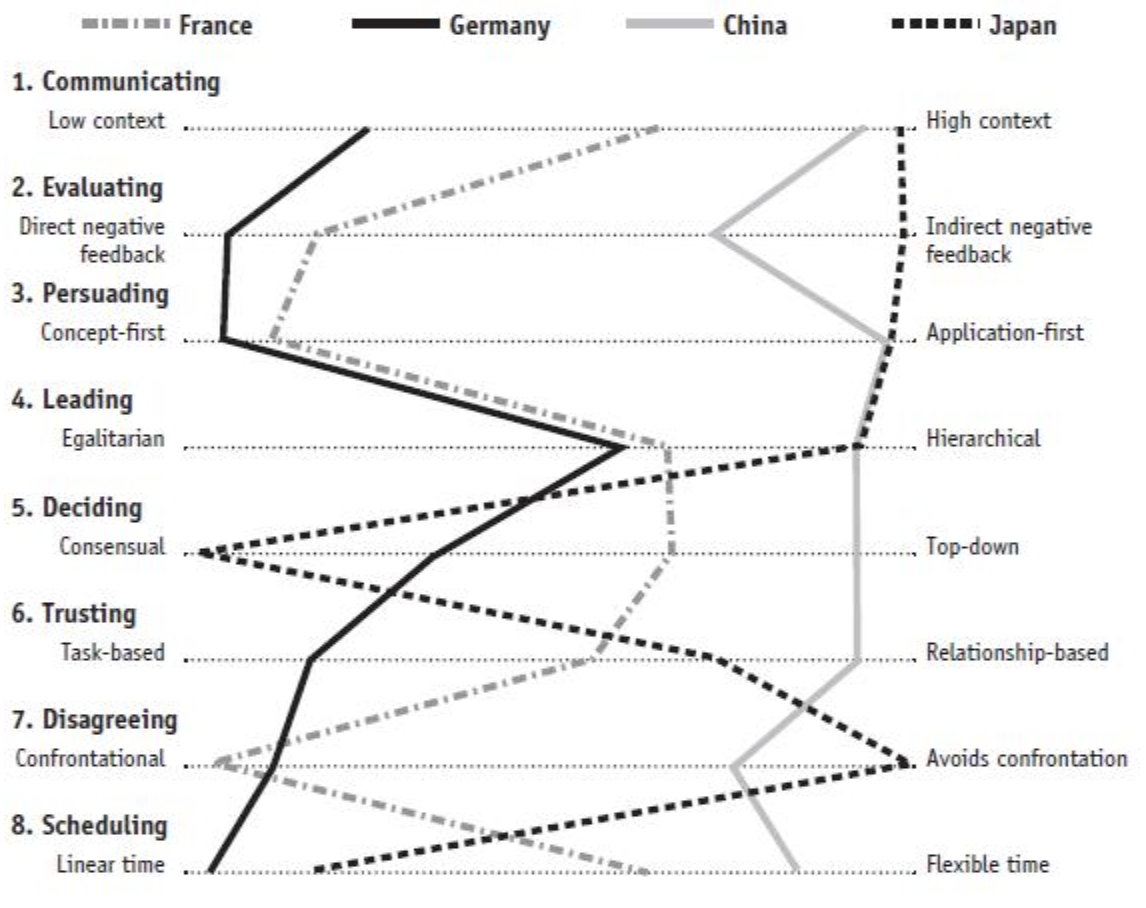
Source: Erin Meyer’s article, Mapping Out Cultural Differences on Teams
Japanese business culture has a high-context communication style. In low-context communication cultures, very little is assumed and the amount of implicit knowledge is limited. Japan is a high-context culture, so the amount of shared context is higher. The communication itself relies on this shared knowledge. Communication is also highly implicit, so active listening and reading between the lines are important. Japanese people can be taken aback by communication that is too direct.
Japan is a culture of indirect negative feedback. Indirect negative feedback is subtle and at times requires reading between the lines. Direct negative feedback can oftentimes come across as too harsh. This applies to both internal and external feedback. If a prospective Japanese buyer were to turn down an offer, the refusal would usually be a very gentle “no.”
Japan is also considered to operate with a linear-time schedule. This means that Japanese businesses tend to be organized and schedule-oriented. It also means that any interruptions to the planned timeline are seen more as a nuisance than an opportunity.
Japan is application-first when it comes to persuading. This is a large topic to unpack, so there’s a dedicated blog post here.
Hierarchical But Consensual Decision Making
Japanese corporations are hierarchical with clearly defined roles. People usually take on very little or no work outside of their role. There is clear separation both vertically and laterally. The positive is that responsibilities and owners are clearly defined. The downside is that when the initiative doesn’t clearly fit a team or person’s responsibility, it gets passed along between teams with little progress.
When it comes to decision making, Erin Meyer very eloquently discusses the differences between Japan and the United States. In her article, “Avoiding Culture Clashes When Making Decision,” she shares:
In a culture like that of the United States, the decision-making responsibility is invested largely in an individual. Decisions tend to be made quickly, early in the process, by one person. But each decision is also flexible—a decision, as I put it, with lowercase d. As more discussions occur, new information arises, or differing opinions surface and decisions may be easily revisited or altered. So plans are subject to continual revision—which means that implementation can take quite a long time.
In a consensual culture, it is the decision-making that may take a long time, since everyone is consulted. But once the decision is made, the implementation is rapid, since everyone is on board. And once the decision is made, it is fixed. Once the group makes a choice, the decision is unlikely to change. A decision with a capital D, one might say. A good example of this phenomenon is the Japanese ringi decision-making process, a very consensual decision-making protocol.
Even though the organizational structure is very hierarchical, the decision making is very democratic. Japanese companies will likely be less agile in adopting new tools and platforms, which has both positive and negative aspects. The negative is that the initial selling may take longer and may be harder to get buyin. Given that the Ringisho process involves many stake holders, there are more people to convince. Given that Japanese companies are less agile, progressing the sales deal will likely take longer compared to other regions. The positive is that after if the intense decision-making process works in your favor, the decisions are long-term.
From a SaaS sales perspective, the sales cycle is longer. There may be more meetings necessary, but in exchange, SaaS providers will get long-tern loyal customers. Being patient with the Japanese sales process will pay likely pay off in the long term.
Conclusion
Navigating Japanese business culture is imperative for success. Assuming that the same business practices in the United States in Japan will be setting your self up for failure. A long and information-heavy website and the “Download Document” call-to-actions are manifestations of the Japanese business culture. Understanding the differences in business culture can also help manage expectations and give you an understanding why things may take longer in Japan. If you’re considering entering Japan and would like to make sure you are properly navigating through the Japanese business nuances, book a consultation here.
 English
  Japanese